
Serving Jeddah & Makkah
Kitchen Pest Field Diagnostic Guide — Jeddah & Makkah14 min diagnostic readJeddah & Makkah

Why Small Cockroaches Keep Appearing in Kitchen Cabinet Hinges and Drains — Even in Clean Homes

A practical biological and structural breakdown comparing hidden German cockroach colonies in cabinet hardware and appliances against drain-borne species, explaining why supermarket aerosols backfire and how precision gel baiting breaks the ootheca reproductive cycle.

Spotting tiny, tan-colored cockroaches darting into kitchen cabinet hinges when you switch on the light at night—or emerging from microwave vents, coffee makers, and dishwasher seals—is one of the most frustrating challenges faced by households in Jeddah and Makkah. Many homeowners immediately assume these sightings reflect a lapse in daily cleaning, prompting intensive scrubbing with bleach and heavy applications of supermarket aerosol sprays. Yet within days, tiny wingless nymphs reappear in even greater numbers and spread to upper cabinets that were previously unaffected.

The scientific explanation lies in the specialized biology of the German cockroach (Blattella germanica). Unlike large reddish-brown American cockroaches that inhabit municipal manholes and main drainage lines, the German cockroach is strictly an indoor hitchhiker. It enters spotless kitchens hidden inside corrugated grocery cartons, paper egg trays, water-bottle crates, secondhand appliances, or shared plumbing chases in multi-story apartment buildings. Once a single gravid female carrying an egg case (ootheca) finds a warm micro-crevice between 1.5 mm and 3 mm wide—such as the recessed cup of a cabinet hinge or a refrigerator compressor bay—she can establish a thriving micro-colony.

This diagnostic guide provides a field-tested framework to identify exactly which species is invading your kitchen, pinpoint hidden breeding harborages without dismantling your cabinetry, and understand why conventional aerosol foggers worsen the infestation. You will learn how to differentiate German cockroach colonies from drain-borne nymphs, why eliminating microscopic grease films is essential to prevent bait competition, and how certified technicians combine non-repellent gel matrices, insect growth regulators (IGRs), and drain-trap engineering to break the reproductive cycle safely.

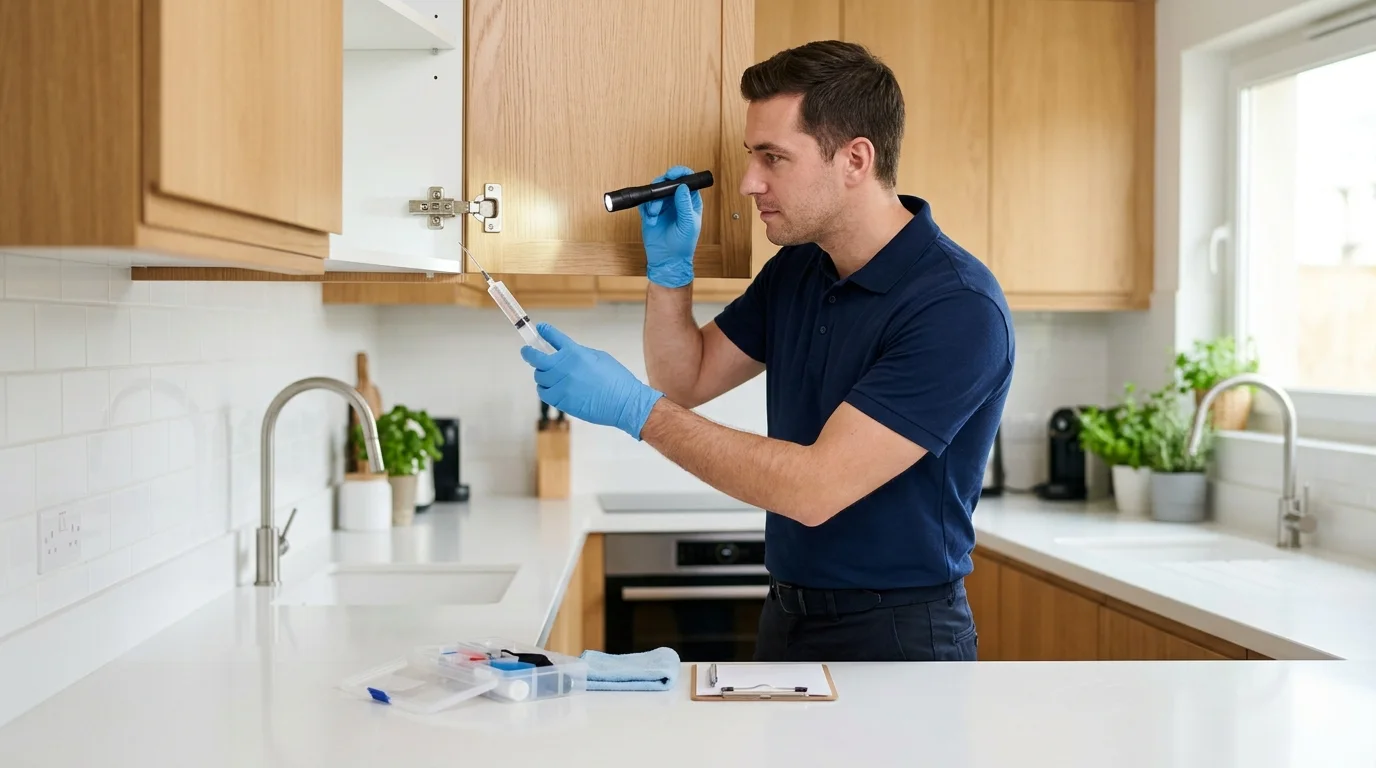
Close-up diagnostic inspection of kitchen cabinet hinges and appliance seals for small German cockroach harborages in Jeddah and Makkah

Executive Summary — Key Takeaways in This Guide:

  • Small light-brown cockroaches clustering inside cabinet hinges and appliance motors are almost always German cockroaches (Blattella germanica) introduced via cardboard packaging, rather than sewer cockroaches emerging from main septic lines.
  • The female German cockroach carries her protective egg capsule (ootheca)—containing 30 to 40 embryos—attached to her abdomen until hours before hatching, shielding the eggs from surface contact sprays.
  • Spraying over-the-counter pyrethroid aerosols triggers behavioral avoidance, scattering roaches deeper into wall voids and dishwasher insulation while contaminating surfaces so future gel baits are rejected.
  • Early-stage nymphs rarely leave dark crevices; instead, they feed on adult secretions and droppings (coprophagy), which is why slow-acting professional gel baits achieve secondary cascade transfer throughout the nest.
  • Long-term eradication requires dual action: deep degreasing of hidden stove hoods and appliance sides to remove competing food sources, paired with two-stage precision gel baiting, IGR application, and floor-drain trap maintenance.
Technical Analysis Matrix

Diagnostic Identification Matrix: German Kitchen Cockroach vs. American Drain Cockroach vs. Brown-Banded Cockroach

Accurate species identification dictates the entire treatment protocol; methods designed for sewer drains fail against cabinet hinge colonies.

Field Diagnostic CriterionGerman Cockroach (Blattella germanica)American / Drain Cockroach (Periplaneta americana)Brown-Banded Cockroach (Supella longipalpa)
Adult Size & Defining Visual MarkingsSmall (12–15 mm); light tan to caramel brown with two distinct dark parallel longitudinal stripes directly behind the head on the pronotum.Very large (35–50 mm adults; nymphs 6–20 mm); glossy reddish-brown with a pale yellowish figure-eight margin framing the pronotum.Small (10–14 mm); lacks dark longitudinal head stripes, featuring two pale transverse bands running across the wings and abdomen.
Primary Harborage & Nesting Micro-ZonesKitchen cabinet cup hinges near sinks, refrigerator compressor bays, dishwasher insulation, microwave control boards, and espresso machines (requires warmth + moisture).Exterior inspection chambers, sewer manholes, dry bathroom/kitchen floor drains, basement sumps, and damp sub-sink pipe penetrations.High, dry locations: top shelves of upper cabinets, behind picture frames, bedroom wardrobes, and dry living room furniture away from water.
Primary Route of Structural EntryPassive hitchhiking inside corrugated grocery boxes, paper egg cartons, produce sacks, used appliances, or migration through shared apartment utility risers.Active crawling up through municipal drainage lines via dried-out floor drain water traps (U/P-traps), unsealed cleanout caps, or threshold gaps.Introduced via moved household furniture, luggage, electronics boxes, or dry storage cartons brought into living areas.
Ootheca Egg-Carrying Behavior & Reproduction RateFemale carries the ootheca (30–40 eggs) protruding from her abdomen for the entire 20–28 day incubation until hatching, maximizing nymph survival.Female drops and glues the dark ootheca (14–16 eggs) onto damp masonry or wood near drains within 24–48 hours; nymphal development takes several months.Female glues tiny yellowish-brown oothecae (14–18 eggs) in small clusters underneath wooden shelves, table frames, and upper cabinetry.
Visual Fecal Spotting & Pheromone SignsFine dark pepper-like or coffee-ground fecal specks smeared tightly around metal hinge cups, drawer slides, and inner cabinet corners.Larger cylindrical, bluntly ridged droppings near floor drains and under-sink plumbing manifolds, accompanied by a musty sewer odor.Scattered dry fecal streaks along upper cabinet crown moldings, closet shelves, and behind wall hangings away from sinks.
Response to Surface Sprays vs. Precision Gel BaitingHigh physiological resistance and dispersal under sprays; responds exceptionally well to non-repellent micro-gel baiting + IGRs inside hinges.Controlled by treating inspection chambers, installing one-way silicone drain valves, sealing pipe collars, and targeted perimeter barrier applications.Requires high-level gel bait placement along upper cabinet frames and bedroom/living room furniture joints rather than just wet zones.

Kitchen Diagnostic Inspection Checklist: 6 Field Indicators to Assess Infestation Severity

Use your smartphone flashlight to inspect these six structural hot spots before applying any cleaners or pesticides.

Indicator #1High (Active Breeding Harborage)

Fine coffee-ground-like dark specks inside European cabinet cup hinges

Root Cause: Active German cockroach aggregation site inside the hinge pocket, depositing fecal pellets infused with aggregation pheromones that retain nymphs.

Do not spray aerosol into the hinge; preserve the pheromone trail so a technician can place a lentil-sized micro-dot of gel bait right beside the hinge arm.
Indicator #2Critical (Colony Population Overflow)

Tiny 2–4 mm black nymphs with a pale dorsal band appearing on countertops during daylight

Root Cause: Recent ootheca hatching combined with severe harborage overcrowding inside wall or cabinet voids, forcing nocturnal nymphs out during daytime.

Requires immediate two-stage professional intervention combining high-palatability gel baits and Insect Growth Regulators (IGRs) to halt nymph maturation.
Indicator #3High (Risk of PCB Short-Circuit & Contamination)

Small roaches entering digital microwave clock panels or espresso machine vents

Root Cause: Colonization of warm internal PCB electronics (30–35°C) where constant transformer heat, moisture, and food vapors create an ideal incubator.

Unplug the appliance, clean exterior crumbs, and never spray liquids inside vents; isolate on glue monitors and apply gel bait around exterior feet and vents.
Indicator #4High (Primary Kitchen Incubator)

Roaches congregating underneath the refrigerator near the rear compressor drip pan

Root Cause: Presence of the ideal biological triad: perpetual darkness, radiant compressor heat, and condensation water in the drip pan mixed with greasy dust.

Pull the refrigerator forward, vacuum dry debris and egg casings, degrease the floor slab, and apply targeted gel placements along the rear chassis frame.
Indicator #5Moderate-to-High (Plumbing Ingress Breach)

Medium-to-large reddish-brown nymphs emerging from the kitchen floor drain or under-sink cabinet

Root Cause: Typically American cockroach nymphs ascending from the drainage network due to a dry floor siphon or an unsealed gap around the drainpipe wall collar.

Install a one-way silicone floor drain backflow valve and seal annular gaps around under-sink drainpipes using sanitary silicone sealant.
Indicator #6Moderate (Compromises Treatment Efficacy)

Sticky yellow cooking grease film on upper cabinets and range hoods alongside persistent roaches

Root Cause: Accumulated lipid films act as an abundant competing food source (bait competition), reducing cockroach feeding on professional gel matrices.

Perform deep kitchen degreasing before or alongside gel application to eliminate competing food lipids and maximize bait uptake.
In-Depth Technical Guide

Deep Technical Breakdown: How Small Cockroaches Colonize Kitchens & How Precision Eradication Works

Five comprehensive engineering and entomological modules detailing German cockroach biology, aerosol pitfalls, and Integrated Pest Management (IPM) protocols.

Module 1: Diagnostic Module 01

Why German Cockroaches Thrive in Clean Kitchens: Ootheca Protection & Thigmotactic Behavior

The presence of German cockroaches (Blattella germanica) inside a meticulously maintained kitchen is driven by specialized anatomical and behavioral traits rather than visible floor hygiene. Foremost among these is positive thigmotaxis—an innate biological drive requiring both the dorsal and ventral surfaces of the insect to maintain physical contact with solid walls simultaneously. Because adults and nymphs seek micro-crevices measuring between 1.6 mm and 4.5 mm in width, over 85% of an active population remains concealed inside recessed European cabinet hinges, delaminated MDF edge banding, aluminum cabinet profile hollow channels, and rubber dishwasher door gaskets.

Compounding this concealment is the unique reproductive strategy of the female German cockroach. Unlike American or Oriental cockroaches that deposit their egg cases within a day or two of formation, the female Blattella germanica carries her ootheca protruding from the tip of her abdomen throughout the entire 20-to-28-day embryonic incubation period. Each sclerotized protein capsule houses 30 to 40 developing nymphs and remains impervious to contact insecticide sprays. Only when the nymphs are ready to burst open the seam does the female release the capsule inside a protected crevice, explaining why waves of tiny hatchlings suddenly appear two weeks after a homeowner or amateur exterminator sprays the kitchen.

Nutritionally, German cockroaches require microscopic quantities of organic matter to sustain rapid growth. Even when countertops are wiped down nightly, aerosolized cooking oils settle behind range hoods and along cabinet undersides, creating a calorie-dense lipid film. Combined with sub-millimeter crumbs beneath drawer glides, starch adhesives inside cardboard boxes, and condensation droplets forming around cold-water angle valves or refrigerator drip pans, a visually spotless kitchen easily supports hundreds of concealed individuals.

Key Biological Takeaways on Kitchen Colony Persistence:

  • German cockroaches spend over 80% of their lifecycle wedged inside micro-crevices narrower than 4.5 mm due to strong positive thigmotaxis.
  • A single ootheca yields 30 to 40 nymphs and is carried by the mother until hatching, protecting embryos from liquid contact sprays.
  • In the warm ambient temperatures of Jeddah and Makkah kitchens, nymphs reach reproductive adulthood in just 6 to 8 weeks.
  • Microscopic aerosolized cooking grease and appliance condensation droplets provide ample nutrition and moisture even when counters are spotless.
  • Spotting roaches foraging during daylight hours typically signals severe harborage overcrowding inside cabinet joints and appliance bays.
Field Specialist Pro-Tip:

Diagnostic Pro Tip: Unpack bulk corrugated cardboard boxes, water cases, and paper egg flats outside the kitchen and discard the cardboard immediately; corrugated flutes are the primary transport vector bringing German cockroach oothecae from warehouses into homes.

Important Safety Caution:

Important Caution: If a gravid female drops a dark brown ootheca right before being captured, do not sweep it into an open kitchen trash bin; mature capsules dropped hours before hatching can still split open and release live first-instar nymphs.

Module 2: Diagnostic Module 02

Why Supermarket Aerosol Sprays and Smelly Liquids Backfire and Scatter the Colony

When homeowners spot small cockroaches inside a cabinet hinge, the instinctive reaction is to blast the hardware and surrounding corners with an over-the-counter aerosol insecticide. However, nearly all consumer aerosol sprays formulate synthetic pyrethroids (such as cypermethrin, permethrin, or imiprothrin) carried in volatile petroleum distillates and heavy fragrances. In urban entomology, pyrethroids act as potent flushing and repellent agents: while the spray kills the two or three roaches hit directly by the wet mist, the sub-lethal vapor plumes trigger immediate sensory avoidance among the dozens of cockroaches hidden deeper inside the cabinet seam.

This chemical repulsion causes a destructive phenomenon known as forced colony budding or dispersal. Instead of remaining localized around the under-sink cabinet and refrigerator where they can be systematically eliminated, gravid females and late-stage nymphs flee through electrical conduit knockouts, behind backsplash tiles, and into upper pantry cabinets, adjacent hallways, or deep inside dishwasher control consoles. Furthermore, urban German cockroach populations worldwide exhibit widespread metabolic and knockdown resistance (kdr) to traditional pyrethroids, meaning survivors quickly recover and establish multiple satellite nests.

The most damaging consequence of DIY spraying is surface contamination that ruins subsequent gel baiting. Non-repellent gel baits work only when cockroaches voluntarily approach and consume the food matrix. If cabinet hinges, drawer runners, or baseboards have been coated with repellent aerosol residues or strong bleach cleaners, cockroaches detect the chemical deterrent upon approach and refuse to feed on the gel placed nearby. Consequently, spraying aerosols inside cabinets actively sabotages professional gel protocols.

Critical Risks of DIY Aerosol Spraying in Kitchens:

  • Consumer aerosols kill only exposed individuals (under 10% of the population) while flushing the remaining 90% into uninfested cabinets and rooms.
  • Repellent chemical residues left on hinges and wood frames deter cockroaches from approaching or feeding on professional gel baits.
  • Spraying pressurized liquids into microwave vents, espresso machines, or dishwasher panels risks short-circuiting PCBs and contaminating food zones.
  • Urban German cockroach strains possess documented genetic resistance to many conventional pyrethroid contact sprays.
  • Modern IPM relies strictly on non-repellent active ingredients that cockroaches cannot detect prior to ingestion.
Field Specialist Pro-Tip:

Pre-Service Pro Tip: Always inform your pest control technician if you sprayed aerosols or bleach inside cabinets during the past 7–14 days so they can place gel baits on uncontaminated micro-surfaces or use bait stations.

Important Safety Caution:

Safety Warning: Never mix household bleach with acidic cleaners or apply agricultural-grade organophosphate liquids inside residential kitchens; such chemicals pose severe respiratory hazards and violate SFDA public-health regulations.

Module 3: Diagnostic Module 03

Anatomy of Hidden Harborages: Why Hinges, Compressors, and Dishwashers Act as Incubators

Understanding why small cockroaches cluster in specific hardware requires examining the kitchen through the lens of microclimatic engineering. Contemporary modular kitchens in Jeddah and Makkah rely heavily on concealed 35 mm European cup hinges bored 12 mm deep into MDF, plywood, or double-walled aluminum cabinet doors. The recessed hinge cup forms a dark, draft-free metallic pocket shielded from air-conditioning currents and routine sponge wiping. Because under-sink and countertop cabinets sit adjacent to plumbing moisture and food prep surfaces, these hinge cups act as pre-engineered modular bunkers for cockroach nymphs and gravid females.

The second critical incubator is the rear mechanical bay of refrigerators and chest freezers. A refrigerator compressor and condenser coil operate continuously, maintaining an ambient pocket temperature between 32°C and 38°C—the exact thermal optimum that accelerates German cockroach embryonic development and molting. Directly above or beside the compressor sits the condensate drip pan, which receives defrost water droplets, alongside fibrous acoustic insulation panels. Together, radiant heat, standing humidity, darkness, and dust create a self-sustaining sanctuary.

Dishwashers, built-in ovens, and countertop espresso machines offer comparable micro-habitats. Dishwashers are wrapped in a thick acoustic and thermal felt blanket sandwiched between the stainless-steel tub and the outer cabinet recess. Warm steam escaping around the door vent during drying cycles humidifies this insulation, turning it into a sprawling nesting matrix. Similarly, espresso machines retain warm boilers, internal water lines, and spent coffee puck drawers. Because liquid sprays cannot safely penetrate appliance insulation or electronics, precision bait placement around external entry seams is the only viable engineering solution.

Priority Structural Hot Spots to Inspect in Every Kitchen:

  • 35 mm recessed European cup hinges—especially inside the under-sink cabinet and cupboards flanking the stove.
  • Refrigerator rear compressor compartments, condensate evaporation pans, and warm magnetic door gasket folds.
  • Dishwasher perimeter insulation blankets, lower kick-plate voids, and steam vent trims.
  • Underneath telescopic metal drawer slides and along the underside lip where granite/marble countertops meet cabinet frames.
  • Ventilation louvers and rubber feet of constantly warm countertop appliances: microwaves, espresso makers, water dispensers, and air fryers.
Field Specialist Pro-Tip:

Flashlight & Mirror Technique: Use a smartphone flashlight and an inspection mirror to check the interior underside lip where the countertop slab rests on the cabinet carcass; this unseen horizontal seam serves as the main highway connecting adjacent cupboards.

Important Safety Caution:

Appliance Safety Note: Always disconnect power before vacuuming behind a refrigerator compressor bay or removing a dishwasher kick-plate, avoiding contact with copper refrigerant tubing or exposed capacitor terminals.

Module 4: Diagnostic Module 04

The Science of Precision Control: Gel Bait Horizontal Transfer & Insect Growth Regulators (IGRs)

Professional control of German cockroaches exploits the insect’s own foraging and social biology rather than chasing individuals with contact sprays. SFDA-registered cockroach gel baits combine a moisture-retaining, high-palatability food matrix of complex carbohydrates, proteins, and dietary lipids with a non-repellent, delayed-action active ingredient (such as indoxacarb, fipronil, clothianidin, or dinotefuran). When a foraging adult consumes a micro-dot of gel placed near a cabinet hinge at night, the delayed metabolic activation allows the roach to return deep inside its concealed harborage before symptoms begin.

Inside the harborage, a powerful biological multiplier known as horizontal transfer—or the secondary/tertiary cascade effect—takes over. Early-instar nymphs rarely venture out of dark cracks to forage; instead, they survive by consuming the nutrient-rich fecal secretions and regurgitations of returning adults (coprophagy), while colony mates also feed on expired individuals inside the nest (necrophagy). Because the active ingredient remains potent inside the droppings and carcasses of baited adults, a single foraging cockroach effectively delivers lethal doses to dozens of hidden nymphs deep inside wall voids and appliance insulation.

To seal the reproductive loop against oothecae that were already incubating prior to the first visit, certified technicians integrate Insect Growth Regulators (IGRs) such as hydroprene or pyriproxyfen alongside rotated gel formulations. IGRs mimic juvenile hormones: when developing nymphs absorb the regulator, their chitin molting process is disrupted or they emerge as sterile adults exhibiting characteristic twisted wings (wing-flexing morphological deformity). Unable to mate or form viable egg capsules, the surviving cohort dies out without reproducing, which is why a structured two-visit protocol spaced 14 to 21 days apart is essential.

Why Precision Gel + IGR Protocols Outperform Liquid Spraying:

  • Applying numerous lentil-sized micro-dots (3–5 mm) across all hinge cups and crevices outperforms long continuous stripes of gel.
  • Engineered delayed toxicity enables returning adults to transfer active ingredients to hidden early-instar nymphs via coprophagy and necrophagy.
  • Insect Growth Regulators (IGRs) sterilize maturing nymphs, visibly confirmed when remaining adults display twisted, curled wings.
  • Odorless micro-gel placement requires no dishware removal or home evacuation when applied strictly inside concealed structural cracks.
  • Rotating active ingredient classes during the 14-to-21-day follow-up prevents behavioral glucose/bait aversion in resilient populations.
Field Specialist Pro-Tip:

Field Indicator of Success: Spotting adult German cockroaches with crinkled, flared, or twisted wings 10–14 days after treatment is positive confirmation that the Insect Growth Regulator (IGR) has successfully sterilized the maturing generation.

Important Safety Caution:

Post-Treatment Rule: Never wipe away gel bait dots or spray cleaner onto treated cabinet hinges after service; professional gel matrices are formulated to remain moist and palatable for weeks so newly hatched nymphs consume them.

Module 5: Diagnostic Module 05

Sanitation & Structural Integration: Combining Deep Degreasing with Drain-Trap Engineering

Even the highest-grade professional gel bait can underperform if deployed inside a kitchen suffering from heavy dietary competition. When oxidized cooking grease coats the side panels of a stove, accumulates beneath range hood filters, or mixes with food debris in the floor gap beside the refrigerator, cockroaches have unrestricted access to lipids and proteins right outside their harborages. Pairing a targeted Deep Kitchen Degreasing service prior to gel placement removes these competing food films, forcing the starved colony to feed aggressively on the hydro-gel bait dots on the very first night.

Simultaneously, many ground-floor apartments and villas across Jeddah and Makkah experience dual infestations involving both German cockroaches in the upper cabinetry and American cockroach nymphs ascending from the drainage network. This overlap typically occurs when kitchen floor drains rarely receive water—causing the U-trap water seal to evaporate in Saudi Arabia’s warm climate—or when plumbers leave wide annular gaps around corrugated dishwasher and sink drain hoses where they enter the wall stub-out.

Achieving durable structural exclusion requires addressing plumbing penetrations alongside cabinet baiting: first, fitting floor drains with one-way mechanical silicone backflow valves that open under water weight and seal shut when dry; second, sealing annular gaps around under-sink supply and waste pipes with anti-fungal sanitary silicone caulk; and third, repairing weeping angle valves or P-trap gaskets. Depriving German cockroaches of free standing moisture stresses their water balance and compels them to seek out moisture-rich gel baits.

Five Structural & Sanitation Rules to Prevent Re-Infestation:

  • Degreasing stove sides, range hoods, and under-appliance floors eliminates bait competition and maximizes gel consumption.
  • Installing one-way silicone floor drain valves blocks American cockroach nymphs from ascending through dry traps.
  • Sealing gaps around under-sink waste pipes with sanitary silicone prevents inter-apartment migration via plumbing chases.
  • Fixing slow valve drips and wiping sinks dry before bedtime drives moisture-stressed cockroaches directly to hydrated gel baits.
  • Completing the scheduled 14-to-21-day follow-up inspection ensures newly hatched ootheca cohorts are intercepted before reaching maturity.
Field Specialist Pro-Tip:

Nightly Sink-Drying Routine: Wipe the kitchen sink bowl dry with a microfiber cloth and insert the sink stopper before going to bed; depriving roaches of free water overnight forces them to consume moisture-rich gel bait placements.

Important Safety Caution:

Plumbing Protection Warning: Never pour diesel fuel, caustic soda, or raw acid down kitchen drains to kill cockroaches; harsh solvents corrode PVC pipe joints and rubber gaskets, causing sub-slab leaks that create damp subterranean breeding pockets.

Hyperlocal City Adaptation

Environmental & Architectural Factors Driving Kitchen Cockroaches in Jeddah & Makkah

How Jeddah’s coastal humidity and Makkah’s residential density and building topology shape cockroach pressure and treatment design.

Jeddah GovernorateJeddah Sectors Hub

Jeddah Kitchen Dynamics: Coastal Humidity, Cabinetry Delamination, and High Water Tables

Jeddah’s year-round Red Sea coastal humidity directly accelerates cockroach survival and structural harborage formation inside residential kitchens. High ambient moisture combined with cooking steam frequently causes MDF and particleboard cabinet carcasses to swell slightly along joints, peeling back PVC edge-banding strips by 2 to 3 millimeters. These delaminated timber seams—alongside corroded cup hinges—create dozens of humid micro-pockets where German cockroach females secure their oothecae.

Simultaneously, elevated coastal water tables across many Jeddah districts keep exterior sewer inspection chambers and courtyard manholes warm and humid throughout the year. This environment sustains dense American cockroach populations that pressure ground-floor villa kitchens and annexes through floor drains and unsealed pipe sleeves. Effective control in Jeddah therefore pairs moisture-stable gel bait matrices inside cabinetry with mechanical drain trap sealing and exterior manhole management.

  • North & Coastal Jeddah (Obhur, Al-Shati, Al-Murjan, Al-Basateen, Al-Mohammedia): Open-plan show kitchens and built-in European appliances require discreet micro-gel application inside soft-close hinges, integrated dishwashers, and island cabinetry alongside courtyard manhole checks.
  • Central Jeddah Apartment Districts (Al-Rawdah, Al-Salamah, Al-Zahra, Al-Faisaliyah): High-density residential buildings sharing vertical plumbing shafts require strict silicone sealing around under-sink pipe collars to block inter-apartment German cockroach migration.
  • East Jeddah Residential Sectors (Al-Samer, Al-Tayseer, Al-Manar, Al-Ajwad): Frequent appliance moves and bulk grocery storage increase hitchhiking German roach introductions, requiring thorough inspection of refrigerator compressor bays and pantry shelving.
  • South Jeddah & Established Districts (Al-Balad, Al-Naseem, Bani Malik, Al-Wurood): Older clay or PVC drainage junctions and seasoned wooden cabinetry demand dual-track protocols addressing both sewer manhole ingress and interior cabinet crevices.

Makkah Kitchen Dynamics: Thermal Acceleration, Multi-Family Buildings, and Seasonal Occupancy

In Makkah, intense ambient heat throughout most of the year accelerates the metabolic and reproductive clock of Blattella germanica, shortening ootheca incubation and nymphal molting intervals inside non-air-conditioned wall voids. Additionally, Makkah’s unique housing landscape—combining multi-generational family buildings, furnished apartments, and seasonal hospitality units—creates high turnover of luggage, bulk food cartons, and appliances that facilitate passive cockroach introduction.

Another common structural trigger in Makkah occurs in apartments or secondary kitchens left unoccupied between peak seasons: rapid thermal evaporation dries out floor-drain water traps within days, allowing American drain cockroaches unrestricted entry, while German cockroaches multiply undisturbed inside plugged-in refrigerators. Consequently, Makkah protocols prioritize high-viscosity, heat-stable gel formulations that will not run or dry out in warm kitchens, paired with mechanical drain valves.

  • Central & Al-Aziziyah Sectors (Al-Aziziyah, Al-Shishah, Al-Rawdah, Mahbas Al-Jinn): High occupancy turnover and shared building utility shafts require heat-stable gel baiting, IGR deployment, and thorough sealing of inter-unit plumbing penetrations.
  • Southern & Western Makkah (Al-Shawqiyyah, Al-Kakiyyah, Batha Quraish, Wali Al-Ahd): Homes featuring both an indoor show kitchen and an enclosed heavy-cooking kitchen require coordinated inspection and treatment across both spaces plus laundry rooms.
  • Eastern Makkah & Elevated Districts (Al-Awali, Al-Sharayea, Al-Rashidiyah, Al-Naseem): Terraced foundations and rock-cut utility trenches make sealing sub-sink plumbing collars and courtyard inspection chambers critical alongside cabinet hinge baiting.
  • Northern Makkah Sectors (Al-Taneem, Al-Nooriyah, Al-Umrah, Al-Buhairat): Villas with attached dry-food pantries and bulk storage rooms require inspecting shelving brackets, water dispenser motors, and deep freezers to eliminate hidden reservoirs.
Illustrative Service Scenario — For Educational Reference

Diagnostic & Eradication Scenario: Persistent Small Roaches in a Modular Kitchen Despite Weekly Spraying

Property Context & Initial Challenge:

A primary family kitchen in a second-floor residential apartment (4×5 m) equipped with modular cabinets with European cup hinges, a double-door refrigerator, a built-in dishwasher, and a countertop microwave.

For three months, the household observed dozens of small tan cockroaches emerging from cabinet hinges and countertops day and night. After applying six cans of supermarket aerosol spray and scrubbing with bleach, roaches spread from the sink cabinet into upper dishware cupboards and the microwave display.

Outcome & Long-Term Prevention:

Complete cessation of nymph and adult sightings following the two-stage protocol, maintained by a strict household rule against aerosol sprays, unpacking grocery cartons outside the kitchen, and keeping the sink dry overnight.

Diagnostic Inspection Findings:

  • Flashlight inspection revealed dense German cockroach (Blattella germanica) aggregations, dark fecal spotting, and hatched ootheca casings inside 14 European cabinet cup hinges surrounding the sink and stove.
  • Pulling forward the refrigerator and inspecting the dishwasher kick-plate identified the primary incubator behind the warm refrigerator compressor and inside the dishwasher acoustic felt, where repellent aerosols had driven the colony.
  • Inspection underneath the countertop overhang and along the stove side-panels exposed a sticky cooking-oil film acting as a continuous competing food source.
  • A slow micro-drip on the cold-water angle valve inside the under-sink cabinet supplied constant standing moisture for nymphs and gravid females.

Technical Protocol Applied:

  • Preparation Phase: Executed targeted degreasing along stove side-panels, range hood undersides, and behind the refrigerator using unscented alkaline degreasers, vacuumed old egg casings and debris via HEPA filtration, and tightened the weeping angle valve.
  • Visit 1 (Precision Baiting): Placed 65+ lentil-sized micro-dots of an SFDA-registered non-repellent gel matrix onto clean hardware surfaces inside cabinet hinge arms, underneath drawer slides, along the refrigerator compressor chassis, and around the dishwasher frame.
  • IGR Integration: Applied an Insect Growth Regulator treatment into deep structural crevices behind the cabinet backing boards to disrupt nymphal molting and sterilize maturing individuals.
  • Visit 2 (Day 18 Follow-Up): Inspected monitoring traps, verified a sharp drop in activity with remaining adults showing sterile twisted wings, and applied a rotated active-ingredient gel formulation to eliminate the final cohort of newly hatched first-instar nymphs.
Safe Decision Boundaries

When DIY Kitchen Care Suffices vs. When to Call a Pest Control Specialist

An honest technical boundary separating manageable single-sighting prevention from established multi-harborage colonies.

Situations Where Safe Home Prevention & Monitoring Suffice:

  • A single isolated adult cockroach sighting near an exterior door or floor drain with zero dark fecal speckling or nymphs inside cabinet hinges.
  • Preventive exclusion when moving into a new home by installing one-way silicone floor drain valves and caulking under-sink pipe gaps.
  • Placing non-toxic sticky monitoring traps beneath the refrigerator and sink cabinet to verify whether a stray roach was an isolated intruder.
  • Routine degreasing of range hoods and stove sides alongside nightly trash removal and sink drying.
  • Inspecting and discarding corrugated grocery boxes, beverage flats, and paper egg cartons immediately before storing items in pantries.

Critical Triggers Requiring Professional Two-Stage Intervention:

  • Sighting tiny wingless nymphs (2–4 mm) or adult females carrying protruding ootheca egg capsules, confirming active indoor breeding.
  • Cockroach colonization inside recessed cabinet cup hinges, microwave control panels, espresso machines, dishwashers, or refrigerator motors.
  • Daytime cockroach activity on countertops or open walls while kitchen lights are on, indicating severe harborage overcrowding.
  • Persistent reappearance after applying supermarket aerosols, foggers, or consumer syringe baits due to colony dispersal or bait aversion.
  • Recurring infestations in multi-unit apartment buildings requiring simultaneous structural pipe-collar sealing, rotated professional gels, and IGRs.

Honest Technical Scope Note: No legitimate pest control service can guarantee instant, single-hour eradication of an established German cockroach colony without follow-up, because incubated embryos inside sclerotized ootheca capsules are biologically shielded until hatching. True eradication requires an initial precision gel + IGR deployment followed by a 14-to-21-day assessment and touch-up to intercept late-hatching nymphs using SFDA-registered public-health formulations.

Frequently Asked Questions

Frequently Asked Questions About Small Kitchen Hinge & Drain Cockroaches

Evidence-based answers to common homeowner questions regarding kitchen preparation, gel safety, and post-treatment timelines.

Do I need to empty all kitchen cabinets and wash every dish for a precision gel treatment?+

No. Unlike liquid spraying or fogging, precision gel baiting uses odorless, non-volatile micro-dots applied strictly inside concealed hinge cups, under drawer slides, and behind appliance frames away from food-contact surfaces. You only need to clear items blocking direct access to cabinet hinges and under-sink plumbing.

Why do I still see small cockroaches for 3 to 5 days after professional gel bait is applied?+

Seeing sluggish roaches during the first few days is expected and confirms the bait is working. Professional gel matrices use delayed-action active ingredients so foraging adults return deep into their crevices before expiring, transferring the active compound to hidden nymphs via droppings and necrophagy.

What is the difference between supermarket gel syringes and professional pest control gel baits?+

First, formulation chemistry: professional public-health gels registered with the SFDA utilize advanced moisture-retaining matrices and novel active ingredients engineered to overcome glucose aversion in resistant cockroach strains. Second, placement engineering: technicians place 50–80 micro-dots directly inside verified aggregation hardware and pair them with Insect Growth Regulators (IGRs) rather than smearing visible strips on counters.

Why is a second follow-up visit at 14 to 21 days necessary even if sightings stop after the first visit?+

Because embryonic German cockroaches inside unhatched ootheca capsules do not feed and are shielded from active ingredients until they hatch 2 to 3 weeks later. The 14-to-21-day follow-up ensures fresh, palatable gel dots and IGRs are in place to eliminate this final hatchling cohort before any nymph reaches reproductive maturity.

How can I stop small cockroaches from getting inside my microwave display and coffee machine?+

Never spray repellent aerosols near countertop appliances, as this drives roaches straight into warm internal circuit boards. Instead, empty coffee grounds nightly, unplug non-essential appliances overnight so internal transformers cool down, and let a technician apply micro-gel dots beneath the exterior rubber feet and around rear vents.

Should I schedule deep kitchen degreasing before or after the cockroach control treatment?+

Ideally, schedule deep kitchen degreasing **before** the gel baiting treatment (either the day prior or immediately before bait placement). Degreasing first removes competing food oils so roaches feed eagerly on the bait, and prevents cleaning crews from accidentally scrubbing away active gel placements afterward.

Can small German cockroaches migrate into my kitchen from a neighboring apartment?+

Yes. Inter-apartment migration is very common in multi-unit buildings in Jeddah and Makkah—especially when a neighbor fogs or sprays their kitchen with repellent chemicals, driving roaches through shared plumbing chases and electrical conduits. Sealing annular gaps around under-sink pipes with silicone and maintaining strategic gel placements blocks this migration.

Unified Service Request Builder

Share Your Request Details for Scheduling & Transparent Pricing

Enter your basic contact details, select your city (Jeddah or Makkah), and choose the service you need. This form organizes your inquiry for immediate coordination.

We respect your privacy. Your information is used strictly to respond to your service inquiry.
CallWhatsAppGet Quote