
Serving Jeddah & Makkah
Deep Carpet Fiber, Upholstery & Courtyard Flea Control — JeddahJeddah

Flea Control in Jeddah Targeting Hidden Carpet Pile Larvae, Cocoons & Jumping Adults

Lasting flea control in Jeddah requires addressing a critical biological reality: the jumping adult fleas you see on your ankles represent only 5% of the population, while 95% hide as eggs, larvae, and sticky cocoons deep inside carpet fibers, sofa crevices, and humid shaded villa courtyards frequented by stray cats. We deliver a structured, lifecycle-breaking treatment plan.

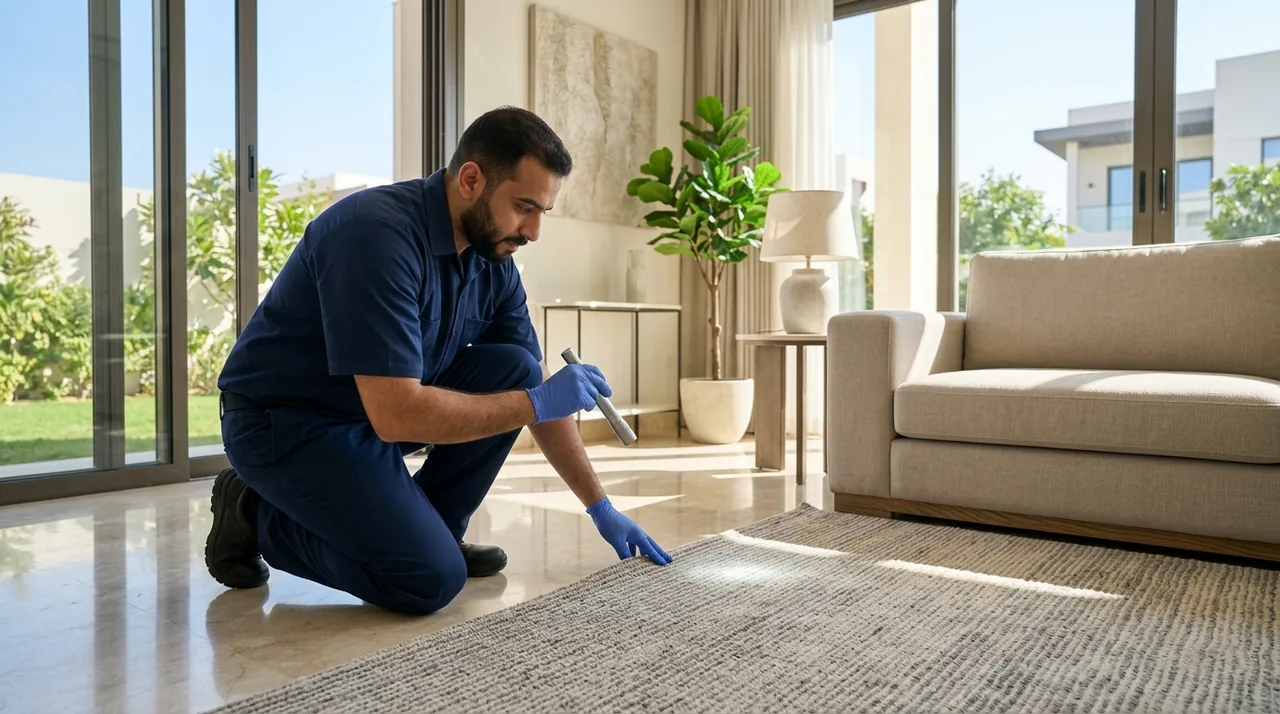
Technician inspecting carpet fibers and upholstery edges for flea activity in Jeddah
Diagnostic & Treatment Summary

Verified Service in Jeddah

Accurate Flea vs. Bed Bug Diagnostics
Deep Carpet Pile & IGR Lifecycle Control
Coordinated Interior & Courtyard Treatment
SFDA-Aligned Public Health Formulations
Safety & Inspection Note:Our service treats residential surfaces, carpets, upholstery, and exterior courtyards only. Direct medical treatment of indoor pets is strictly separate and must be handled concurrently by a licensed veterinarian.
Real-World Problem Analysis

Why Flea Infestations in Jeddah Persist Despite Surface Mopping and Retail Sprays

Fleas—most notably the cat flea (Ctenocephalides felis), which readily infests both cats and dogs and bites humans indoors—are among the most frustrating textile pests encountered by families in Jeddah. Equipped with powerful hind legs and a laterally compressed body built to glide effortlessly through dense fibers, adult fleas leap from carpets and floor cushions onto ankles and lower legs the moment someone walks across a room, making living areas and majlis halls uncomfortable to use.

The primary reason DIY sprays and routine floor wiping fail is a misunderstanding of flea population dynamics. Visible jumping adults account for roughly 5% of an indoor flea infestation. The remaining 95% consists of smooth, non-sticky eggs (~50%), light-avoiding worm-like larvae (~35%), and camouflaged silk cocoons/pupae (~10%) nestled at the very base of carpet pile, inside floorboard crevices, and beneath sofa cushions where light surface misting never penetrates.

Even more challenging is the pupal cocoon stage: larvae spin sticky silk cocoons that gather dust and carpet lint, forming a protective armor that resists desiccation and shields the developing flea from standard liquid sprays. In vacant apartments or closed rooms, pre-emerged fleas can remain dormant inside their cocoons for weeks or months, only to burst out simultaneously when footstep vibrations and body heat signal that occupants have returned. Breaking this cycle requires pairing targeted residual and growth-regulating chemistry with mechanical HEPA vacuuming and source control.

Humid Villa Courtyards, Carports & Ground-Floor Entrances in Jeddah01

Stray Courtyard Cats or Indoor-Outdoor Household Pets

Even households that do not own an indoor pet frequently experience flea outbreaks when outdoor stray cats rest in shaded garden courtyards, beneath parked cars, on exterior stairs, or in building lightwells. Flea eggs drop into shaded, humid soil or doorway mats, develop into hungry adults, and hitchhike indoors on shoes, socks, and long garments straight onto living room rugs.

Recently Vacated Apartments, Villas, or Post-Holiday Returns02

Sudden "Mass Emergence" Upon Moving Into a Newly Vacated Property

A classic scenario occurs when a previous tenant with a pet moves out and the apartment sits empty for several weeks. During the vacancy, thousands of larvae mature into dormant cocoons deep inside the carpets or floor joints. Within hours of the new family walking inside—or residents returning from vacation—the mechanical pressure and warmth of footsteps trigger a synchronized mass emergence of hungry adult fleas.

Plush Living Room Area Rugs & Upholstered Sofas in Jeddah03

Deep Establishment in Wall-to-Wall Carpeting and Floor Seating

High-pile area rugs, wall-to-wall carpeting, and traditional floor cushions (masanid) create an ideal microclimate for flea development. Smooth flea eggs roll down to the carpet backing where photophobic (light-fearing) larvae feed on organic debris and dried "flea dirt," sheltered from ordinary broom sweeping or light vacuuming.

Field Observation & Identification Guide

Field Identification Guide: How to Confirm Flea Activity in Carpets & Fabrics

Distinguishing fleas from bed bugs or mosquitoes relies on observing their unmistakable jumping locomotion, lower-body activity zone, and physical traces nestled inside carpet fibers and pet resting spots.

Laterally Compressed (1.5–3 mm) + Hind Jumping Legs

Clinical anatomical reference schematic for preliminary visual distinction

Siphonaptera — Fleas
Typical Size Range:
1.5–3 mm (very small)
Movement & Activity Pattern:
Moves by rapid vertical and horizontal jumping from carpet fibers, floor cracks, or pet bedding.
Anatomical Profile: Laterally compressed (flattened side-to-side) wingless body, hard glossy dark brown shell, and powerful hind jumping legs.
Key Distinguishing Sign: Jumping behavior, sideways-flattened body, and ankle-level activity distinguish fleas from crawling bed bugs.
Important Note on Visual Indicators & Confirmation:Important Non-Diagnostic & Veterinary Disclaimer: Skin bites, red bumps, or itching on the legs cannot medically or technically diagnose a flea infestation without physical inspection of the room and textiles, as human skin reactions overlap with mosquitoes, bed bugs, and dermatitis. Furthermore, veterinary care for pets (topical spot-ons, oral medications, or medicated baths) is a separate medical service that must be performed by a licensed veterinarian alongside residential surface pest control.
Primary Behavioral Indicator

Tiny Dark Insects Jumping Forcefully from Carpets

Adult fleas are small (1.5 to 3 mm), wingless, dark reddish-brown insects flattened from side to side like a sesame seed on edge. When disturbed by footsteps or hand movement, they do not crawl away slowly—they launch themselves 15 to 20 cm vertically or horizontally with a sudden spring.

Inspection Note: Spotting tiny dark specks jumping onto white socks or pant cuffs when walking across a rug is the clearest field indicator.
Spatial Distribution Pattern

Activity Concentrated Around Ankles, Feet & Lower Legs

Because adult fleas emerge from cocoons resting at the base of carpets, rugs, and floor crevices, their primary zone of contact with humans is around the feet, ankles, and lower calves while walking or sitting near the floor.

Inspection Note: If an infested cat rests on top of sofas or beds, flea activity can also extend onto elevated upholstery.
Biological Residue in Fibers

"Flea Dirt" (Coarse Black-Red Specks) in Pet Resting Zones

Fine, pepper-like dark reddish-black granules accumulating on pet bedding, sofa corners, or carpet edges where cats or dogs habitually nap. This material is dried partially digested blood excreted by adult fleas, which serves as the essential food source for developing larvae.

Inspection Note: When placed on a damp white paper towel, flea dirt dissolves and leaves a distinct rusty reddish-brown halo.
Rapid Field Assessment Check

Positive "White Sock Test" Across Carpeted Rooms

Walking slowly across suspected carpets and past sofa skirts while wearing knee-high white cotton socks attracts emerging adult fleas via footstep vibration, warmth, and high visual contrast, allowing them to be seen clearly against the white fabric.

Inspection Note: Our technicians combine visual fiber inspection with crevice checks to map the exact hotspots across each room.

Diagnostic Distinction: Fleas in Carpets vs. Bed Bugs in Mattresses

Comparison CriterionFleas (Ctenocephalides spp.)Bed Bugs (Cimex lectularius)
Movement & Escape BehaviorJumps rapidly and forcefully up to 20 cm when approached; never flies.Crawls steadily along seams and wood; completely unable to jump or fly.
Primary Habitat in the HomeDeep inside carpet pile, rugs, under sofa cushions, pet beds, and shaded courtyards.Mattress piping seams, upholstered headboards, wooden bed slats, and bedside crevices.
Body Profile & ShapeLaterally compressed (flat side-to-side), 1.5–3 mm, shiny dark reddish-brown with jumping hind legs.Dorsoventrally flattened (flat top-to-bottom), 4–5 mm broad apple-seed oval.
Eggs & Immature StagesSmooth, non-sticky eggs roll into carpet fibers; hatch into worm-like larvae and silk cocoons.Eggs are cemented firmly inside mattress seams and wood crevices; hatch into crawling nymphs.
Primary Introduction SourceIndoor pets, stray courtyard/garden cats, or dormant cocoons in vacated apartments.Travel luggage, overnight guest turnover, and second-hand bedroom furniture.
Root Causes & Environmental Drivers

Why Flea Infestations Develop in Jeddah Properties

A residential flea outbreak develops when an external or animal vector introduces eggs or adults into an indoor environment with sufficient carpet fiber depth and humidity to nurture larvae and cocoons.

01

Shaded, Humid Courtyards and Stray Cat Resting Spots

In Jeddah, coastal humidity combined with shaded villa gardens, irrigated planters, and cool areas beneath parked cars creates ideal micro-habitats where stray cats shed flea eggs that mature and hitchhike indoors.

Common Vulnerable Spots: Villa courtyards, under exterior stairs, shaded carports, and ground-floor building entrances.
02

Untreated Indoor Pets Moving Between Outdoors and Living Rooms

When a household cat or dog spends time in the courtyard and returns to nap on living room rugs and sofas, smooth flea eggs continuously roll off its coat into the upholstery and carpet pile.

Common Vulnerable Spots: Pet beds, sofa corners, under coffee tables, and favorite sunny floor spots.
03

Dense Carpet Pile and Floor Cushions Sheltering Photophobic Larvae

Flea larvae exhibit negative phototaxis (they actively crawl away from light) and positive geotaxis (they burrow downward), sinking deep into wall-to-wall carpeting and beneath floor cushions where surface sweeping cannot reach.

Common Vulnerable Spots: Wall-to-wall majlis carpets, high-pile area rugs, and under heavy furniture skirts.
04

Prolonged Cocoon Dormancy in Vacant or Seasonal Rooms

Pre-emerged adult fleas inside silk cocoons can remain quiescent for months in unoccupied apartments or closed guest rooms until mechanical floor vibrations and carbon dioxide trigger rapid emergence.

Common Vulnerable Spots: Newly rented apartments, recently vacated units, and seasonally closed rooms.
Diagnostic-First Inspection Protocol

Our 5-Step Pre-Treatment Flea Inspection & Diagnostic Process

Effective flea control requires mapping both the indoor developmental hotspots and the external or pet-related introduction pathway before any product is applied.

01

Vector & Entry Pathway Identification

We determine whether the infestation originates from an indoor pet, stray cats resting in the villa courtyard or building lightwell, or dormant cocoons left behind in a recently vacated apartment.

Client Value:Prevents rapid re-infestation from an overlooked outdoor courtyard or untreated entryway.
02

Differential Diagnosis (Fleas vs. Bed Bugs or Carpet Pests)

Our technician inspects carpet fibers, sofa skirts, and baseboards—cross-checking bedroom mattresses if needed—to verify physically that jumping fleas are the active pest.

Client Value:Ensures the treatment plan targets carpet pile depth and larval stages rather than misdirected surface sprays.
03

Larval & Cocoon Hotspot Mapping Across Carpets and Sofas

Because flea larvae cannot travel far on their own, we pinpoint shaded, undisturbed zones where pets rest—underneath sofa cushions, beneath low tables, and along carpet edges—where 90% of eggs and cocoons accumulate.

Client Value:Concentrates residual and growth-regulator applications exactly where immature stages hide.
04

Exterior Courtyard, Setback & Entryway Inspection

For villas and ground-floor apartments, we inspect shaded soil patches, areas under exterior stairs, carports, and doorway thresholds where outdoor stray cats shelter.

Client Value:Establishes a coordinated interior-and-perimeter barrier when outdoor strays are the root source.
05

Vacuuming Verification, Dual-Action Plan & Safety Briefing

We verify pre-treatment HEPA vacuuming readiness, select the appropriate combination of adulticide and Insect Growth Regulator (IGR), and brief the family on drying times and post-treatment carpet care.

Client Value:Clear expectations regarding the 10–14 day pupal emergence window and safe re-entry procedures.
Case-Driven Treatment Selection

Targeted Flea Control Methods: Breaking Both Adult & Larval Stages

Relying solely on a fast knockdown spray that kills adult fleas on top of a rug is a recipe for failure, because thousands of eggs, larvae, and shielded cocoons deep inside the carpet backing will replenish the population within days. Our flea control protocol pairs targeted adulticide residuals with Insect Growth Regulators (IGRs) and mechanical vacuuming synergy.

Formulations are applied using calibrated low-pressure fan and crevice nozzles designed to penetrate carpet fibers and reach baseboard joints evenly without misting the indoor air.

Factors Determining the Site Treatment Plan:

  • Flooring composition across affected rooms (wall-to-wall carpeting, thick area rugs, parquet wood joints, or tile).
  • Presence of resident pets and confirmation of concurrent veterinary treatment.
  • Involvement of outdoor villa courtyards, shaded garden beds, or building entrance setbacks.
  • Density of upholstered sofas, floor mattresses, and traditional majlis backrests (masanid).
  • Household occupancy considerations (infants crawling on rugs, elderly residents, or respiratory sensitivities).
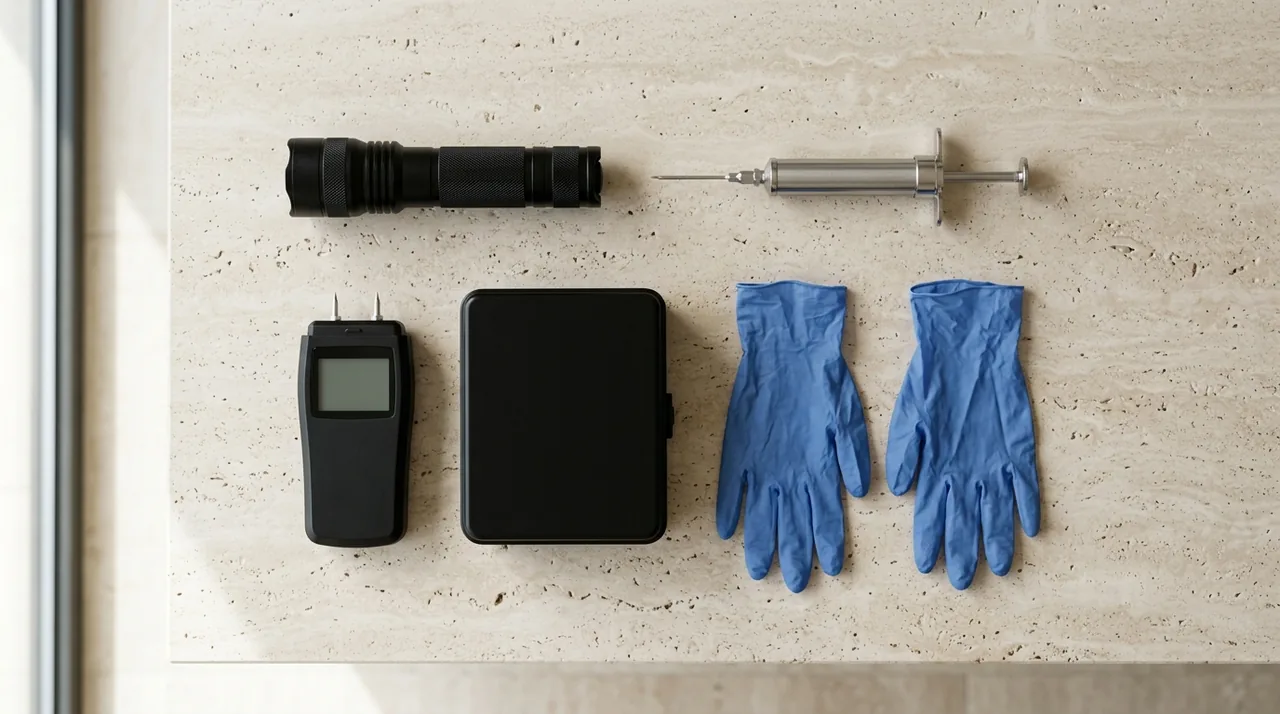
Professional carpet inspection tools and calibrated low-pressure application equipment for flea control in Jeddah

Fiber inspection tools, low-pressure carpet applicators, and crevice nozzles for thorough flea lifecycle control.

Deep Carpet Fiber & Floor Perimeter Residual Application

Wall-to-wall carpets, area rugs, floorboard crevices, and baseboards across affected rooms.

Uniform, low-pressure application of registered public-health residual formulations that penetrate down into the carpet pile to eliminate jumping adult fleas and intercept newly emerging adults as they exit their cocoons.

Safety Consideration: Applied as a controlled coarse droplet spray rather than an airborne fog; requires full drying and ventilation before re-entry.

Insect Growth Regulator (IGR) Lifecycle Disruption

All indoor carpet and upholstery flea treatments to prevent generational rebound.

Integration of specialized Insect Growth Regulators that mimic juvenile insect hormones, preventing flea eggs from hatching and halting worm-like larvae from molting into pupal cocoons and biting adults.

Safety Consideration: Targets insect-specific developmental hormones with long-lasting stability deep inside carpet fibers.

Upholstery Crevice, Sofa Skirt & Under-Furniture Treatment

Sofas, armchairs, majlis floor cushions, and dark zones underneath beds and low tables.

Precision treatment directed under removable sofa cushions, along upholstery seams, and across shaded floor zones underneath furniture where photophobic flea larvae congregate away from room light.

Safety Consideration: Focused on recessed crevices and underside zones while washable cushion covers and pet blankets are laundered thermally.

Shaded Courtyard, Under-Stair & Entryway Perimeter Control

Villas and ground-floor residences affected by stray courtyard cats.

Targeted exterior application to shaded, moist resting spots in courtyards, beneath staircases, and around doorway thresholds to eliminate outdoor flea reservoirs before they hitchhike indoors.

Safety Consideration: Children and animals must remain off treated courtyard surfaces until dry; physical exclusion of stray cats is advised.
Clear Service Scope Distinction

Service Scope: Our 5-Phase Flea Control Protocol

Because successful flea resolution depends on coordinating indoor fiber treatment, pet veterinary care, and post-treatment vacuuming, we define our 5-phase service scope clearly:

1. Pre-Treatment Assessment & Preparation Check

Pre-Service Gate

Confirming that carpets and sofas have been thoroughly vacuumed, small floor items and children’s toys have been cleared, and all pets have been safely removed from the treatment zones.

Scope Note: Our scope covers residential surfaces, carpets, upholstery, and courtyards only. We never apply pest control products to pets; veterinary care is strictly separate.

2. Carpet Pile, Upholstery & Courtyard Inspection

On-Site Diagnostics

Inspecting carpet fibers, sofa crevices, pet sleeping zones, and shaded exterior entryways to confirm flea activity and map larval hotspots.

Scope Note: Identifies whether the outbreak is purely indoor or continuously fed by stray cats in the courtyard or lightwell.

3. Targeted Dual-Action Fiber & Crevice Treatment

Core Execution

Applying combined residual adulticide and Insect Growth Regulator (IGR) treatments across carpets, rugs, baseboard crevices, under-furniture zones, and designated courtyard hotspots.

Scope Note: Strict drying and ventilation intervals are enforced before residents or pets walk on treated carpets.

4. Pupal Emergence Window Review & Follow-Up

Lifecycle Follow-Through

Monitoring across the 10-to-14-day post-treatment window during which protected cocoons stimulated by footstep vibrations emerge and contact the treated fibers, with scheduled follow-up when required.

Scope Note: Seeing occasional fleas during the first 7–10 days after treatment is a normal biological phenomenon known as the "pupal window" as pre-formed cocoons hatch and hit the residual barrier.

5. Post-Treatment Vacuuming & Carpet Cleaning Coordination

Long-Term Prevention

Providing clear schedules for ongoing dry vacuuming, guidance on when to resume wet carpet shampooing, and practical steps to block stray cats from resting in courtyards.

Scope Note: Timing professional steam/extraction carpet cleaning two weeks after treatment preserves the active IGR barrier during the critical emergence phase.

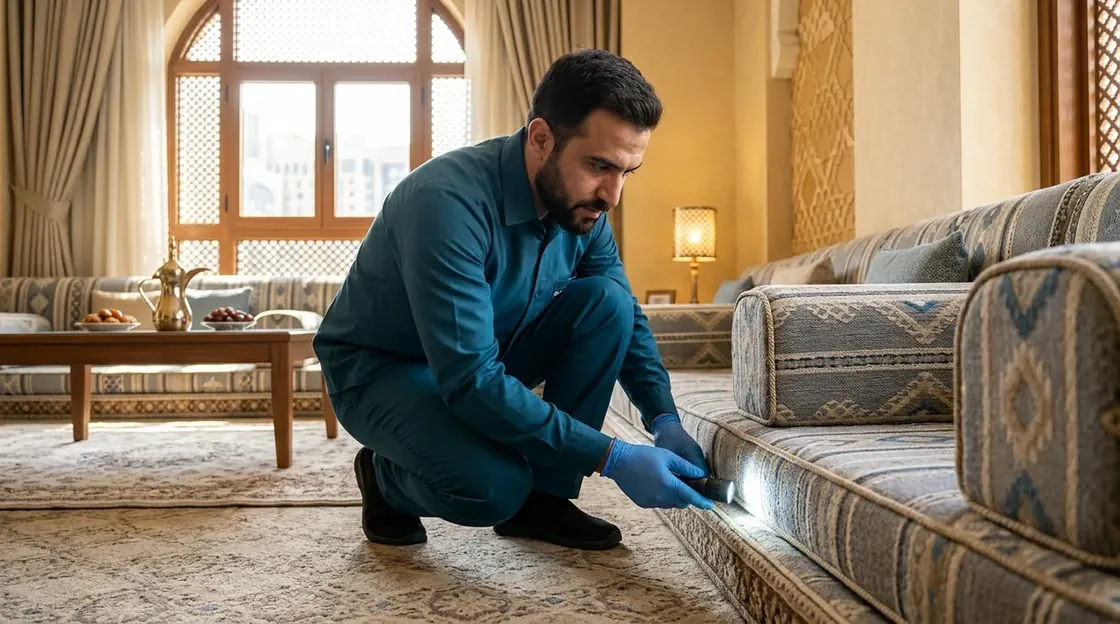
Inspecting and treating carpets and upholstered majlis seating for fleas in Jeddah
This lifecycle breakdown illustrates why killing only the jumping adult fleas leaves 95% of the infestation untouched deep inside your carpets.

The 95% Rule: Where Flea Life Stages Hide Inside Your Home

Stage 1: Eggs (~50%)

Smooth, Non-Sticky Eggs Rolling Into Carpet Pile

  • •Laid on the host animal’s fur but smooth and dry, rolling off immediately onto rugs and sofas.
  • •Concentrated heavily wherever pets or stray cats nap, groom, or jump down.
  • •Microscopic (0.5 mm) pearly-white ovals that sink to the bottom of carpet fibers.
  • •Hatch within 2 to 7 days in warm, humid indoor or shaded courtyard environments.
Stage 2: Larvae (~35%)

Light-Avoiding Larvae Burrowing to the Carpet Backing

  • •Blind, legless worm-like larvae that actively flee light (negative phototaxis).
  • •Burrow deep into carpet pile, parquet floor cracks, and beneath sofa cushions.
  • •Feed on organic debris and dried "flea dirt" (adult flea feces) at the fiber base.
  • •Highly susceptible to Insect Growth Regulators (IGRs) that halt molting.
Stage 3: Pupae/Cocoons (~10%)

Camouflaged Silk Cocoons Resistant to Surface Sprays

  • •Larvae spin sticky silk cocoons that bind carpet lint and dust for camouflage.
  • •The sealed cocoon protects the developing flea from drying out and simple misting.
  • •Can remain dormant for weeks or months in vacant apartments until triggered.
  • •Footstep vibrations, vacuuming, and warmth trigger rapid adult emergence.
Stage 4: Adults (~5%)

Jumping Biting Fleas Emerging in Search of a Host

  • •The only visible stage, leaping from carpets onto ankles, lower legs, or pets.
  • •Attracted immediately to body warmth, exhaled CO2, and floor movement.
  • •Eliminated upon contacting residual public-health formulations on carpet fibers.
  • •Prevented from laying viable new eggs when exposed to IGR-treated surfaces.

A complete flea control program must target all four developmental stages across carpet fibers, upholstery crevices, and shaded courtyard soil.

Specialized Technical Reference

In-Depth Technical Guide: Flea Biology, Carpet Cocoons & Integrated Control

Understanding how fleas differ from bed bugs, why 90%+ of an infestation hides deep inside carpet fibers, and how HEPA vacuuming unlocks resistant cocoons is key to permanent resolution.

التفريق العملي بين البراغيث القافزة في السجاد وبين بق الفراش الزاحف في المراتب

Diagnostic Distinction: Lower-Leg Jumping Fleas in Carpets vs. Nocturnal Crawling Bed Bugs in Seams

When household members notice insect bites or irritation indoors, they frequently confuse fleas with bed bugs—yet the two insects belong to entirely different orders, occupy different zones of the room, and require completely different treatment strategies. Adult fleas are laterally compressed (flattened side-to-side like a knife blade) so they can slip rapidly through animal fur and dense carpet fibers, and they possess spring-loaded hind legs capable of launching them up to 20 cm into the air. Because fleas emerge from carpets, rugs, and floor crevices, their interaction with humans typically occurs around the feet, ankles, and lower legs whenever someone walks across an infested floor, day or night.

By contrast, bed bugs are dorsoventrally flattened (flat from top to bottom like an apple seed) and have zero ability to jump; they move strictly by crawling. Bed bugs hide inside tight mattress piping seams, upholstered headboards, and wooden bed slats within two meters of where people sleep, emerging exclusively in the dark of night while the host is stationary in bed.

Their reproductive biology also diverges sharply: female bed bugs cement their eggs onto solid seams and wood surfaces where they hatch into crawling nymphs, whereas female fleas lay smooth, non-sticky eggs that roll loosely deep into carpet pile and hatch into worm-like larvae that spin silk cocoons. Accurately distinguishing between the two during initial inspection ensures we treat the right substrate with the right methodology.

  • Fleas jump forcefully from carpets and floor cushions; bed bugs only crawl and can never jump.
  • Flea activity concentrates around feet, ankles, and lower legs; bed bugs feed at night on sleeping hosts in bed.
  • Fleas are laterally flattened (side-to-side) and tiny (1.5–3 mm); bed bugs are flat, broad ovals (4–5 mm).
  • Flea eggs roll loosely into carpet fibers and form larvae/cocoons; bed bug eggs are glued inside mattress seams.
  • Fleas trace back to pets, stray courtyard cats, or vacant units; bed bugs trace back to travel luggage and furniture.
لماذا يتركز أغلب نشاط البراغيث في أطوار البيض واليرقات والشرانق داخل وبر السجاد والموكيت

Why 90% of a Flea Infestation Hides as Eggs, Larvae & Cocoons Deep in Carpet Fibers

Whenever you see jumping adult fleas on a rug or sofa, you are looking at roughly 5% of the total flea population inside the room. Fleas undergo complete metamorphosis comprising four distinct stages: eggs (~50%), larvae (~35%), pupae inside cocoons (~10%), and adults (~5%). Because flea eggs are dry and smooth rather than sticky, gravity carries them down between carpet tufts, into floorboard cracks, and beneath sofa cushions within hours of being laid.

Once hatched, the tiny, blind, worm-like larvae exhibit strong negative phototaxis—meaning they actively flee light and burrow deep down to the dark carpet backing and under furniture skirts. Down at the base of the rug, larvae feed on organic lint and "flea dirt" (dried blood excreted by adult fleas) before spinning a sticky silk cocoon. Because the outer silk of the cocoon collects carpet fibers, dust, and sand grains, it becomes tightly bound to the base of the carpet where light sweeping or surface misting cannot reach it.

This cocoon stage is the reason single-pass surface sprays fail and why entomologists refer to the 7-to-14-day period after treatment as the "pupal window." While inside its sealed cocoon, the pre-emerged adult flea is largely shielded from liquid sprays. Our dual-action protocol deposits both a residual adulticide and an Insect Growth Regulator (IGR) deep into the carpet fibers: the IGR stops larvae from ever forming new cocoons, while the residual eliminates emerging adults as soon as vibration triggers them to exit their cocoons.

  • Approximately 95% of an indoor flea population consists of invisible eggs, larvae, and cocoons hidden in fibers.
  • Flea larvae actively avoid light, burrowing to the bottom of wall-to-wall carpeting and beneath furniture.
  • Sticky silk cocoons accumulate dust and carpet lint, camouflaging and shielding the pupa inside.
  • Mechanical pressure (footsteps or vacuum rollers) and warmth trigger dormant cocoons to open in seconds.
  • Combining an Insect Growth Regulator (IGR) with a residual adulticide breaks both larval development and adult survival.
مصادر انتقال البراغيث بين الحيوانات الأليفة، قطط الأحواش والحدائق، والشقق بعد الإخلاء

Sources of Infestation: Indoor Pets, Outdoor Courtyard Cats & Vacant Property Transitions

One of the most common questions we hear from families in Jeddah and Makkah is: "How did we get fleas in our living room when we don’t own a cat or dog?" In most cases, the culprit is just outside the door. Stray neighborhood cats frequently shelter from the sun inside shaded villa courtyards, beneath parked cars, under exterior staircases, or in ground-floor building setbacks (irtidadat) and lightwells. As these cats rest and groom on shaded soil or doorway mats, flea eggs drop off and develop into hungry adult fleas that leap onto shoes, socks, and clothing hems as family members walk past, hitchhiking straight onto indoor carpets.

In households that do own an indoor cat or dog, treating the home’s carpets without treating the pet on the very same day leaves a mobile breeding reservoir active. We maintain a strict ethical and technical boundary: our pest control technicians treat residential floors, carpets, upholstery, and courtyards only, while your licensed veterinarian provides the medical spot-on or oral flea treatment for your pet.

A third frequent source is moving into a newly rented apartment or reopening a home that sat vacant for weeks after a previous occupant with pets departed. Deprived of a host, pre-emerged fleas remain quiescent inside their carpet cocoons for months—then erupt in a sudden synchronized wave the day new residents walk across the floors.

  • Stray cats resting in shaded villa courtyards, carports, and under stairs drop flea eggs right outside entry doors.
  • Adult fleas hitchhike indoors on shoes, socks, and long garments even in strictly pet-free homes.
  • Pet-owning households must arrange veterinary flea treatment for their animals concurrently with home treatment.
  • Dormant cocoons in vacant apartments can wait for months before hatching en masse when new tenants walk in.
  • Blocking stray cat access to under-stair voids and keeping courtyard soil dry eliminates external breeding pockets.
أهمية التنسيق بين معالجة البراغيث والشفط الميكانيكي العميق وتنظيف السجاد والمجالس

Coordinating Flea Treatment with Deep HEPA Vacuuming & Professional Carpet/Sofa Extraction

A HEPA-filtered vacuum cleaner with a rotating beater bar is one of the most powerful biological allies in professional flea control. Vacuuming all carpets, rugs, and sofas thoroughly right before our technician arrives accomplishes three critical tasks: it physically extracts a significant percentage of loose eggs, larvae, and nutrient-rich "flea dirt"; it stands matted carpet fibers upright so our low-pressure treatment can penetrate to the backing; and most importantly, the mechanical vibration and warmth of the vacuum head trick shielded cocoons into opening up so the emerging fleas are exposed to treatment.

Once our dual-action residual and IGR treatment has been applied and dried, proper timing between dry vacuuming and wet carpet cleaning is essential. You must avoid wet-mopping, steam-cleaning, or shampooing treated carpets for 10 to 14 days after application, because wet washing prematurely strips the active residual and growth regulator from the fibers before the "pupal emergence window" finishes. Instead, continue dry vacuuming every 2 to 3 days to coax any remaining cocoons into emerging and contacting the treated pile.

After the 14-day lifecycle window closes and all flea activity has ceased, scheduling our professional deep hot-water carpet and sofa extraction service is the ideal final step to flush out dead organic debris, sanitize upholstery fibers, and restore complete freshness to your home.

  • Pre-treatment vacuuming lifts carpet pile and uses vibration to stimulate resistant cocoons to open.
  • Always seal the vacuum bag or empty the canister into a sealed plastic bag in an outdoor bin immediately after use.
  • Do not wet-shampoo or steam-clean treated carpets during the first 10–14 days so the IGR and residual stay active.
  • Continue periodic dry vacuuming after the carpet dries to accelerate emergence of any remaining cocoons.
  • Schedule deep hot-water carpet and upholstery extraction 14 days post-treatment for final sanitization.
Client Readiness Checklist

Customer Preparation Checklist: Before, During & After Flea Control

Mechanical vacuuming and thermal laundering of pet bedding are vital partners to professional flea treatment. Following these six steps exposes hidden cocoons and maximizes fiber penetration:

1. Before the Visit

Perform a Deep, Slow Vacuuming of All Carpets, Rugs & Sofas

Right before our technician arrives, vacuum all carpets, under tables, along baseboards, and between sofa cushions thoroughly. Vacuuming removes loose eggs and larval food debris, lifts matted carpet fibers so the treatment penetrates deeper, and uses vibration and warmth to stimulate protective cocoons to open up. Seal and discard the vacuum bag immediately in an outdoor bin.

Wash Pet Bedding at 60°C+ and Clear Floor Clutter

Gather all pet beds, throw blankets, and washable floor mats and launder them in hot water (at least 60°C) followed by high-heat drying. Pick up shoes, children’s toys, and small items from floors and under beds so carpets are fully accessible.

2. During Service

Vacate Treated Rooms & Arrange Concurrent Veterinary Care for Pets

All family members and pets must remain out of the treated areas during application (fish tanks should be covered and air pumps switched off). If you own a cat or dog, coordinate a veterinary visit on the same day for approved topical or oral flea medication so the pet does not re-seed the house.

Point Out Favorite Pet Nap Spots and Stray Cat Entry Zones

Show the technician the specific sofa corners, sunny rug patches, or shaded courtyard corners under stairs where indoor pets or outdoor stray cats frequently rest.

3. Post-Service Care

Wait for Full Carpet Drying and Ventilation Before Re-Entry

Do not walk barefoot on treated rugs or allow children and pets back onto carpets until the technician’s specified drying time (typically 4 to 6 hours) has passed and rooms have been ventilated thoroughly for 30 to 60 minutes.

Delay Wet Carpet Shampooing for 14 Days While Continuing Dry Vacuuming

Do not wet-mop, steam-clean, or shampoo treated carpets for 10 to 14 days after treatment so the residual adulticide and IGR remain active against emerging cocoons. Instead, vacuum dry carpets every 2 to 3 days to stimulate remaining cocoons to hatch and contact the treated fibers.

Safety Standards & Responsible Practice

Safety Standards & Responsible Practices for Carpet & Courtyard Treatments

Because flea control involves treating carpets, area rugs, and living room floors where families walk and children play, strict safety discipline is mandatory. We never use agricultural pesticides, unapproved chemical concentrates, or hazardous fumigants inside residential properties.

We reject misleading marketing claims of "100% chemical-free instant eradication." Instead, we uphold transparent professional standards: applying registered public-health formulations and targeted Insect Growth Regulators (IGRs) at calibrated rates, enforcing mandatory drying and ventilation intervals before re-entry, and maintaining a strict boundary between residential surface treatment and veterinary medicine.

Strict Separation Between Surface Pest Control & Veterinary Pet Care

We never spray pets or apply pest control products to animal fur, litter boxes, or pet food and water bowls. All pet feeding dishes must be removed prior to treatment, and pets must be treated solely with veterinarian-prescribed products.

Child-Safe Re-Entry Protocols on Carpeted Floors

In homes with toddlers or children who play on carpets, we enforce strict waiting periods until carpet fibers are 100% dry and rooms are fully ventilated, followed by optional deep extraction cleaning once the 14-day lifecycle window closes.

Insect Growth Regulators (IGRs) for Targeted Biological Control

By incorporating IGRs that specifically disrupt insect molting hormones, we halt larval development deep inside carpets without relying on excessive applications of harsh conventional sprays.

Responsible Exterior Courtyard Application

When treating villa courtyards and shaded entryways, applications are focused directly onto soil harborages, under-stair voids, and stray cat resting zones away from ornamental blooms and water features.

Saudi Regulatory Alignment Note:Saudi Regulatory Alignment: All public-health insecticides and Insect Growth Regulators (IGRs) utilized in our residential flea control programs comply with Saudi Food and Drug Authority (SFDA) public-health pesticide registration requirements and Ministry of Municipalities and Housing (MOMAH / Balady) municipal standards.

Factors Affecting Flea Control Pricing in Jeddah

Because flea treatment requires thorough coverage of carpeted floor area, upholstery crevices, and potential outdoor courtyards rather than isolated spot baiting, pricing is determined transparently by these operational factors:

Total Carpeted Area & Number of Rooms Treated

Treating a single carpeted room requires different time and formulation volume compared to a multi-room apartment or villa with extensive wall-to-wall carpeting and area rugs.

Inclusion of Exterior Villa Courtyards, Gardens & Setbacks

Upper-floor apartments require interior carpet and upholstery treatment only, whereas ground-floor units and villas with stray cat activity in shaded courtyards require coordinated interior and exterior perimeter treatment.

Volume of Upholstered Sofas & Floor Cushions (Masanid)

Rooms furnished with large sectional sofas, removable cushions, and traditional floor seating require additional crevice and underside inspection and application.

Infestation Severity & Vacant-Property Cocoon Load

Heavy mass-emergence outbreaks in recently vacated apartments often carry a dense reservoir of dormant cocoons, requiring a structured two-visit follow-up package.

Post-Treatment Deep Carpet & Sofa Extraction Cleaning

Clients who schedule professional hot-water carpet and upholstery extraction two weeks after flea control completes receive a coordinated service plan.

Property Layout & Accessibility

Whether servicing a coastal villa with a shaded garden courtyard or a residential apartment in Jeddah, pricing reflects the exact indoor and outdoor square footage.

We provide a clear, itemized quote after assessing your carpeted rooms and courtyard requirements—with no hidden fees.

Request Assessed Quote
Local Environmental Context — Jeddah

Flea Control Challenges in Jeddah: Coastal Humidity, Garden Courtyards & Vacant Rentals

Jeddah’s warm Red Sea coastal climate and elevated year-round relative humidity create optimal biological conditions for flea survival. Unlike arid desert interiors where low humidity dries out fragile flea larvae, Jeddah’s humid air (easily exceeding the 50% relative humidity threshold larvae need) allows flea eggs and larvae to thrive both indoors and inside shaded villa courtyards, beneath irrigated garden shrubs, and under parked vehicles.

Across Jeddah’s residential neighborhoods, stray cats frequently shelter in shaded villa setbacks, carports, and ground-floor building entrances, dropping flea eggs that mature into hungry adults and hitchhike indoors on residents’ shoes and clothing. In addition, high tenant turnover in Jeddah apartments often triggers sudden "vacant apartment flea syndrome" when dormant cocoons awaken upon a new family moving in.

Our Jeddah flea control service addresses both indoor carpet pile and outdoor shaded courtyard reservoirs simultaneously, ensuring stray cat resting zones outside your door do not immediately re-infest your living room rugs.

Key Local Factors in Jeddah

  • High coastal humidity in Jeddah accelerating flea egg hatch and sustaining outdoor larval survival in shaded soil and planters.
  • Stray cats nesting in villa courtyards, under cars, and beneath exterior stairs right next to ground-floor living room doors.
  • Synchronized mass emergence of dormant flea cocoons when families move into recently vacated apartments or return from travel.
  • Combination of indoor household cats and high-pile area rugs or sectional sofas in air-conditioned living rooms.
  • Hitchhiking fleas carried from ground-floor building lobbies and lightwells into apartments on shoes and clothing hems.

Property Types Served in Jeddah

  • Private villas with garden courtyards, carports, and shaded setbacks across Jeddah
  • Family residential apartments and ground-floor condominium units
  • Recently vacated rental apartments prior to new tenant move-in
  • Pet-owning households (in coordination with licensed veterinary care)
  • Furnished apartments, coastal chalets, and family rest houses
Scheduling & Dispatch

We offer prompt inspection and dual-action flea treatment across all Jeddah districts, plus optional deep carpet and sofa extraction cleaning scheduled 14 days post-treatment.

Need This Service in Makkah?

Switch directly to our dedicated Makkah page for this exact pest service.

Deep Carpet Fiber, Upholstery & Courtyard Flea Control — Jeddah in Makkah
Interactive Pest Service Finder (6 Quick Steps)

Pest Service Finder

Select your city, apparent pest issue, property type, and location to reach the right specialized service page or prepare a structured inspection inquiry.

Note: This tool provides preliminary service routing and does not replace on-site professional inspection.
1

Step 1 — Select Your City:

2

Step 2 — Apparent Pest or Issue Type:

3

Step 3 — Property Type:

4

Step 4 — Where Is the Problem Observed?

Steps 5 & 6 — Preliminary Match & Next Action

Recommended Service Page: Fleas Control in Jeddah

We matched your selection to Fleas Control in Jeddah (Apartment — Kitchen). View the full service guide for inspection steps and safety protocols, or send your inquiry now.

View Fleas in Jeddah
Related Problem-Solution & Diagnostic Guides

Technical & Diagnostic Guides to Help You Make the Right Decision in Jeddah

Pest Identification & Decision Guide10 min read

Bed Bugs vs. Fleas in Mattresses & Carpets: Practical Field Identification & Treatment Guide for Jeddah & Makkah

Field comparison of nocturnal crawling bed bugs in mattress seams versus jumping fleas in carpet fibers, explaining inspection checkpoints, thermal steam integration, and follow-up protocols.

  • Tiny dark fecal spots, shed skins, or flat reddish-brown insects tucked inside mattress piping and headboards
  • Fast-jumping minute insects springing from carpet pile or patio thresholds toward ankles and lower legs
Read Full Diagnostic Guide
Cockroach Diagnostic Guide10 min read

Why Small Cockroaches Appear in Kitchen Cabinet Hinges & Appliances Despite Daily Cleaning—And How to Stop Them

Distinguishing German kitchen cockroaches from American drain cockroaches, why supermarket aerosol sprays scatter infestations, and how precision syringe gel baiting breaks the egg-case cycle.

  • Tiny tan cockroaches and pinhead nymphs clustering inside metal cabinet hinges and warm appliance motors
  • Dark pepper-like droppings and empty light-brown egg capsules (oothecae) in drawer corners
Read Full Diagnostic Guide
Termite & Wood Protection Guide10 min read

Early Signs of Subterranean Termites in Wooden Door Frames, Baseboards & Parquet in Jeddah & Makkah

How to detect mud tubes, hollow-sounding wood, and sub-slab moisture triggers early, differentiate subterranean termites from household ants, and apply structural perimeter treatments.

  • Pencil-thick dried mud tubes climbing foundation walls, doorframes, or behind wooden skirting boards
  • Wood sounding hollow or papery when tapped while the outer paint layer still looks intact
Read Full Diagnostic Guide
Direct Technical Answers

Frequently Asked Questions About Flea Control in Jeddah

Honest, science-backed answers about the flea cocoon emergence window, carpet preparation, pet safety, and outdoor courtyard strays.

This is a well-documented biological stage called the "pupal emergence window." While initial treatment eliminates active adult fleas and exposed larvae, roughly 10% of the population hides inside sealed, camouflaged silk cocoons deep in the carpet backing that shield them from liquid sprays. Over the next 7 to 14 days, footstep vibrations and vacuuming stimulate these pre-formed cocoons to open; as the new adults emerge onto the treated carpet fibers, the residual formulation eliminates them while the Insect Growth Regulator (IGR) prevents any new eggs from hatching.

Eliminate Fleas from Your Carpets, Majlis & Courtyards in Jeddah

Don’t let hidden carpet cocoons and outdoor courtyard reservoirs keep cycling fleas into your home. Contact us today to schedule a thorough inspection and dual-action lifecycle treatment.

Dual-Action Residual & IGR Control • Strict Carpet Drying Safety • Clear Vacuuming & Courtyard Guidance.

Unified Service Request Builder

Share Your Request Details for Scheduling & Transparent Pricing

Enter your basic contact details, select your city (Jeddah or Makkah), and choose the service you need. This form organizes your inquiry for immediate coordination.

We respect your privacy. Your information is used strictly to respond to your service inquiry.
CallWhatsAppGet Quote