
Serving Jeddah & Makkah
Field Identification & Service Decision Guide — Jeddah & Makkah15 min comparison & decision readJeddah & Makkah

Bed Bugs vs. Fleas: How to Inspect Mattresses, Headboards, and Carpets to Choose the Right Treatment

An actionable entomological comparison detailing physical traits, movement mechanics, flashlight inspection zones, and why bed bugs and fleas require fundamentally different treatment protocols.

Waking up to nocturnal discomfort or spotting tiny dark insects vanishing into bedroom upholstery or majlis seating creates immediate anxiety for households in Jeddah and Makkah. Yet homeowners frequently struggle to answer the most decisive question first: are we dealing with crawling bed bugs (Cimex lectularius) or jumping fleas (Ctenocephalides spp.)? Confusing the two leads directly to failed treatments, because a flea eradication protocol targets floor-level carpet fibers, pet resting zones, and courtyard thresholds, whereas bed bug eradication focuses intensively on mattress piping, box-spring staples, bed slats, and upholstered headboards.

From a rigorous scientific and public-health standpoint, no pest control technician—or homeowner—can reliably identify an insect species based solely on skin irritation or redness. Human dermatological reactions vary dramatically between individuals and can be triggered by environmental allergens, fabric friction, mosquitoes, or carpet beetle hairs; evaluating skin symptoms is strictly the domain of a medical professional. Definitive pest identification always requires discovering physical entomological evidence: the specimen itself, its locomotion (rapid crawling vs. vertical jumping), fecal spotting patterns, cast exoskeletons, or eggs inside specific structural micro-habitats.

This commercial comparison and decision guide equips you with a step-by-step field inspection methodology before you book a service. You will learn how to perform the flashlight-and-card mattress seam check for bed bugs, how to execute the white-sock floor test for fleas, why supermarket foggers fail against both pests, and how to coordinate professional SFDA-registered treatments with 60°C laundry and deep upholstery extraction in Jeddah and Makkah.

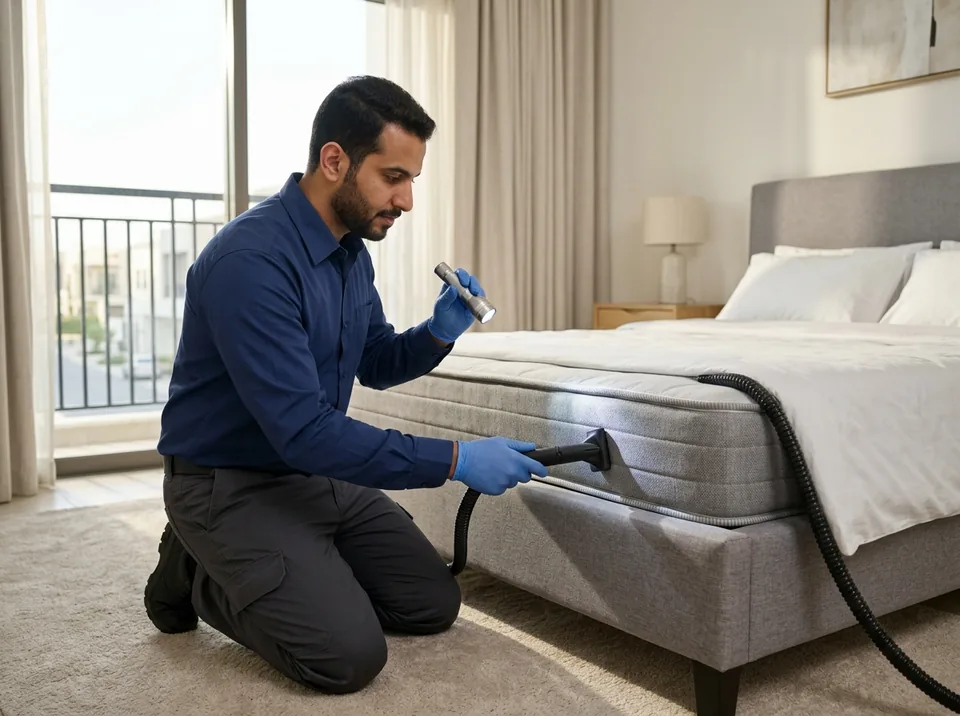
Detailed physical inspection of mattress seams and bed frame joints comparing bed bug and flea indicators in Jeddah and Makkah

Executive Summary — Key Takeaways in This Guide:

  • Locomotion is the fastest field differentiator: bed bugs are flat, oval, apple-seed-shaped crawlers that never jump or fly, whereas fleas are laterally compressed insects that leap 15–30 cm vertically when disturbed.
  • Harborage elevation differs sharply: 85% of bed bugs cluster within 1.5–2 meters of the sleeper (mattress piping, bed slats, headboards, sofas), while fleas and their larvae inhabit floor-level carpet pile, rugs, and patio thresholds.
  • Skin irritation alone cannot medically or entomologically diagnose the culprit; physical confirmation requires flashlight inspection for live specimens, ink-like fecal dots, or translucent molted skins.
  • Both pests produce resilient eggs (and flea pupae spin protective cocoons) that survive a single spray, making a scheduled two-visit protocol with Insect Growth Regulators (IGRs) essential.
  • Combining targeted pest control with thermal laundry (60°C wash/dry cycles) and deep sofa or carpet hot-water extraction removes organic debris, allergens, and dormant life stages.
Commercial Decision Matrix

Commercial Decision & Identification Matrix: Bed Bugs vs. Fleas vs. Carpet Beetle Larvae

Match the physical signs observed during your room inspection to select the exact service protocol required.

Inspection CriterionBed Bugs (Cimex lectularius)Fleas (Ctenocephalides spp.)Carpet Beetle Larvae (Common Lookalike)
Physical Shape, Size & ColorDorso-ventrally flattened, broad oval shaped like an apple seed (4–6 mm adult); mahogany brown turning elongated dark red after feeding; nymphs are translucent tan.Tiny (1.5–3 mm), laterally flattened (thin side-to-side) with a hard glossy dark reddish-black shell and powerful elongated hind legs built for jumping.Small bristly caterpillar-like grubs (3–5 mm) covered in dense brown hairs (setae); they do not bite humans, but their shed hairs cause prickly contact dermatitis.
Movement Pattern Under FlashlightCrawls steadily and rapidly into dark crevices when exposed to light; completely incapable of jumping or flying.Leaps instantaneously upward and horizontally (15–30 cm) in response to footstep vibrations, shadows, or warmth.Crawls very slowly along dark carpet edges, baseboards, and wool closet corners without sudden bolting.
Primary Harborage Zones (Where to Look)Mattress piping seams, corner tufts, wooden bed slats, screw holes, behind upholstered headboards, sofa cushions, and wall frames near the bed.Deep inside carpet pile, rug underlays, floor cracks, pet bedding, and ground-floor patio thresholds or courtyards frequented by stray cats.Underneath heavy furniture resting on wool rugs, undisturbed closet corners, felt pads, and accumulations of lint or pet hair.
Fecal Spotting & Physical TracesDark ink-like dots that bleed into mattress ticking like a felt-tip marker (smearing rusty-red when wiped with a damp cloth), plus translucent cast skins and 1 mm pearly eggs.Loose, dry pepper-like granules ("flea dirt") scattered loose at the base of carpet fibers rather than absorbed into mattress seams; dissolves red on wet tissue.Bristly, hollow cast larval skins accumulating along baseboard edges alongside irregular grazing holes in wool or natural-fiber textiles.
Typical Source of Introduction into the HomeLuggage returning from travel, visiting guests’ bags, secondhand furniture or mattresses, or migration from adjacent apartments via wall penetrations.Household pets or stray cats nesting in villa courtyards, building basements, or rooftops, with adult fleas hitchhiking indoors on socks and trousers.Tiny adult beetles flying in through window screens or arriving on stored woolens, rugs, and dried botanicals.
Recommended Professional Service SelectionSpecialized Bed Bug Treatment (targeted mattress seam, bed frame, and upholstery treatment + thermal steam integration + 10–14 day follow-up).Specialized Flea Control (broadcast carpet, floor, and courtyard treatment with adulticide + IGR to arrest larvae + deep carpet extraction).Deep HEPA vacuuming and hot-water carpet/upholstery extraction paired with targeted baseboard crevice treatment.

Bedroom & Majlis Field Inspection Checklist: 6 Practical Tests to Confirm the Pest

Perform these six non-destructive diagnostic checks in order to document the exact pest before scheduling treatment.

Indicator #1Critical (Confirmed Bed Bug Harborage)

Dark ink-like spots absorbed into the mattress perimeter piping and corner label folds

Root Cause: Digested liquid excretions deposited by bed bugs immediately upon retreating into tight mattress welt seams.

Photograph the seam under flashlight, do not drag the mattress or bedding through hallways into other rooms, and book Specialized Bed Bug Treatment.
Indicator #2Critical (Established Bed Bug Breeding Colony)

Translucent yellowish shed skins and flat mahogany ovals along wooden bed slats and screw recesses

Root Cause: Bed bug nymphs molt five times before adulthood, leaving piles of cast exoskeletons and pearly white eggs inside unvarnished timber joints.

Requires in-room dismantling of bed slats and headboard brackets for combined high-heat steam and two-stage residual chemical treatment.
Indicator #3High (Active Floor-Level Flea Infestation)

Tiny dark insects leaping onto white knee-high socks when walking slowly across carpets

Root Cause: Adult fleas waiting in the carpet base detect body heat, CO2, and footstep vibrations, jumping onto the high-contrast white fabric.

Book Specialized Flea Control incorporating an Insect Growth Regulator (IGR) across all floor surfaces, paired with HEPA vacuuming and carpet extraction.
Indicator #4High (Exterior Courtyard Flea Reservoir)

Pest activity concentrated near ground-floor thresholds, annexes, or courtyards frequented by cats

Root Cause: Flea larvae develop in shaded, humid sand or porch mats where stray or domestic cats rest, riding indoors on footwear and hems.

Treat shaded exterior courtyards and entry thresholds simultaneously with indoor rooms, exclude stray cats, and launder entrance mats at 60°C.
Indicator #5High (Classic Bed Bug Introduction Vector)

Onset of activity shortly after returning from travel, hosting overnight guests, or buying used furniture

Root Cause: Passive hitchhiking of bed bugs concealed inside luggage zipper seams, wheel housings, or the dust-cover staples beneath used sofas and beds.

Inspect luggage seams, sofa undersides, and beds immediately with a flashlight, and launder all washable linens at 60°C followed by high-heat drying.
Indicator #6Low-to-Moderate (Requires Monitoring & Deep Sanitation)

Skin redness or itching experienced by a resident with zero insects, fecal spots, or shed skins found after thorough inspection

Root Cause: May stem from mosquitoes, house dust mites, carpet beetle larval hairs, or detergent contact dermatitis; pesticides should never be sprayed blindly without pest evidence.

Consult a dermatologist for skin symptoms while placing passive traps under bed legs and scheduling deep steam cleaning for mattresses, sofas, and carpets.
In-Depth Technical Guide

Comprehensive Technical Analysis: Distinguishing Bed Bugs from Fleas & Executing Eradication

Five detailed modules covering biological mechanics, flashlight inspection protocols, multi-stage chemical/IGR treatments, and thermal sanitization.

Module 1: Comparison Module 01

Anatomical & Behavioral Divergence: Why Bed Bugs Crawl High While Fleas Jump Low

Although both bed bugs (Cimex lectularius) and fleas (primarily the cat flea, Ctenocephalides felis) are obligate hematophagous ectoparasites, they belong to entirely different insect orders with opposite anatomical adaptations. Bed bugs are dorso-ventrally flattened (compressed top-to-bottom) with a broad, oval, reddish-brown body resembling an apple seed measuring 4 to 6 mm in length. Lacking wings and jumping legs, bed bugs rely on steady crawling and thigmotactic flattening to wedge themselves into credit-card-thin structural cracks located near the host’s upper sleeping zone—specifically mattress welt cords, bed-frame mortise joints, headboard brackets, and sofa seams.

Conversely, fleas are laterally compressed (flattened side-to-side like a microscopic knife blade) measuring just 1.5 to 3 mm, armored in a slick sclerotized exoskeleton with backward-pointing bristles and powerful hind legs loaded with an elastic protein called resilin. This lateral profile allows fleas to glide effortlessly through dense carpet pile and animal fur, while their resilin spring mechanism propels them 15 to 30 cm upward and forward the instant they detect floor vibrations, thermal radiation, or shifting shadows.

Their developmental lifecycles also dictate completely different control strategies. Bed bugs undergo simple (hemimetabolous) metamorphosis: pearly white eggs cemented inside wood or fabric crevices hatch into translucent nymphs that look like miniature adults and require a blood meal at each of their five molting instars. Fleas undergo complete (holometabolous) metamorphosis: smooth eggs roll off hosts deep into carpet fibers, hatching into blind, worm-like larvae that never bite humans but feed on organic lint and adult "flea dirt" at the carpet base before spinning a camouflaged, pesticide-resistant silk cocoon (pupa).

Five Definitive Biological Differentiators:

  • Locomotion: If the insect leaps away when approached, it is a flea; if it crawls rapidly into a fabric fold or wood crack, it is a bed bug.
  • Body Profile: Bed bugs are flat top-to-bottom like an apple seed; fleas are compressed side-to-side and appear paper-thin from above.
  • Vertical Distribution: Bed bugs colonize elevated sleeping and seating structures; fleas and their larvae inhabit floor-level carpets and thresholds.
  • Immature Stages: Bed bug nymphs resemble tiny translucent adults sharing the same crevice, whereas flea larvae are blind detritus-feeding grubs deep in rug pile.
  • Host Association: Flea outbreaks in Jeddah and Makkah almost always trace back to indoor pets or stray courtyard/rooftop cats; bed bugs trace to human travel and furniture.
Field Specialist Pro-Tip:

The Wet-Tissue Fecal Test: Wipe suspect black specks from a mattress seam or carpet base onto a damp white tissue; if the dark particles dissolve or smear into a rusty reddish-brown stain, it confirms digested blood excreta rather than ordinary household dust.

Important Safety Caution:

Diagnostic & Medical Disclaimer: Never attempt to identify a pest species solely by inspecting skin marks or comparing online bite photos; human dermatological responses vary widely and require a physician for medical evaluation. Always base pest control decisions on physical insect or harborage evidence.

Module 2: Comparison Module 02

The 10-Minute Field Inspection Protocol: Flashlight, Card Seam Check & White-Sock Test

To conduct a professional-grade bed bug inspection in a bedroom or majlis, equip yourself with a bright LED flashlight and a stiff plastic card (such as an expired loyalty card). Gently peel back the fitted bedsheet and pull open the raised perimeter seam (piping/welt cord) running along the top and bottom edges of the mattress. Slowly slide the edge of the plastic card along the inside of the seam while shining the flashlight at a low angle. Focus intensively on the four corners and underneath the manufacturer’s sewn fabric label, looking for three unmistakable physical markers: felt-tip-like black fecal spots absorbed into the ticking fabric, papery translucent nymph skins, or 1 mm pearly-white eggs glued into the thread crevices.

Next, move beyond the mattress to inspect the structural bed frame—where over 60% of the colony typically hides. Lift the mattress to examine the wooden support slats, side-rail mortise joints, recessed Allen-screw holes, and the stapled black non-woven dust cover underneath box springs or divan bases. Pay special attention to upholstered headboards mounted against the wall, deep diamond-tufted fabric buttons, nightstand backs, and the rear frames of adjacent majlis sofas.

If the mattress and bed frame yield zero physical traces, execute the White-Sock Floor Test to check for fleas. Pull on a pair of clean, knee-high white cotton socks and shuffle slowly across the bedroom carpet, rug edges, sofa footrest zones, and doorway thresholds leading toward courtyards or hallways for three to five minutes. Footstep vibrations and body heat trigger waiting adult fleas to leap out of the carpet fibers and cling to the white cotton weave, where their dark, laterally flattened bodies are immediately visible against the bright background.

Five Priority Micro-Zones Every Technician Inspects:

  • Top and bottom perimeter mattress piping seams, side carrying handles, and beneath the folded manufacturer’s specification tag.
  • Wooden bed slats, support ledger strips, screw recesses, and the stapled black cambric dust-cover fabric beneath divans and sofas.
  • The rear wall-facing cavity of upholstered headboards, deep diamond-button tufts, and behind adjacent wall frames and outlet plates.
  • Deep carpet pile beneath bed skirts, sofa overhangs, and ground-floor patio thresholds frequented by cats (primary flea larval zones).
  • Curtain header pleats beside the bed alongside zipper tracks and wheel housings of luggage stored beneath beds or atop wardrobes.
Field Specialist Pro-Tip:

Warm-Air Flushing Trick: If you suspect bed bugs are hiding inside a deep headboard joint that a plastic card cannot reach, blow gentle warm air from a hairdryer into the crack for 30 seconds; the thermal plume stimulates hidden bed bugs to emerge toward the heat source.

Important Safety Caution:

Containment Rule: Never carry pillows, blankets, or mattresses out of a suspect bedroom to sleep on the living room sofa; relocating bedding—or sleeping in another room—transports hitchhiking nymphs and prompts bed bugs to spread into previously clean rooms.

Module 3: Comparison Module 03

Why Single-Visit Spraying Fails Biologically: The Egg & Pupal Cocoon Barrier

One of the most critical entomological facts every homeowner must understand before hiring a pest control provider is why neither bed bugs nor fleas can be reliably eradicated through a single, unmonitored spray visit. The barrier is not pesticide potency, but the biological armor protecting their developing life stages. In a bed bug infestation, females cement pearly eggs deep inside microscopic timber pores and fabric weaves. The egg chorion is largely impermeable to standard liquid residuals, requiring 6 to 10 days at room temperature to hatch into feeding first-instar nymphs.

In a flea infestation, the biological bottleneck is known as the "pupal window." After worm-like flea larvae finish feeding at the base of the carpet pile, they spin a sticky silk cocoon coated with camouflaging dust and lint fibers. Inside this watertight cocoon, the quiescent pupa is biologically shielded from all liquid insecticides and aerosols. Pupae remain dormant inside their cocoons for 7 to 14 days—or even months in vacant apartments—emerging only when mechanical pressure, footstep vibrations, and thermal cues signal that a warm-blooded host is standing overhead.

Consequently, scientifically sound pest control relies on a structured two-stage intervention. For bed bugs, technicians combine targeted non-repellent crevice applications with direct high-heat steam (which coagulates egg proteins on contact), followed by a mandatory 10-to-14-day follow-up inspection and treatment to eliminate newly hatched nymphs before they reach reproductive adulthood. For fleas, technicians pair an adulticide with a long-residual Insect Growth Regulator (IGR such as pyriproxyfen or methoprene) that halts larval development in carpets, combined with mechanical vacuum vibrations to trigger cocoon emergence onto treated fibers.

Scientific Realities of the Two-Stage Eradication Timeline:

  • Bed bug eggs hatch in 6 to 10 days, making the Day 10–14 follow-up visit essential to intercept newly emerged nymphs before they can lay eggs.
  • Direct high-temperature dry steam (exceeding 60–80°C at the nozzle) physically denatures bed bug eggs on contact inside accessible seams.
  • Flea pupae inside silk cocoons survive sprays; routine vacuuming provides the vibration needed to stimulate adult emergence onto treated surfaces.
  • Incorporating Insect Growth Regulators (IGRs) into carpet treatments prevents flea larvae from pupating for months.
  • Avoid contractors promising "instant single-spray guarantees without follow-up" or using illegal agricultural fumigant tablets inside homes.
Field Specialist Pro-Tip:

The Pre-Treatment Vacuum Strategy for Fleas: Vacuum all carpets and rugs thoroughly one hour before the technician arrives; rotary brush vibrations stimulate quiescent flea pupae to burst out of their protective cocoons so the treatment hits them directly (seal and discard the vacuum bag outdoors immediately).

Important Safety Caution:

Critical Life-Safety Warning: Never allow any unlicensed operator to use aluminum phosphide ("gas tablets/fumigation pellets") inside an apartment or villa for bed bugs; phosphine gas is an agricultural grain fumigant that is lethal to humans and strictly prohibited in residential buildings by SFDA and municipal authorities.

Module 4: Comparison Module 04

Thermal & Extraction Synergy: Coordinating 60°C Laundry, Sofa Steam, and Carpet Extraction

Public-health safety standards strictly prohibit spraying residual liquid insecticides directly onto bedsheets, pillowcases, blankets, or clothing that make prolonged contact with human skin. Yet these washable textiles frequently harborbed bug eggs, early-instar nymphs, or flea eggs. The definitive scientific solution is exploiting the insect Thermal Death Point: every life stage of both bed bugs and fleas—including cemented eggs and pupae—suffers irreversible protein coagulation and mortality when exposed to sustained temperatures of 55°C to 60°C for at least 30 minutes.

To execute thermal laundry safely without seeding hallways with dropped pests, households must follow the Sealed-Bag Containment Protocol. Strip all bed linens, duvet covers, pillow shams, and floor-length curtains inside the affected bedroom and place them directly into heavy-duty plastic bags, sealing the necks tightly before walking to the laundry room. Tip the contents straight into the washing machine drum, immediately discard the transport bag outdoors, wash at 60°C, run a high-heat dryer cycle, and store the sanitized fabrics inside fresh sealed bags until treatment concludes.

For non-washable furnishings—such as upholstered majlis seating, sectional sofas, mattresses, and dense wall-to-wall carpeting—coordinating pest control with professional Sofa Steam Cleaning or Deep Carpet Extraction delivers decisive synergy. For bed bugs, commercial dry-vapor steam penetrates fabric piping and tufting before crevice residuals are applied to structural frames. For fleas, deep rotary carpet extraction physically flushes out organic lint, larval food ("flea dirt"), and allergens from the backing weave so follow-up IGR treatments perform at peak efficacy.

Five Rules for Coordinating Thermal Laundry & Upholstery Cleaning:

  • Never carry loose bedsheets through the home; bag all linens inside the bedroom and empty them directly into the washing machine drum.
  • Cold water washing does not kill bed bug eggs; use a 60°C wash cycle or a 30–40 minute high-heat dryer cycle.
  • Luggage and shoes that cannot enter a washing machine should be inspected and treated along seams with targeted dry steam.
  • In flea infestations, deep hot-water carpet extraction removes the digested blood debris ("flea dirt") that larvae require to survive.
  • Once mattress treatment is complete and dry, installing a zippered bed-bug-proof mattress encasement locks out future harborage.
Field Specialist Pro-Tip:

Dry-First Thermal Shortcut: For clean blankets, plush toys, or pillows that do not require stain washing, place them dry directly into a clothes dryer on high heat for 40 minutes; dry heat penetrates faster than water and kills all insect and egg stages without shrinking wet fibers.

Important Safety Caution:

Service Sequencing Rule: When booking both upholstery/carpet cleaning and pest control, always coordinate the schedule so deep steam or extraction cleaning occurs **before** residual insecticide and IGR application—never wash treated surfaces immediately after pest control.

Module 5: Comparison Module 05

Commercial Decision Framework: Choosing the Right Service in Jeddah & Makkah and Preparing Your Room

Booking the exact service that matches your physical findings saves time and prevents cross-room spread. If your flashlight inspection reveals apple-seed-shaped crawlers, ink-like black spots on mattress piping, or translucent shed skins along bed slats and sofa seams, your correct choice is **Specialized Bed Bug Treatment**. Under this protocol, technicians systematically inspect and treat bed frames, headboards, mattress welt folds, sofa under-frames, curtain headers, and baseboard joints using non-repellent formulations and steam integration, backed by a scheduled follow-up visit.

Conversely, if the White-Sock Test reveals tiny dark insects jumping from carpets, rugs, or thresholds—especially in homes with pets or courtyard/rooftop stray cats—your correct choice is **Specialized Flea Control**. This protocol treats 100% of floor-level textiles, rug underlays, baseboard crevices, and shaded exterior courtyards or annexes using an SFDA-registered adulticide combined with a residual Insect Growth Regulator (IGR) to arrest carpet-dwelling larvae before they pupate.

To maximize treatment reach on Day 1, complete four simple preparation steps before the technician arrives: first, bag all bed linens and washable fabrics inside the room for 60°C laundering; second, clear clutter stored directly underneath the bed (keeping items inside the room for inspection rather than moving them elsewhere); third, pull beds and sofas 15–20 cm away from the wall so headboards and baseboards are accessible; and fourth, plan to vacate the treated rooms for the recommended 4-to-6-hour drying and ventilation window.

Quick Pre-Booking & Preparation Checklist:

  • Match the service: Mattress/frame seams + crawling = Bed Bug Treatment; carpet/courtyard + jumping = Flea Control.
  • If uncertain, snap a clear macro photo of the insect or mattress spotting and send it via WhatsApp for pre-visit identification.
  • Keep suspect luggage, pillows, and furniture inside the affected room so they are treated in place rather than spreading pests.
  • For flea treatments, secure courtyard fences or basement vents to prevent stray cats from re-entering and dropping fresh flea eggs.
  • Observe the 4-to-6-hour re-entry and ventilation interval, and avoid wet-mopping treated baseboards or bed frames for 10–14 days so residuals remain active.
Field Specialist Pro-Tip:

Smartphone Photo Tip: Capture a suspect insect on a piece of clear adhesive tape, press it against a plain white sheet of paper beside a pen tip or coin for scale under bright light, and photograph it; this allows instant species and life-stage confirmation.

Important Safety Caution:

Furniture Preservation Note: Do not throw away structurally sound mattresses or sofas; professional multi-stage treatment paired with thermal steam and zippered encasements rescues furniture without the expense of replacement.

Hyperlocal City Adaptation

Regional & Architectural Dynamics of Bed Bugs and Fleas in Jeddah & Makkah

How coastal humidity, courtyard cats, hospitality turnover, and housing density influence pest patterns across both cities.

Jeddah GovernorateJeddah Sectors Hub

Jeddah Context: Coastal Humidity in Carpets, Courtyard Cats, and Travel Turnover

In Jeddah, high Red Sea coastal humidity (60%–80% RH) strongly favors the survival of flea larvae inside indoor carpets and shaded sandy villa courtyards, as flea larvae require at least 50% relative humidity to avoid desiccation and complete pupation. Consequently, ground-floor apartments, annexes (mulhaqs), and landscaped gardens frequented by stray cats seeking shade experience recurring seasonal flea pressure across Jeddah.

Simultaneously, as the primary international aviation and Red Sea tourism hub, Jeddah’s residential apartments, serviced suites, and villa compounds experience continuous travel luggage movement and furniture turnover—the leading vectors for indoor bed bug introductions. Our Jeddah operational protocols therefore calibrate specifically for high-humidity courtyard and carpet IGR barriers against fleas, and precision interior bedroom/majlis seam remediation against bed bugs.

  • North & Coastal Jeddah (Obhur, Al-Shati, Al-Murjan, Al-Basateen, Al-Mohammedia): Villas with shaded gardens and outdoor annexes require synchronized exterior yard and indoor carpet IGR treatments for fleas, plus careful inspection behind decorative bedroom wall panels for bed bugs.
  • Central Jeddah Districts (Al-Rawdah, Al-Salamah, Al-Zahra, Al-Faisaliyah): High travel frequency and serviced apartment density make luggage protocols and upholstered headboard inspections the frontline defense against bed bugs.
  • East Jeddah Residential Sectors (Al-Samer, Al-Tayseer, Al-Manar, Al-Ajwad): Family apartments and weekend rest houses (istirahas) benefit from combined majlis sofa steam cleaning and building shaft/rooftop cat exclusion to stop flea cycles.
  • South Jeddah & Established Districts (Al-Balad, Al-Naseem, Bani Malik, Al-Jami’ah): Closely spaced multi-story buildings and traditional wooden bedroom sets require thorough crevice sealing alongside two-stage bed bug remediation.

Makkah Context: Year-Round Pilgrim Hospitality, Guest Turnover, and Seasonal Vacancy

Makkah possesses a uniquely dynamic residential and hospitality profile driven by year-round Umrah visitors, Hajj seasons, and visiting extended family from across the globe. Because luggage, prayer rugs, and travel bags move constantly through bedrooms and family majlis rooms, passive bed bug introduction represents a primary operational challenge for both homeowners and hospitality managers in Makkah.

Additionally, seasonal residential units or ground-floor annexes that remain closed for weeks between peak periods frequently experience the "vacant-apartment flea surge": stray cats shelter from Makkah’s intense summer heat in shaded courtyards or building shafts, and dormant flea pupae inside indoor carpets burst out simultaneously the moment returning occupants walk across the floor. Our Makkah teams therefore deploy low-odor, rapid-turnaround bed bug and flea protocols tailored to active family homes and seasonal apartments.

  • Central & Al-Aziziyah Sectors (Al-Aziziyah, Al-Shishah, Al-Rawdah, Al-Misfalah): High guest turnover across apartments and hospitality buildings makes preventive mattress encasements, luggage racks, and two-stage bed bug protocols essential.
  • Southern & Western Makkah (Al-Shawqiyyah, Al-Kakiyyah, Batha Quraish, Wali Al-Ahd): Large family apartments hosting seasonal guests benefit from post-season bedroom inspections and combined sofa steam sanitization.
  • Eastern Makkah Districts (Al-Awali, Al-Sharayea, Al-Rashidiyah, Al-Naseem): Villas with shaded courtyards and garden perimeters require synchronized outdoor/indoor flea IGR treatments when stray cats trigger ground-floor outbreaks.
  • Northern Makkah Sectors (Al-Taneem, Al-Nooriyah, Al-Umrah, Al-Buhairat): Multi-story family homes and seasonal units require pre-occupancy carpet vacuuming and targeted inspection after periods of vacancy.
Illustrative Service Scenario — For Educational Reference

Diagnostic Case Scenario: Suspected Carpet Fleas Revealed as a Hidden Headboard Bed Bug Colony

Property Context & Initial Challenge:

A five-room family apartment where nocturnal pest discomfort began in the master bedroom and adjacent guest room one month after hosting traveling relatives.

Assuming the culprit was carpet fleas, the homeowner sprayed the bedroom rug twice with consumer aerosol cans and scrubbed the floor, yet nocturnal discomfort intensified and spread to a reading armchair inside the bedroom.

Outcome & Long-Term Prevention:

Complete elimination of bed bug activity across both rooms while preserving all mattresses and furniture, supported by a new household habit of inspecting luggage on hard racks away from beds after travel.

Diagnostic Inspection Findings:

  • Performing the White-Sock Test across the bedroom carpets yielded zero jumping insects and no loose "flea dirt" at the fiber base.
  • Flashlight and card inspection of the mattress piping uncovered eight ink-like black fecal spots absorbed into the ticking fabric near the top-right pillow corner.
  • Unbolting the wall-mounted upholstered headboard exposed the primary breeding colony: adult bed bugs, translucent nymphs, cast exoskeletons, and cemented white eggs clustered around the rear fabric staples.
  • Inspecting the bedroom armchair revealed a satellite group of four adults along the cushion zipper track, driven there after consumer aerosol sprays flushed them from the lower bed skirt.

Technical Protocol Applied:

  • Thermal Textile Containment: Bagged all bed linens, pillowcases, and curtains inside the bedroom for immediate 60°C washing and high-heat drying.
  • Direct High-Heat Steam Pass: Applied slow-moving commercial dry steam across all mattress piping seams, tufted headboard cavities, and armchair cushion seams to thermally denature exposed eggs and nymphs.
  • Precision Residual Application (Visit 1): Applied an SFDA-registered non-repellent formulation into wooden bed slats, screw recesses, rear headboard frames, and baseboard crevices.
  • Day 12 Follow-Up & Encasement (Visit 2): Re-inspected all structural joints under LED light, applied a second-stage treatment to intercept any late-hatching first-instar nymphs, and installed a zippered protective mattress encasement.
Safe Decision Boundaries

Safe Home Inspection Limits vs. When to Call a Professional Specialist

Clear operational boundaries distinguishing safe homeowner containment from active infestations requiring professional eradication.

Safe Homeowner Actions (Inspection, Containment & Prevention):

  • Conducting flashlight-and-card mattress seam inspections or the White-Sock carpet test to capture physical evidence.
  • Bagging bedsheets, pillowcases, and clothing inside the room and washing/drying them at 60°C high heat.
  • Vacuuming carpets, rugs, and bed frames with a HEPA vacuum and immediately disposing of the sealed vacuum bag in an outdoor bin.
  • Inspecting returning travel suitcases on hard tile floors (entryways or bathrooms) rather than unpacking them on top of beds.
  • Securing courtyard gates, basement vents, and rooftop doors to prevent stray cats from nesting and introducing fleas.

Triggers Requiring Immediate Professional Intervention:

  • Confirming even a single live bed bug, cast nymph skin, pearly egg cluster, or ink-like fecal spotting on a mattress, bed frame, or sofa.
  • Observing fleas jumping onto ankles or white socks from carpets, rugs, or courtyard thresholds.
  • Spread of nocturnal pest activity from one bedroom into adjacent bedrooms or living room majlis seating.
  • Rebound of pest activity a few days after applying consumer aerosol sprays, foggers, or household disinfectants.
  • Need for a structured two-visit eradication program combining SFDA-registered residuals, IGRs, and upholstery steam cleaning.

Honest Professional Scope Note: Pest control technicians do not provide medical diagnoses for skin symptoms (which should always be evaluated by a physician); our assessments rely strictly on physical entomological inspection. Furthermore, complete eradication of bed bugs or fleas is a partnership requiring a two-stage professional treatment to break the egg/cocoon cycle using SFDA-registered products, paired with homeowner cooperation on 60°C laundry and room containment.

Frequently Asked Questions

Frequently Asked Questions About Bed Bugs vs. Fleas Identification & Treatment

Practical entomological answers covering identification, pet factors, furniture safety, and post-treatment recovery.

How can our home have a flea infestation if we do not own any indoor pets?+

This is very common in Jeddah and Makkah. Stray cats frequently rest in shaded villa courtyards, beneath outdoor stairs, inside building utility shafts, or on rooftops. Flea eggs drop off the cats and develop in shaded thresholds; when hungry adult fleas emerge, they leap onto residents’ shoes, socks, or ankle-length garments and ride indoors into the living room carpets.

Can a technician determine whether I have bed bugs or fleas just by looking at skin marks?+

No. Scientifically and medically, insect species cannot be diagnosed from skin reactions alone. Two people sleeping in the same bed can react completely differently—one showing zero visible marks and the other developing redness—and reactions closely mimic mosquito bites or fabric allergies. Accurate pest selection always requires finding physical insect evidence on mattresses, frames, or carpets.

Do I have to throw away my mattress or majlis sofa if bed bugs are confirmed?+

In almost all cases, no. As long as the mattress or sofa is structurally intact, commercial dry steam sanitizes the seams and piping while non-repellent residuals treat the rigid wooden frame. Afterward, sealing the mattress inside a zippered bed-bug-proof encasement permanently traps any hidden stage and prevents re-infestation. Discarding furniture and bringing in a new bed before treating the room simply exposes the new mattress to remaining bugs.

Why might I see a few jumping fleas for several days even after professional flea treatment?+

This is known as the "pupal window." Flea pupae sealed inside silk cocoons deep in the carpet prior to treatment are impervious to sprays. As footstep vibrations over the next 7 to 14 days stimulate these last cocoons to hatch, the emerging adults contact the treated carpet fibers and succumb before they can reproduce.

Can I starve bed bugs out by locking the bedroom door and leaving it empty for a couple of weeks?+

No. Locking a bedroom for a few weeks will not starve bed bugs. Adult bed bugs can enter a low-metabolic state and survive for three to six months without feeding inside climate-controlled homes. Worse, abandoning a bedroom while occupying adjacent rooms often prompts hungry bed bugs to migrate under doors or through wall outlets into the rest of the home.

How long should we stay out of the treated bedrooms after bed bug or flea service?+

Standard safety protocol requires vacating treated rooms for 4 to 6 hours until all surface and crevice applications have dried completely, followed by 30 to 60 minutes of cross-ventilation before re-entry. Technicians provide specific safety guidance tailored to SFDA-registered products, particularly for households with infants or respiratory sensitivities.

How can I prevent bed bugs from entering my home after traveling or hosting guests?+

Adopt three simple habits: first, never place returning suitcases onto beds or carpets—unpack them on hard tile floors in the laundry area or bathroom; second, transfer all travel clothing directly into a 60°C wash or high-heat dryer cycle; and third, vacuum or steam the suitcase zipper tracks before storing luggage away.

Unified Service Request Builder

Share Your Request Details for Scheduling & Transparent Pricing

Enter your basic contact details, select your city (Jeddah or Makkah), and choose the service you need. This form organizes your inquiry for immediate coordination.

We respect your privacy. Your information is used strictly to respond to your service inquiry.
CallWhatsAppGet Quote