
Why Are Arabic Coffee (Cardamom & Saffron) and Tea Stains So Difficult to Remove from Light Fabrics?
Arabic coffee served across homes in Jeddah and Makkah differs fundamentally in its chemical profile from standard black coffee. It is a complex botanical suspension combining lightly roasted green coffee beans, volatile essential oils from crushed cardamom pods, and potent carotenoid crocin pigments from saffron threads—often alongside cloves or dairy creamers. When hot Arabic coffee spills onto beige, cream, or off-white upholstery, the thermal energy of the liquid expands the microscopic pores of the textile fibers, allowing saffron carotenoids and botanical tannins to bond directly with the yarn much like a commercial fabric dye.
The most destructive household mistake is rushing to scrub Arabic coffee or black tea spills with high-alkaline dish detergents, laundry powders, or chlorine bleach. Chemically, coffee, tea, date syrup, and fruit juices belong to the family of acidic botanical tannin stains. When tannins and saffron pigments encounter strong alkaline cleaners (pH > 9), they undergo a chemical mordanting reaction that locks the pigment into the fiber structure, turning a treatable yellowish spot into a permanent orange-brown stain that resists future extraction.
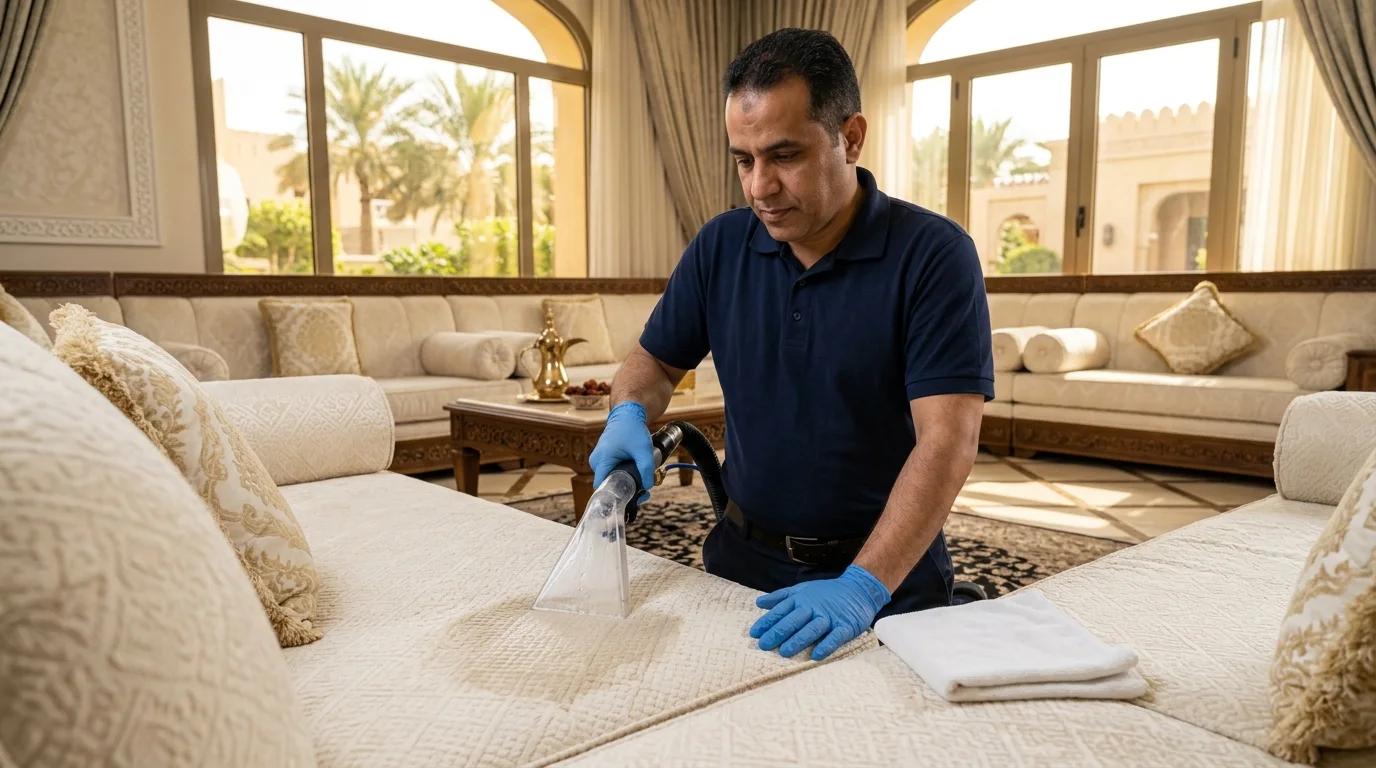
Professional remediation of Arabian hospitality spills therefore relies on a targeted two-stage chemical protocol. After immediate dry vertical blotting to remove free liquid, technicians apply a specialized, mildly acidic tannin-reducing agent (pH 4.5–5.5) engineered to cleave the ionic bond between botanical pigments and upholstery fibers, paired with a gentle non-ionic surfactant to emulsify cardamom oils. The suspended stain is then flushed and recovered immediately using calibrated warm-water vacuum extraction.
Key Takeaways for Arabic Coffee & Tea Spills
- Arabic coffee combines botanical tannins, saffron carotenoid pigments, and volatile cardamom oils.
- High-alkaline soaps and bleach chemically set coffee and tea tannins, worsening yellow-brown discoloration.
- Proper treatment requires a mildly acidic tannin spotter rather than alkaline household detergents.
- Scalding water at the initial stage cooks proteins and sets saffron; always start with cool or lukewarm water.
- Vertical blotting with plain white towels prevents secondary dye transfer from colored napkins onto wet upholstery.
Pro Tip: If Arabic coffee just spilled, press a thick white paper towel firmly over the spot with the heel of your hand for 10 seconds, lift straight up, and repeat with fresh dry towels until zero moisture transfers before applying any liquid.
Caution: Never sprinkle alkaline baking soda onto a wet Arabic coffee or tea spill; the alkaline shift chemically darkens and locks saffron and tannin pigments into the weave.