
Serving Jeddah & Makkah
Commercial Comparison & Decision Guide — Residential & Villa Cleaning14 min comparison & decision guideJeddah & Makkah

Foundational Deep Cleaning vs. Regular Cleaning & Post-Construction in Jeddah & Makkah: Which Scope Does Your Property Actually Need?

A clear reference guide distinguishing the three residential cleaning tiers for furnished and vacant apartments and villas—helping you select the exact scope before move-in, after tenant turnover, or ahead of Ramadan and Eid.

When a homeowner, tenant, or villa manager in Jeddah or Makkah decides to book professional cleaning, they are often confronted with overlapping terminology: "regular maintenance cleaning," "deep cleaning," "foundational move-in cleaning," and "post-construction cleaning." Ambiguity between these tiers frequently leads to one of two costly mismatches: booking a standard surface cleaning for a property suffering from baked-on kitchen grease, bathroom limescale, or renovation dust—resulting in disappointment—or requesting heavy construction scrubbing for a furnished home that actually requires upholstery extraction and detailed steam sanitization.

From an operational and engineering standpoint, the distinction between these service tiers is not merely about "how many hours the crew stays," but revolves around three decisive variables: the chemistry of the target soil (daily loose dust vs. oxidized culinary grease and mineral scale vs. cured cement grout, gypsum, and paint), the mechanical equipment deployed on-site (microfiber tools vs. thermal steam and upholstery extractors vs. single-disc rotary scrubbers and industrial HEPA wet/dry vacuums), and the occupancy state of the property (furnished and lived-in vs. vacant prior to move-in).

We structured this commercial decision guide to serve as a transparent roadmap for families and property owners across Jeddah and Makkah. Inside, you will find a side-by-side matrix, a room-by-room scope breakdown, and a diagnostic checklist showing exactly when regular care suffices, when foundational deep cleaning is essential, and when post-construction restoration is required.

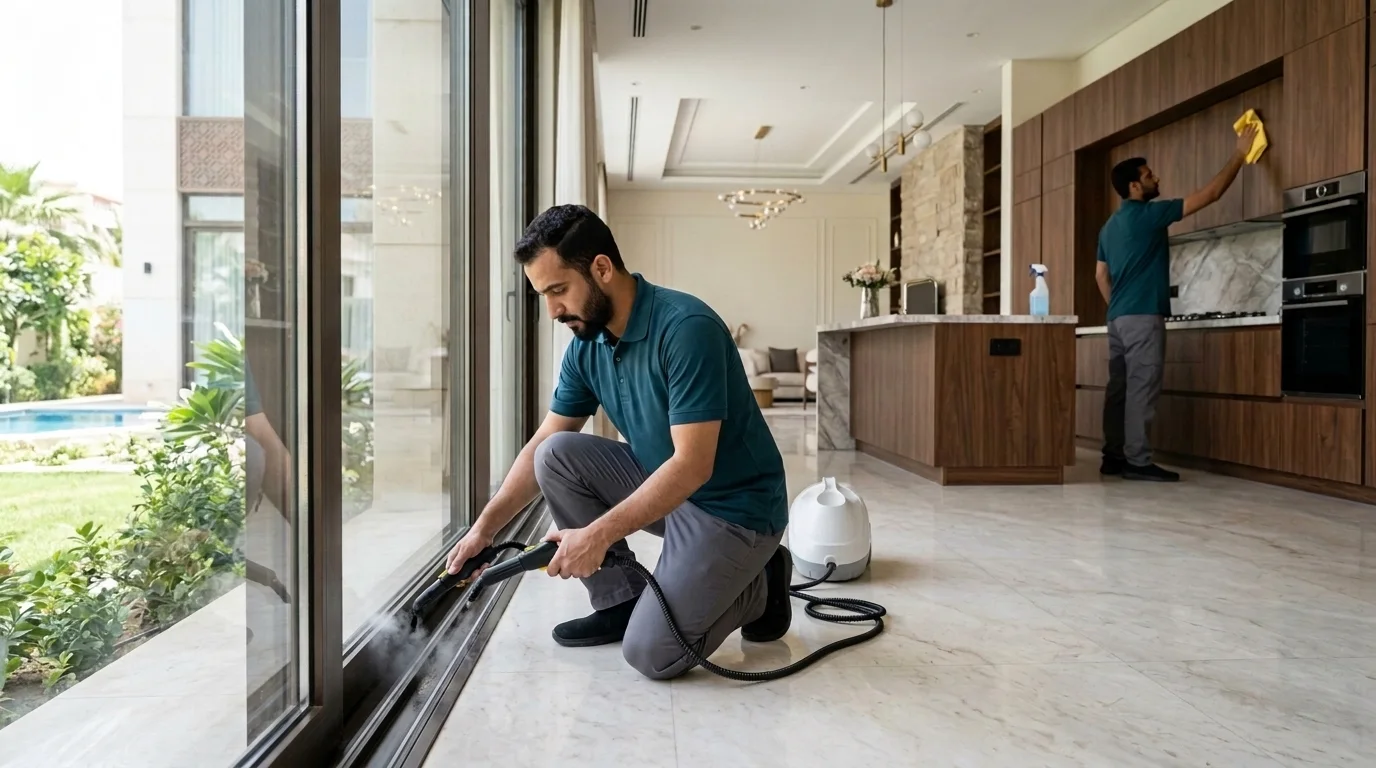
Comprehensive comparison between machine-assisted foundational deep cleaning and regular maintenance cleaning for homes and villas in Jeddah and Makkah

Executive Summary — Key Takeaways in This Guide:

  • Regular Maintenance Cleaning: Focuses on weekly surface hygiene, dusting reachable areas, and standard floor mopping; it does not include heavy hood degreasing, limescale descaling, or wet upholstery extraction.
  • Furnished Home Deep Cleaning: Targets cumulative organic buildup in lived-in homes—covering deep kitchen degreasing, steam bathroom descaling, window track detailing, behind-furniture cleaning, and sofa/carpet/mattress extraction.
  • Vacant Move-In / Turnover Deep Cleaning: Resets an empty apartment or villa after previous occupants by sanitizing inside all cabinets and wardrobes, machine-scrubbing floors, and disinfecting bathrooms and kitchens prior to furniture arrival.
  • Post-Construction Handover Cleaning: Engineered specifically for inorganic contractor residues—removing polymer grout haze, gypsum sanding dust, paint splatters, cured silicone, and sun-baked window frame stickers.
  • The Golden Property Rule: Scheduling foundational deep cleaning while a property is vacant allows unimpeded wall-to-wall rotary floor scrubbing, whereas furnished homes require precision detailing and low-moisture upholstery extraction.
Commercial Decision Matrix

Master Comparison Matrix Across the Three Residential Cleaning Tiers

Compare the exact scope, equipment deployed, and target outcomes across each cleaning tier in Jeddah and Makkah.

Comparison Criterion1. Regular Maintenance Cleaning2. Foundational Deep Cleaning (Furnished/Vacant)3. Post-Construction Handover Cleaning
Primary Objective & Target SoilRemoving daily loose dust, tidying rooms, and wiping exposed surfaces and floors to maintain weekly upkeep.Eliminating cumulative organic grime: baked kitchen grease, bathroom limescale, hidden crevice dust, and deep upholstery stains.Removing inorganic contractor residues: polymer grout haze, gypsum plaster dust, paint splatters, cured silicone, and baked window tapes.
Floor & Grout Joint TreatmentStandard vacuuming and manual mopping with daily floor sanitizer across open walking areas.Mechanical rotary scrubbing, deep brushing of darkened grout lines, and cleaning underneath/behind movable furniture.Industrial HEPA dry vacuuming of gypsum, acid-free removal of grout haze and paint, single-disc scrubbing, and wet-vac extraction.
Kitchen Cabinets, Hoods & AppliancesWiping exposed countertops, cleaning the sink basin, and wiping exterior appliance doors.Degreasing range hoods and filters, sanitizing cabinet interiors/exteriors, deep oven cleaning, behind appliances, and wall steaming.Vacuuming sawdust and plaster from new cabinets, peeling factory protective films, removing silicone smears, and sanitizing surfaces.
Bathrooms & Sanitary FixturesRoutine washing of basin, toilet bowl, mirror, and quick floor rinsing with disinfectant.Descaling hard-water mineral deposits and soap scum from shower glass and mixers, ceiling-to-floor wall scrubbing, and steam drain sanitization.Removing mortar, grout haze, and silicone from new tiles and sanitary ware while protecting chrome/matte fixtures and stainless drains.
Windows, Sliding Tracks & DoorsWiping reachable interior glass panes to remove light surface smudges.Vacuuming and washing mud-packed sliding tracks, washing insect screens, polishing glass, and detailing doors, frames, and hinges.Steam-releasing sun-baked frame stickers, extracting mortar pebbles from tracks, and lubricated safety-blade removal of paint on glass.
Upholstery (Sofas, Carpets & Mattresses)Quick surface pass with a standard household vacuum and cushion straightening.In furnished homes: deep hot-water/low-moisture extraction of sofas, majlis, carpets, and mattresses to remove stains, odors, and dust mites.Property is typically vacant; if furniture was present during renovation, fine gypsum dust is HEPA-extracted followed by deep wet extraction.

Rapid Decision Checklist: Which Cleaning Service Matches Your Property Right Now?

Find the scenario that best describes your apartment or villa today to identify the exact recommended service tier.

Indicator #1Recommended Tier: Vacant Foundational Deep Cleaning

Vacant apartment or villa after previous tenants moved out or upon resale handover (no recent construction)

Root Cause: Accumulated living residues inside cabinets, kitchen grease, bathroom scale, and the need for a full hygienic reset before your furniture arrives.

Book a Vacant Foundational Deep Clean (rotary floor scrubbing, cabinet interior sanitization, kitchen/bathroom reset, window tracks) 2 days before moving in.
Indicator #2Recommended Tier: Furnished Deep Cleaning + Upholstery Extraction

Occupied, furnished home or villa preparing for Ramadan, Eid, Hajj season, or a family gathering

Root Cause: Accumulated dust in window tracks and chandeliers, hospitality stains on sofas and carpets, and kitchen grease beyond daily housekeeping.

Schedule a Furnished Home Deep Clean combining room-by-room detailing, kitchen/bathroom restoration, and on-site sofa and carpet extraction.
Indicator #3Recommended Tier: Post-Construction Handover Cleaning

Brand-new villa/apartment or a property that just completed painting, tiling, or gypsum renovation

Root Cause: Widespread fine gypsum dust, polymer-cement grout haze, paint splatters, silicone smears, and protective tapes on windows and floors.

Book Post-Construction Handover Cleaning exclusively (HEPA dry extraction + acid-free grout/paint removal + rotary scrubbing), as standard cleaning cannot remove cement.
Indicator #4Recommended Tier: Comprehensive Deep Cleaning & Odor Reset

Large villa or apartment left closed and unoccupied for several months (e.g., seasonal residence or post-travel)

Root Cause: Fine dust blankets across all surfaces, stagnant drain traps, and musty humidity odors trapped in upholstery and AC filters.

Execute a top-down HEPA dust extraction, window and track washing, drain trap sanitization, and steam/extraction refreshment of upholstery.
Indicator #5Recommended Tier: Targeted Wet-Area Deep Cleaning

Only the kitchen and bathrooms suffer from heavy grease and limescale while bedrooms are well-maintained

Root Cause: Oxidized cooking grease vapors on cabinets/hoods and hard-water mineral scale on shower glass, mixers, and tile grout.

Deploy targeted steam degreasing and alkaline emulsifiers in the kitchen alongside chrome-safe descaling and grout scrubbing in bathrooms.
Indicator #6Recommended Tier: Regular Maintenance Cleaning

Home recently underwent a deep clean and simply needs routine weekly upkeep and surface freshness

Root Cause: Normal day-to-day living without stubborn upholstery stains, heavy grease buildup, or renovation debris.

Maintain a routine weekly cleaning schedule, supplemented by a professional deep clean every 4 to 6 months.
In-Depth Technical Guide

In-Depth Engineering & Operational Breakdown of Residential Cleaning Tiers

Five detailed modules explaining exactly what happens inside your property during each service tier and how to plan effectively.

Module 1: Module 1: Core Engineering Differences

Why Routine Daily Housekeeping Cannot Replace a "Foundational Deep Cleaning" Cycle

Many homeowners assume that as long as floors are mopped and rooms are tidied daily or weekly, a residence never needs professional deep cleaning. However, the fundamental divide between regular maintenance cleaning and foundational deep cleaning lies in the physics of cumulative, out-of-sight buildup. Routine housekeeping is designed to cover the 80% of open, easily accessible surfaces quickly using manual cloths and light household sprays.

Over months of living in Jeddah’s humid coastal air or Makkah’s dust-prone environment, the remaining 20% of architectural zones accumulate stubborn multi-layered compounds that manual wiping cannot touch: airborne cooking lipids polymerize with fine dust into a sticky resin on top of upper kitchen cabinets and inside exhaust hoods; calcium and magnesium minerals crystallize around faucet bases, shower glass, and tile grout joints; damp dust packs into sliding aluminum window tracks like mud; and microscopic skin cells and allergens settle deep inside sofa foam, carpets, and mattresses.

Foundational deep cleaning acts as a comprehensive hygienic reset. Rather than a single housekeeper wiping visible areas, a specialized multi-technician crew deploys rotary floor scrubbers, pressurized thermal steamers, commercial wet/dry extractors, and surface-specific chemistry (alkaline kitchen degreasers, chrome-safe mineral descalers, and enzymatic upholstery extractors) to strip away months of accumulated biofilm and restore the property from ceiling coves to floor drains.

Core Distinctions: Deep vs. Regular Cleaning

  • Regular cleaning handles loose daily dust, whereas deep cleaning breaks down polymerized grease, mineral scale, and embedded grime.
  • Deep cleaning targets neglected zones: cabinet tops, behind appliances, sliding window tracks, grout lines, and ceiling coves.
  • Foundational cleaning relies on rotary machines, thermal steam, and hydraulic extractors unavailable in routine housekeeping.
  • Scheduling a professional deep clean every 4–6 months makes daily upkeep effortless and extends surface lifespan.
  • Deep cleaning dramatically improves indoor air quality by extracting allergens trapped in upholstery, drapes, and AC vents.
Field Specialist Pro-Tip:

Pro Tip: The most cost-effective strategy for managing a villa or apartment is starting with a Foundational Deep Clean to strip away entrenched buildup, making subsequent weekly maintenance fast and effortless.

Important Safety Caution:

Caution: Booking unequipped hourly labor for a deep-cleaning project usually results in hours of slow manual wiping without the mechanical power needed to degrease hoods, scrub grout lines, or extract sofa stains.

Module 2: Module 2: Furnished vs. Vacant Properties

How Deep Cleaning Protocols Differ Between a "Furnished Occupied Home" and a "Vacant Property"

One of the first diagnostic questions we ask when scoping any residential project in Jeddah or Makkah is: "Is the property currently furnished and occupied, or completely vacant?" Far from an administrative detail, occupancy status reshapes the entire engineering workflow, tool selection, and crew deployment. In a vacant apartment or villa (whether prior to move-in or immediately after a tenant vacates), 100% of floor slabs, baseboards, and cabinet interiors are unobstructed wall-to-wall. This allows technicians to run rotary single-disc scrubbing machines and wet-vacuum extractors across entire rooms and sanitize every shelf and drawer inside empty kitchen cabinets and bedroom wardrobes.

In a furnished, occupied home, the engineering protocol splits into two simultaneous priorities. The first is "asset protection and precision detailing"—protecting wood parquet, electronics, artwork, and personal belongings inside closets by using controlled steam and targeted application rather than flooding floors with water, while carefully shifting movable furniture to vacuum and wash hidden floor zones underneath. The second priority is "textile extraction and sanitization"—deep-cleaning sofas, floor majlis sets, area rugs, curtains, and mattresses, which act as the primary sponges for dust, stains, and odors in lived-in homes.

For this reason, if you are preparing to move into a newly purchased or rented villa or apartment, our golden rule is always to schedule your Foundational Deep Clean while the property is 100% empty—1 to 2 days before the moving trucks arrive. With zero furniture obstructing the rooms, every square centimeter of tile, grout, cabinetry, window tracks, and sanitary ware can be mechanically scrubbed and sanitized without restriction.

Decision Rules: Furnished vs. Vacant Scope

  • Vacant foundational cleaning includes full interior washing and sanitization of all empty kitchen cabinets and bedroom wardrobes.
  • In furnished homes, personal wardrobes and closed storage containing private belongings are only opened upon explicit owner request.
  • Empty properties allow unimpeded wall-to-wall mechanical rotary scrubbing across all hard floor surfaces.
  • Furnished deep cleaning places heavy emphasis on hot-water extraction for sofas, majlis, rugs, and mattresses alongside kitchen degreasing.
  • Cleaning a property before moving boxes and furniture arrive delivers a far more thorough hygienic baseline in less time.
Field Specialist Pro-Tip:

Pro Tip: When moving into a previously rented apartment, ensure your turnover deep clean prioritizes three critical hygiene hotspots: inside kitchen cabinets and hinges, bathroom drain traps and behind toilets, and AC filters/vents.

Important Safety Caution:

Caution: In furnished homes featuring laminated wood parquet or moisture-sensitive vinyl flooring, heavy water flooding must never be used; controlled low-moisture microfiber cleaning is applied to prevent board swelling.

Module 3: Module 3: Kitchen & Bathroom Restoration

Technical Anatomy of Wet-Zone Deep Cleaning: Kitchen Degreasing and Bathroom Descaling

Kitchens and bathrooms serve as the ultimate benchmark of any deep cleaning operation because they endure daily heat, steam, lipid vapors, and mineral water exposure. In the kitchen, airborne cooking oils rise with steam and condense onto cooler surfaces—including range hood baffles, the tops of upper wall cabinets, backsplash tiles, and cabinet hinges. Over weeks and months, these lipid films oxidize and polymerize into a tacky amber varnish that ordinary dish soap and wet cloths merely smear around.

During a professional deep clean, kitchen restoration pairs pressurized thermal steam with cabinet-safe alkaline degreasers (engineered for aluminum, cladding, acrylic, and wood finishes). Range hood filters and burner grates are removed and soaked in degreasing baths; steam nozzles liquefy hardened grease inside tight corners, cabinet hinges, and oven door seals; and heavy appliances (refrigerators and stoves) are pulled forward so hidden floor traps and wall backs can be degreased and sanitized—eliminating the primary food source for kitchen pests.

In bathrooms across Jeddah and Makkah, the core challenge is the combination of hard-water calcium/magnesium salts with fatty acid soap residues, forming stubborn white scale and soap scum across tempered glass shower enclosures, faucet bases, rain-shower nozzles, and tile grout lines. Rather than using corrosive hydrochloric acid that ruins chrome, technicians apply buffered organic descalers (citric/sulfamic formulations safe for plated metals) alongside detailing brushes and high-temperature steam to dissolve mineral deposits, sanitize floor drains, and restore crystal clarity to shower glass.

What Changes in Your Kitchen & Bathrooms After a Deep Clean?

  • Complete removal of polymerized sticky grease from cabinet tops, hood filters, and stove backsplashes.
  • Cleaning and sanitizing hidden floor zones behind and beneath refrigerators, ovens, and washing machines.
  • Dissolving hard-water limescale and soap scum from shower glass and faucets without scratching or burning chrome.
  • Scrubbing and steam-sanitizing bathroom tile grout lines, wall tiles, and floor drain traps.
  • Streak-free polishing of mirrors, ceramic basins, and metallic hardware.
Field Specialist Pro-Tip:

Pro Tip: Once the invisible top ledges of your upper kitchen cabinets have been completely degreased during a deep clean, line those top ledges with replaceable wax paper or clear film to catch future airborne cooking grease effortlessly.

Important Safety Caution:

Caution: Never use coarse metal steel wool on high-gloss acrylic kitchen doors, brushed stainless steel appliances, or shower glass; it creates thousands of micro-scratches that trap future grease and limescale even faster.

Module 4: Module 4: Deep Clean vs. Post-Construction Boundary

When "Deep Cleaning" Is Not Enough and You Must Book "Post-Construction Handover Cleaning"

A frequent misconception occurs when homeowners complete a partial renovation (such as repainting an apartment, retiling bathrooms, or installing new gypsum ceiling coves) or purchase a new developer apartment that was lightly swept by the contractor. Assuming the property only needs a quick wipe, the owner books a standard or regular residential cleaning—only to discover on-site that the surfaces are coated in cured construction compounds that household cleaning tools cannot budge.

The decisive engineering boundary between the two services lies in soil chemistry: "Residential Deep Cleaning" is formulated to break down organic and domestic buildup (cooking lipids, body oils, airborne dust, food spills, and water scale), whereas "Post-Construction Cleaning" is engineered to strip inorganic contractor materials—specifically polymer-modified cement grout haze, hardened gypsum plaster, acrylic and enamel paint overspray, cured silicone sealant, mortar grit inside window tracks, and UV-baked protective frame tapes.

Removing construction residues safely requires specialized post-construction machinery and consumables: industrial fine-dust HEPA extractors (since gypsum powder destroys standard vacuum motors), buffered cement/polymer haze emulsifiers, powder-coat-safe adhesive releasers, lubricated safety scrapers, and weighted single-disc rotary scrubbers. The rule of thumb is simple: if painters, tilers, or plasterers worked inside the space, you need Post-Construction Cleaning—even if the property looks "mostly swept."

Clear Signs You Need Post-Construction Cleaning

  • A chalky white haze reappearing on porcelain tiles minutes after mopping with water.
  • Paint splatters or overspray dots along floor skirting boards, electrical switches, door frames, or window glass.
  • Talcum-fine white gypsum sanding powder settled inside ceiling coves, corners, and sliding tracks.
  • Factory protective tapes and stickers still attached to aluminum window profiles, doors, or new bathroom fixtures.
  • Hardened mortar, grout blobs, or silicone smears around new floor drains and tile joints.
Field Specialist Pro-Tip:

Pro Tip: When booking, send 3 to 4 quick photos of your floors, window frames, and bathrooms via WhatsApp; our technical supervisor will immediately confirm whether your property qualifies for standard deep cleaning or requires post-construction equipment.

Important Safety Caution:

Caution: Attempting to scrub away paint splatters, polymer grout haze, and gypsum plaster using regular household tools not only fails to remove the residue, but frequently scratches surfaces and spreads cloudy film.

Module 5: Module 5: Villa vs. Apartment Planning

How Crew Deployment and Workflow Differ Between Multi-Story Villas and Residential Apartments

Operational planning for standalone and duplex villas in Jeddah and Makkah differs significantly from single-level apartment cleaning—not merely due to square footage, but because villas encompass architectural zones that demand specialized equipment. A typical villa includes a rooftop annex and terrace, an upper bedroom floor, a ground-floor formal reception and majlis wing, both a show kitchen and heavy-duty fry kitchen, a multi-flight central staircase with glass or wrought-iron balustrades, high exterior windows, outdoor courtyards, driver/maid quarters, and underground/overhead water tanks.

To execute a full villa reset without cross-contaminating already cleaned zones, our crews follow a strict "Top-Down and Inside-Out Workflow." Operations begin on the rooftop annex and upper floor bedrooms/bathrooms, progress downward to the ground-floor reception halls, majlis sets, and kitchens, continue down the central marble or porcelain staircase, and conclude with high-pressure washing and scrubbing of exterior courtyards, walkways, and entrance steps.

In residential apartments, operational focus shifts toward compact efficiency, same-day turnaround, and strict moisture containment so zero water seeps into shared building corridors or neighboring units. The apartment is zoned into dedicated work sectors (bedrooms/storage, living/majlis, and kitchen/bathrooms) with technicians assigned to parallel tasks—delivering the entire apartment sanitized, dry, and ready for occupancy within a single coordinated visit.

Keys to Successful Property Cleaning Planning

  • In multi-story villas, work strictly flows from the rooftop annex down through upper bedrooms, ground halls, staircases, and finally outdoor courtyards.
  • Villas with both a show kitchen and heavy fry kitchen require dedicated degreasing allocation for the main cooking space.
  • When moving into a villa, sanitizing the underground water tank first ensures clean water flows through pipes during interior washing.
  • In apartment buildings, immediate wet-vacuum recovery prevents water pooling or seepage into shared hallways and elevators.
  • Accurately specifying property status (vacant, furnished, or post-construction) when booking ensures the right crew size and machines arrive on day one.
Field Specialist Pro-Tip:

Pro Tip: When preparing a full villa before move-in or Ramadan, schedule AC coil cleaning (and water tank sanitization) first, followed immediately by interior deep cleaning and upholstery extraction—so AC servicing never drops dust onto freshly cleaned sofas.

Important Safety Caution:

Caution: Always verify that electricity, running water, and adequate lighting are active inside a vacant property on cleaning day; rotary scrubbers, HEPA extractors, and steam units require live power and water to operate.

Hyperlocal City Adaptation

Seasonal & Environmental Adaptation for Cleaning Services in Jeddah & Makkah

How regional climate patterns and religious/social seasons in Jeddah and Makkah dictate the timing and scope of residential cleaning.

Jeddah GovernorateJeddah Sectors Hub

Jeddah Context: Coastal Humidity, Family Apartments, and Modern Villas

Residential life in Jeddah is dynamic year-round, spanning contemporary ownership apartments, coastal duplex villas in northern districts, and spacious family residences. Because of Jeddah’s humid Red Sea climate, moisture-laden airborne dust adheres stubbornly to window screens, sliding tracks, glass facades, and AC vents, while accelerating sticky grease film buildup across the open-plan kitchens popular in modern Jeddah layouts.

Consequently, demand for professional cleaning in Jeddah peaks across three primary scenarios: handover of new ownership apartments and villas, tenant turnover moves, and pre-Ramadan/Eid or post-summer travel resets. Our Jeddah deep cleaning protocol emphasizes stripping humid grime from windows and open kitchens, descaling bathrooms, and performing fast-drying upholstery extraction engineered for coastal humidity.

  • North Coastal Jeddah (Obhur, Al-Shati, Al-Murjan, Al-Basateen, Al-Mohammadiyah): Modern villas and duplexes with large glass facades and open kitchens requiring full-villa deep cleaning and delicate stone/linen care.
  • Central Jeddah (Al-Rawdah, Al-Zahra, Al-Salamah, Al-Khalidiyah, Al-Naeem): High-density occupied family apartments frequently booking furnished deep cleaning (kitchens, bathrooms, and sofa/carpet extraction) ahead of seasons.
  • East Jeddah (Al-Hamdaniyah, Al-Samer, Al-Manar, Al-Tayseer, Al-Falah): Active move-in and handover corridor requiring vacant foundational cleaning or post-construction scrubbing with heavy desert dust extraction.
  • South Jeddah (Al-Ajaweed, Al-Sanabel, Prince Fawaz, Al-Khumrah): Large family homes and villas with expansive majlis rooms and courtyards requiring multi-floor foundational resets.

Makkah Context: Ramadan & Hajj Seasons, Majlis Hospitality, and Seasonal Turnovers

Residential care across Makkah is deeply intertwined with the blessed seasonal calendar—most notably preparations ahead of Ramadan, Eid Al-Fitr, and the Hajj and Umrah pilgrimage seasons. Prior to these milestones, Makkah families prioritize a comprehensive Foundational Deep Clean across reception majlis rooms, bedrooms, and kitchens to welcome guests and pilgrims in pristine comfort, followed by post-season restorative cleaning and upholstery extraction after intensive hosting.

Additionally, Makkah neighborhoods experience high demand for rapid, hygienic apartment turnovers before and after seasonal occupancy, alongside continuous new villa construction in expanding residential districts. Our Makkah teams are structured to deliver occupied family home deep cleaning, rapid vacant/furnished unit turnover sanitization, and full post-construction villa handover.

  • Southern & Western Makkah (Al-Shawqiyyah, Al-Kakiyyah, Batha Quraish, Wali Al-Ahd): Spacious family apartments and villas frequently booking pre-Ramadan furnished deep cleaning, majlis extraction, and new unit handovers.
  • Eastern Makkah (Al-Awali, Al-Naseem, Al-Shara’i, Al-Rashidiyah): Large multi-story villas requiring comprehensive villa cleaning packages covering marble foyers, multiple majlis halls, kitchens, and courtyards.
  • Central Makkah & Al-Aziziyah (Al-Aziziyah, Al-Khalidiyah, Al-Zahir, Al-Rusaifah): Intensive demand for deep sanitization and turnover cleaning of residential apartments before and after Ramadan and Hajj seasons.
  • Northern Makkah (Al-Taneem, Al-Nawariyah, Al-Umrah, Al-Buhairat): Villas and apartments exposed to mountain dust requiring deep window-track, floor, and upholstery restoration or post-construction care.
Illustrative Service Scenario — For Educational Reference

Selecting and Executing the Right Protocol for a 5-Room Apartment After Tenant Turnover Prior to Family Move-In

Property Context & Initial Challenge:

A vacant 5-room residential apartment with a living hall, fitted kitchen cabinetry, and 3 bathrooms; previously occupied by a tenant for 3 years, with 2 bedrooms freshly repainted by the new owner ahead of moving family furniture in within 48 hours.

The owner was unsure whether to book basic hourly cleaning or full post-construction cleaning. Assessment revealed a hybrid condition: heavy 3-year domestic buildup (polymerized grease inside kitchen cabinets and range hood, plus thick limescale in all 3 bathrooms) combined with fresh paint splatters in just the 2 repainted bedrooms.

Outcome & Long-Term Prevention:

Accurate tier selection saved the owner unnecessary expense while delivering a complete hygienic reset: kitchen cabinets and bathrooms were restored free of any previous tenant trace, paint splatters were eliminated, and the family moved their furniture into a spotless apartment the next day.

Diagnostic Inspection Findings:

  • Standard hourly housekeeping would fail to strip the 3-year polymerized grease inside the kitchen cabinets, the bathroom mineral scale, or the bedroom paint splatters.
  • Because the floors had no new cement grout haze or widespread gypsum plaster, full post-construction pricing was unnecessary; the optimal fit was a "Vacant Foundational Deep Clean" with targeted paint-spot detailing in the two repainted rooms.
  • Sliding aluminum window tracks across all rooms were packed with hardened mud, and bathroom drain traps emitted stagnant odors.
  • Performing the work while the apartment was 100% vacant allowed unrestricted rotary floor scrubbing and full interior cabinet sanitization before furniture arrived.

Technical Protocol Applied:

  • Step 1 (Windows & Repainted Rooms): Vacuuming and washing all sliding window tracks and screens, and safely lifting paint splatters from the two repainted bedrooms using lubricated low-angle blades.
  • Step 2 (Full Kitchen Reset): Soaking hood filters and steam-degreasing the interiors, shelves, hinges, and exteriors of all kitchen cabinets and backsplash tiles, followed by food-safe sanitization.
  • Step 3 (Bathroom Descaling): Applying chrome-safe organic descalers to dissolve mineral scale on mixers and shower glass, scrubbing walls and grout lines ceiling-to-floor, and steam-sanitizing floor drains.
  • Step 4 (Rotary Floor Scrubbing & Handover): Scrubbing all vacant room floors wall-to-wall with a single-disc rotary machine, extracting slurry with a wet vacuum, and detailing doors and switches prior to furniture arrival.
Safe Decision Boundaries

When Routine Home Care Is Enough vs. When to Book Professional Deep Cleaning

A clear decision framework to help you choose the right approach based on your home’s condition and timeline.

Tasks Successfully Covered by Routine Household Maintenance

  • Daily or weekly vacuuming and damp mopping of open floor areas across living rooms, bedrooms, and hallways.
  • Wiping dining tables, kitchen countertops, and stove surfaces immediately after daily meal preparation.
  • Making beds, straightening sofa cushions, and dusting reachable low furniture and tabletops.
  • Quick daily rinsing of bathroom basins and toilets with mild disinfectant and replacing towels.
  • Blotting minor fresh spills immediately upon occurrence before they dry or penetrate porous surfaces.

Triggers That Warrant Calling a Professional Deep or Foundational Cleaning Crew

  • Before moving into a newly purchased or rented apartment or villa (ideally while vacant prior to furniture delivery) for a 100% hygienic reset.
  • Accumulation of sticky amber grease across kitchen cabinets and range hoods, or heavy limescale and darkened grout in bathrooms.
  • Preparing the home and reception majlis ahead of major seasons in Jeddah and Makkah (Ramadan, Eid, Hajj) or recovering after large events.
  • Visible stains, damp odors, or embedded dust inside sofas, floor majlis, carpets, and mattresses requiring hot-water extraction.
  • Re-opening a villa or apartment after extended travel closure, or following any painting, maintenance, or renovation work.

Transparent Scope Note: Foundational deep cleaning restores surfaces, kitchens, bathrooms, and upholstery to peak hygienic cleanliness, but does not include structural repair trades (such as regrouting missing mortar joints, repainting peeling walls, or mechanical diamond grinding of acid-etched marble), which are scoped separately when needed.

Frequently Asked Questions

Frequently Asked Questions About Deep Cleaning vs. Regular & Post-Construction Cleaning

Clear answers to help you book the exact cleaning tier your property needs in Jeddah or Makkah.

Is it better to schedule deep cleaning for a new apartment before moving furniture in or after unpacking?+

It is always significantly better to perform foundational deep cleaning while the apartment is 100% vacant—1 to 2 days before furniture arrives. Empty rooms and cabinets allow unimpeded wall-to-wall rotary floor scrubbing and full interior sanitization of every shelf and drawer.

Does deep cleaning for a furnished home include washing sofas, carpets, and curtains?+

In furnished homes, on-site hot-water extraction for sofas, majlis sets, carpets, and mattresses can be integrated directly into your comprehensive deep cleaning package so both hard surfaces and textiles are restored in a single coordinated visit.

How long does a foundational deep cleaning take for an apartment or villa in Jeddah and Makkah?+

Duration depends on property size and condition, but because we deploy a full multi-technician crew with commercial equipment, a standard apartment typically takes 5 to 8 hours (same-day completion), while a large multi-story villa takes a full 8 to 10 hour day.

Does the deep cleaning crew bring all machinery and cleaning solutions, or must the homeowner provide them?+

For all deep, foundational, and post-construction cleaning services, our crew brings all commercial machinery (rotary scrubbers, wet/dry HEPA vacuums, steamers, and upholstery extractors), specialty chemicals, microfiber cloths, and ladders; you only need active electricity and water on-site.

I just rented an apartment after a previous tenant—should I book deep cleaning or post-construction cleaning?+

If no new tiling or plastering took place, the right choice is "Vacant Foundational Deep Cleaning," which strips previous tenant kitchen grease, bathroom scale, and sanitizes inside all cabinets. If the apartment was freshly repainted leaving paint splatters on skirting and floors, we integrate paint-detailing into the scope.

Do we need to vacate our furnished home while the crew performs deep cleaning?+

You do not need to leave your home. Our crew works in sequential zones (for example, completing the reception majlis and kitchen while the family stays in the inner rooms, then switching), and all solutions used in occupied homes are fume-free and completely acid-free.

How often should an occupied home in Jeddah or Makkah undergo professional deep cleaning?+

Given Jeddah’s coastal humidity and Makkah’s seasonal hospitality and dust patterns, we recommend scheduling a professional deep clean every 4 to 6 months—typically once ahead of Ramadan and once after the summer/Hajj season—to maintain hygiene and protect finishes.

Unified Service Request Builder

Share Your Request Details for Scheduling & Transparent Pricing

Enter your basic contact details, select your city (Jeddah or Makkah), and choose the service you need. This form organizes your inquiry for immediate coordination.

We respect your privacy. Your information is used strictly to respond to your service inquiry.
CallWhatsAppGet Quote