
Serving Jeddah & Makkah
Technical Decision & Floor Textile Restoration Guide — Jeddah & Makkah15 min technical comparison & decision readJeddah & Makkah

Heavily Soiled Carpet, Area Rug & Moquette Restoration: The Complete Deep Extraction & Fiber Protection Guide

Why pouring water and shampoo over dusty carpets creates deep mud residue, crunchy fibers, and musty odors. Compare professional cleaning technologies and learn how high-suction extraction restores rugs and fitted moquette safely.

Area rugs, patterned oriental carpets, and wall-to-wall fitted moquette form the visual and acoustic foundation of reception majlises, living rooms, and hallways across Jeddah and Makkah. Yet the combination of warm Arabian hospitality—bringing inevitable spills of cardamom-and-saffron Arabic coffee, sweetened tea, juices, and food oils—and an unseen environmental culprit, ultra-fine desert silica dust, places floor textiles under relentless stress. Over months of foot traffic, microscopic sand grains sink deep to the structural backing of the carpet, abrading fiber roots and dulling vibrant colors into matted gray traffic lanes.

When homeowners attempt to restore heavily soiled carpets—either through DIY scrubbing or by hiring unequipped crews that flood the pile with soapy shampoo and a rotary brush without industrial vacuum extraction—the outcome is often worse than the original dirt. Pouring water directly onto embedded dry sand turns the base of the carpet into a layer of wet mud. Without high-suction rinsing, heavy soap residues dry into a sticky, crunchy crust that attracts new dirt within days, while trapped moisture soaking into the sub-carpet padding breeds pungent mildew odors in Jeddah’s humid coastal air.

This commercial decision and technical comparison guide equips you with the textile engineering knowledge needed to choose the right restoration method for every carpet type in your property. We detail why dry particulate extraction must precede any moisture, compare deep hot-water extraction against low-moisture encapsulation and surface shampooing, explain dye-fastness testing on multi-colored rugs, and show how to eliminate capillary stain wicking and sub-carpet dampness permanently.

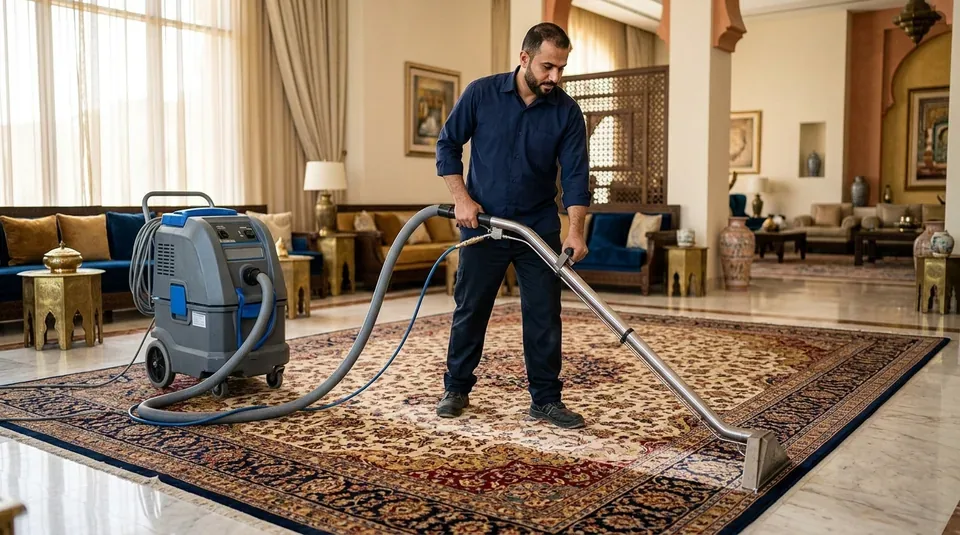
Specialized technician operating professional deep extraction equipment to clean carpets and rugs in Jeddah and Makkah

Executive Summary — Key Takeaways in This Guide:

  • The dry-soil first rule: Never apply water or foam before thorough industrial dry vacuuming; wetting embedded desert sand at the base of the pile instantly creates unextractable mud.
  • Superiority of deep extraction: Dual-stage hot water extraction flushes and immediately vacuums out suspended soil and detergent, leaving fibers soft, residue-free, and nearly dry.
  • Solving recurring stains (wicking): Stains that vanish during washing only to reappear 48 hours later are caused by unextracted liquid trapped in the backing migrating upward during evaporation.
  • Mandatory dye-fastness testing: Patterned oriental, wool, and viscose rugs require hidden spot testing and neutral-pH buffering to prevent dark red and blue dyes from bleeding into light borders.
  • Fitted moquette moisture control: Wall-to-wall carpet installed over tile or underlayment demands high-lift vacuum extraction and accelerated airflow drying to prevent sub-surface mildew in humid climates.
Commercial Decision Matrix

Commercial Decision Matrix: Comparing Carpet & Moquette Cleaning Technologies

An objective engineering comparison across the three primary cleaning methods to help you select the safest, deepest restoration approach

Technical CriterionDeep Hot Water Extraction (Rinse & Vacuum)Low-Moisture Foam EncapsulationTraditional Rotary Shampoo (No Extraction)
Removal of Deep Basal Sand & Embedded SoilSuperior — Flushes fiber roots and immediately extracts suspended mud and grit into the recovery tankModerate — Cleans the upper third of the pile effectively but cannot lift heavy deep-seated basal sludgePoor — Scrubs surface dirt around while pushing dissolved mud and soap deeper into the carpet backing
Post-Drying Fiber Texture (Softness vs. Stiffness)Leaves pile soft, resilient, and fluffy because fresh-water rinsing extracts all chemical detergent residuesAcceptable — Polymer crystals encapsulate soil for subsequent dry vacuuming with minimal stiffnessCrunchy and stiff — Unrinsed shampoo dries onto fibers like glue, attracting fresh walk-on dirt rapidly
Drying Time & Risk of Musty Mildew OdorsFast, safe drying (3–6 hours) because high-lift vacuum motors extract up to 90% of moisture immediatelyVery fast drying (1–2 hours) due to minimal liquid moisture introductionExtremely slow drying (24–48+ hours) with a severe risk of sub-carpet backing rot and sour mildew smells
Effectiveness Against Arabic Coffee, Food Oils & SpillsVery High — Combines targeted spot emulsification with deep flushing and vacuuming to prevent stain wickingLimited on deep spills — Handles light surface traffic well but cannot extract liquids soaked into the backingSpreads stains — Circular scrubbing without suction widens the spill diameter and triggers post-dry wicking
Safety on Patterned Oriental Rugs & Delicate FibersCompletely safe when calibrated with neutral-pH rinse agents and gentle wand strokes without harsh rotary abrasionSafe and well-suited for moisture-sensitive viscose or delicate decorative rugs needing light maintenanceHigh Risk — Aggressive rotary bristles and alkaline soaps cause dye bleeding and fuzzy pile distortion
Ideal Recommended Application in Jeddah & MakkahPrimary choice for heavily soiled rugs, family room moquette, deep stain/odor removal, and hygienic restorationQuick interim maintenance for lightly soiled office corridors or moisture-sensitive specialty fibersNot recommended for indoor wall-to-wall fitted moquette or fine residential area rugs

6-Point Carpet & Moquette Diagnostic Checklist: Identifying Fiber & Sub-Surface Issues

Match the visible or sensory symptom on your rug or fitted carpet to its physical cause and proper engineering cure

Indicator #1Moderate to High — Accelerates fiber wear and rapid re-soiling

Carpet fibers feel stiff, sticky, or crunchy underfoot and turn gray again days after being washed

Root Cause: Unextracted alkaline soap and shampoo residue dried onto the fibers, acting like sticky flypaper that grabs walk-on dust instantly

Perform a deep neutralizing fresh-water extraction rinse to strip away hardened soap film and restore natural fiber softness
Indicator #2High — Surface scrubbing only pushes the stain up and down repeatedly

A coffee or soda stain disappears during cleaning, only to reappear in the exact same spot 24 to 48 hours after drying

Root Cause: Capillary wicking: liquid trapped deep in the carpet backing and underlayment migrated upward to the fiber tips as moisture evaporated

Apply targeted deep-spot flushing followed by high-lift subsurface vacuum extraction and rapid air-mover drying
Indicator #3Critical Hygiene Risk — Fouls indoor air and degrades carpet backing glue

A heavy, sour mildew or wet-sock odor filling the room after wall-to-wall fitted moquette gets wet or washed

Root Cause: Excess water saturating the sub-carpet foam pad or adhesive over non-porous tile without adequate extraction, triggering microbial growth

Extract trapped water with industrial vacuum turbines, apply antimicrobial and enzymatic odor treatment, and run dehumidifying airflow
Indicator #4High — Sharp silica grit saws through basal carpet fibers under foot traffic

Endless muddy brown water coming out of the rug during washing, or fine sand puffing up when the rug is stepped on

Root Cause: Kilograms of fine desert silica sand settled at the base of the rug knots turning into heavy liquid mud upon contact with water

Perform intensive multi-pass industrial dry vacuuming and pile agitation to extract dry sand before any wet extraction begins
Indicator #5Critically Damaging — Can permanently ruin fine patterned rugs

Dark red, burgundy, or navy blue dyes bleeding into adjacent cream or white patterns and fringes on a decorative rug

Root Cause: Applying high-pH alkaline cleaners or excessive heat to unstable dyes without prior colorfastness testing and acid-dye stabilization

Always conduct pre-wash dye-fastness testing, use buffered neutral-pH solutions at controlled temperatures, and dry flat rapidly
Indicator #6Moderate — Creates unsightly contrast against clean perimeter areas

Crushed, matted gray traffic pathways down the center of hallways and living rooms that still look dark after basic cleaning

Root Cause: Oily soils from bare feet and household aerosols bonding to fibers alongside mechanical pile crushing and micro-abrasion

Apply a specialized traffic-lane pre-conditioner with pile-lifting agitation prior to hot water rinse extraction
In-Depth Technical Guide

Applied Textile Cleaning Engineering: 5 Deep Modules on Carpet & Rug Restoration

An in-depth breakdown of desert sand physics, stain chemistry, extraction mechanics, and moisture control in Jeddah and Makkah homes

Module 1: Module 1: Desert Sand Physics in Carpet Pile

Why Wet-Washing Over Dry Desert Sand Creates Deep Basal Mud—And Why Dry Extraction Must Come First

In the environmental conditions of Jeddah and Makkah, ultra-fine windblown desert sand and mineral silt account for 75% to 80% of the total dry weight of soil trapped inside residential carpets and area rugs. Unlike surface crumbs or lint, these microscopic silica particles filter downward under the vibration of daily foot traffic, settling tightly at the very base of the carpet tufts against the primary structural backing. Because desert quartz grains have sharp, angular edges under magnification, embedded basal sand acts like microscopic sandpaper—sawing against fiber roots every time someone walks across the rug.

The single greatest technical blunder in amateur carpet washing is pouring water and detergent directly onto a carpet without first extracting this dry particulate reservoir. The moment liquid water hits dry silt and clay packed at the bottom of the pile, it hydrates into heavy, sticky mud that bonds tenaciously to the backing yarns. Once converted into wet mud, the soil becomes dramatically heavier and resists complete removal; when the carpet eventually dries, this basal mud cake cracks into dusty powder and wicks dirty brown discoloration back up the fibers.

Consequently, our professional restoration protocol always begins with thorough dry particulate extraction before a single drop of moisture touches the textile. High-airflow industrial vacuums paired with pile-lifting agitation open up matted tufts and extract dry sand, dust mites, hair, and lint while they are still light and loose. By removing up to 80% of dry insoluble soil upfront, the subsequent wet extraction phase only has to dissolve and flush away oily films and liquid spills—delivering true root-to-tip cleanliness.

Core Rules for Managing Desert Sand in Carpets

  • Nearly 80% of carpet soil in Jeddah and Makkah consists of dry desert sand and fine silt settled deep at the backing.
  • Wetting an unvacuumed rug immediately turns loose dry sand into heavy basal mud that resists extraction.
  • Intensive industrial dry vacuuming before wet cleaning is mandatory to prevent mud formation.
  • Unremoved silica grit at the base of the pile mechanically cuts and abrades fibers under foot traffic.
  • Pre-vacuum pile brushing opens dense tufts so dry sand grains can be lifted out effortlessly.
Field Specialist Pro-Tip:

Home Care Tip: When vacuuming thick area rugs at home, push and pull the vacuum head slowly in two perpendicular directions (north-south, then east-west); rapid strokes skim the surface without giving suction time to lift deep sand.

Important Safety Caution:

Preservation Warning: Violently beating aging or hand-knotted rugs over hard balcony rails can snap brittle cotton warp and weft foundation threads; controlled suction and gentle vibration are far safer.

Module 2: Module 2: Extraction vs. Shampooing Mechanics

Why Dual-Stage Hot Water Extraction Outperforms Traditional Rotary Shampooing

To understand why professionally restored carpets remain soft and stay clean for months—while carpets washed by basic shampoo crews turn stiff and re-soil within weeks—we must examine the physics of soil removal. Traditional rotary shampooing floods the carpet with high-foaming detergent and spins a circular brush across the surface. While the thick white foam looks impressive during the process, brushing without simultaneous vacuum extraction simply redistributes emulsified dirt and soap throughout the pile without actually removing the contaminated liquid from the room.

As a shampooed carpet dries by evaporation, the water turns to vapor while all the dissolved detergent solids and suspended soil remain behind, drying into a microscopic sticky film wrapped around every yarn. This soap residue causes two immediate defects: it makes the carpet pile feel stiff and crunchy underfoot, and it acts as a soil magnet that binds fresh dust from shoes and bare feet—causing traffic lanes to turn dark gray faster than before the wash.

In contrast, professional Hot Water Extraction (often referred to as steam/rinse extraction) separates soil suspension from rinse recovery—just like a modern washing machine rinses clothes with clean water before spinning them dry. First, a targeted pre-conditioning solution is misted onto the fibers to break the molecular bond between oils, spills, and carpet yarns. Next, the extraction wand injects a controlled pressurized rinse solution deep into the pile while powerful dual/triple vacuum turbines instantaneously extract the water, dissolved dirt, and cleaning agents into a sealed recovery tank—leaving fibers genuinely rinsed, residue-free, and soft.

Engineering Advantages of Deep Rinse Extraction

  • Scrubbing without extraction leaves dissolved dirt and soap inside the rug; rinse extraction physically removes them.
  • Using a neutralizing rinse agent strips away alkaline detergent films, restoring natural fiber softness and sheen.
  • High-lift vacuum recovery extracts moisture from the base of the pile, eliminating dampness and mildew risks.
  • Residue-free fibers resist rapid re-soiling, keeping high-traffic majlis and living room carpets clean far longer.
  • Calibrated spray pressure cleans the textile fibers thoroughly without over-wetting the underlying floor or pad.
Field Specialist Pro-Tip:

Quality Check: You can see the proof of true extraction in the machine’s recovery tank—proper rinsing continues until the extracted water transitions from dark muddy brown to clear.

Important Safety Caution:

Technical Clarification: While commonly called "steam cleaning," true professional machines use heated water extraction rather than 100°C live vapor steam, which could shrink natural wool, melt synthetic olefin/polypropylene tips, or permanently set protein stains.

Module 3: Module 3: Stain Chemistry & Capillary Wicking

Chemistry of Removing Arabic Coffee, Saffron & Oil Stains—And Preventing Post-Dry Stain Wicking

Household spills in Jeddah and Makkah reception rooms present complex chemical profiles that cannot be solved with a single generic soap. Traditional Arabic coffee combines natural coffee tannins with yellow-orange saffron carotenoids and cardamom essential oils; sweetened red tea and fruit juices contain synthetic food dyes and sticky sugars; while dining spills introduce hydrophobic fats and grease that repel plain water.

Rubbing these diverse stains with generic household bleach or harsh alkaline degreasers either sets the stain permanently into the fiber dye sites or strips the carpet’s original color into an irreversible pale blotch. Professional spot restoration applies targeted chemistry prior to general extraction: non-volatile solvent spotters emulsify heavy grease and oils; buffered tannin reducers gently release Arabic coffee, saffron, and tea discoloration without chlorine; and bio-enzymatic digesters break down protein and organic spills (such as milk, infant accidents, or pet urine) at the molecular level.

Equally critical is preventing the frustrating phenomenon known in textile science as "capillary wicking"—where a dark spill vanishes completely during cleaning, only to reappear in the exact same spot 24 to 48 hours later. When a liquid cup spills onto a carpet, only a small circle shows on top while gravity pulls the bulk of the liquid into a wider pool deep inside the backing and underlayment. If a cleaner only washes the surface tips and leaves moisture in the backing, evaporation draws that deep, dirty liquid upward through the fibers like oil rising up a candle wick, depositing the brown stain right back on the tips once dry. We prevent wicking by performing deep subsurface vacuum extraction directly over spill zones and accelerating surface evaporation.

Keys to Permanent Stain Removal & Wicking Prevention

  • Targeted spot chemistry matches the spill: emulsifiers for grease, tannin reducers for coffee/tea, and enzymes for organic odors.
  • Chlorine bleach must never be applied to carpets, as it permanently destroys fiber dye bonds and weakens yarn structure.
  • Stains reappearing 48 hours post-wash (wicking) happen when deep backing reservoirs are left unextracted during cleaning.
  • Blotting fresh spills immediately with a white towel prevents backing saturation, whereas circular rubbing spreads the stain.
  • Deep subsurface vacuum extraction combined with rapid airflow drying stops capillary wicking completely.
Field Specialist Pro-Tip:

First-Aid for Arabic Coffee Spills: Never scrub a fresh coffee spill! Immediately press a folded white cotton towel firmly over the spot to absorb the liquid before it sinks into the backing, mist lightly with plain water, and blot again.

Important Safety Caution:

Honest Technical Expectation: Stains that were previously treated with household bleach, ironed with heat, or left for many months to chemically dye light fibers (such as concentrated saffron or artificial red dyes) will be hygienically cleaned, though a faint permanent tint shift may remain if the yarn itself was dyed.

Module 4: Module 4: Dye-Fastness & Delicate Rug Care

Protecting Patterned Oriental, Wool & Viscose Rugs from Dye Bleeding and Fringe Damage

Homes across Jeddah and Makkah feature a wide spectrum of area rugs—ranging from durable synthetic polypropylene and heat-set polyester pieces to densely knotted Turkish and Persian-style patterned rugs, natural wool carpets, and high-sheen viscose (art silk) accent rugs. Treating every rug with the same high-alkaline detergent, water temperature, and brush stiffness is a recipe for textile damage.

The primary threat to multi-colored patterned rugs and natural wool is dye bleeding (color migration). Dark acid dyes—particularly deep crimson, burgundy, and navy blue—become chemically unstable when exposed to high-pH alkaline cleaners or excessive heat, bleeding into adjacent ivory medallions and staining white cotton fringes pink. Meanwhile, cellulosic viscose fibers lose up to 50% of their tensile strength when wet and can suffer permanent pile distortion, cellulose browning, or texture loss if scrubbed aggressively.

Our fiber-protection protocol begins with mandatory pre-wash identification and dye-fastness testing. Before any overall moisture is applied to a patterned or specialty rug, technicians test each dominant dark dye color in an inconspicuous spot using a white transfer cloth. For wool and dye-sensitive pieces, we utilize pH-buffered, neutral-to-slightly-acidic cleaning solutions that lock dye molecules firmly inside the fiber cortex, employ gentle non-rotary extraction strokes, clean fringes separately, and ensure flat, rapid airflow drying so colors remain crisp and distinct.

Safety Controls for Patterned & Delicate Rugs

  • Pre-wash dye-fastness spot testing is mandatory on all multi-colored patterned rugs prior to wet cleaning.
  • pH control is paramount: neutral and acid-buffered solutions stabilize wool and dark dyes against bleeding.
  • Viscose and delicate pile rugs are cleaned with low-moisture, gentle extraction strokes without stiff rotary brushes.
  • White cotton fringes receive isolated detailing and rapid drying so body dyes cannot migrate into the tassels.
  • Patterned rugs must never be rolled or folded while damp, as wet-on-wet contact causes color transfer.
Field Specialist Pro-Tip:

Rug Longevity Tip: Rotate your area rugs 180 degrees every 6 months in sunny rooms or busy majlises to distribute foot traffic wear and UV light exposure evenly across the entire piece.

Important Safety Caution:

Chemical Warning: Never use laundry powder or concentrated dish soap on wool or patterned rugs; their high alkalinity strips natural wool lanolin and unlocks unstable red and blue dyes.

Module 5: Module 5: Fitted Moquette & Sub-Carpet Drying

Cleaning Wall-to-Wall Fitted Moquette In-Place: Engineering Fast Drying Without Sub-Carpet Mildew

Wall-to-wall fitted moquette—widely installed across bedrooms, large family majlises, corporate offices, and prayer halls in Jeddah and Makkah—presents a unique physical challenge compared to loose area rugs. Because fitted moquette is stretched or glued directly over non-porous ceramic tile, porcelain, or concrete slabs (often over a thick foam or felt underlayment pad), any excess water that penetrates past the carpet backing hits an impermeable floor barrier with zero downward drainage.

In Jeddah’s high ambient humidity or inside closed rooms, flooding wall-to-wall moquette leaves liters of water trapped inside the dark, warm underlayment layer. Whenever carpet backing remains wet for more than 24 hours, dormant fungal spores and bacteria multiply rapidly, producing a sour, pervasive "wet-dog" or mildew smell that saturates the entire room, weakens latex backing adhesives, and causes seam curling.

To eliminate this risk completely, our in-place fitted moquette cleaning protocol enforces strict moisture-depth control and accelerated psychrometric drying. First, extraction spray pressure and wand speed are calibrated so flushing penetrates the fiber pile without drenching the sub-carpet foam pad. Second, technicians execute multiple dry-stroke vacuum passes over every section—using maximum vacuum lift with the water trigger released to pull up to 90% of moisture out of the textile. Third, we leverage high-velocity air circulation and recommend running room split ACs on cooling/dry mode immediately post-service, achieving bone-dry, odor-free moquette within just 3 to 6 hours.

Strict Rules for Safe Fitted Moquette Cleaning

  • Because fitted moquette sits over non-porous tile, moisture must be confined to the pile and never flood the underlayment.
  • Executing extra vacuum-only dry passes after rinsing extracts the vast majority of water before the crew leaves.
  • Target drying time for indoor fitted moquette is 3 to 6 hours to completely prevent microbial mildew growth.
  • Running the room’s AC on cooling or dehumidify mode post-cleaning rapidly pulls evaporating moisture out of the room air.
  • Avoid walking with outdoor shoes or placing unshielded wooden/metal furniture legs onto the moquette until 100% dry.
Field Specialist Pro-Tip:

Post-Wash Drying Tip: Immediately after deep extraction finishes, keep the room’s split AC running at 22–24°C for 3–4 hours; the AC acts as a powerful dehumidifier that pulls remaining moisture out of the carpet pile.

Important Safety Caution:

Furniture Protection Caution: Never place bare stained-wood or metal furniture legs directly onto damp carpet; moisture will wick dark wood stain or rust permanently into the fibers unless protective plastic/foil tabs are placed under the legs.

Hyperlocal City Adaptation

Environmental & Hospitality Adaptations: Carpet & Moquette Care in Jeddah & Makkah

Tailoring extraction power and drying protocols to Jeddah’s coastal humidity and Makkah’s intensive hospitality foot traffic

Jeddah GovernorateJeddah Sectors Hub

Carpet & Moquette Dynamics in Coastal Jeddah

Jeddah’s high coastal humidity is the primary engineering factor governing indoor carpet and moquette cleaning. Because ambient air already holds significant moisture, natural evaporative drying is slower than in arid inland regions. Any cleaning method that leaves excess water inside dense rug pile or fitted moquette padding in a Jeddah home risks triggering sour mildew odors. Our Jeddah protocol therefore emphasizes maximum vacuum extraction lift, extra dry-pass strokes, and antimicrobial treatment.

Additionally, humid marine air mixes with fine dust across coastal and eastern Jeddah neighborhoods to create a slightly tacky soil film on carpet fibers—especially near courtyard entrances and ground-floor reception halls—requiring targeted enzymatic and surfactant pre-conditioning prior to rinse extraction.

  • North & Coastal Jeddah (Obhur, Ash Shati, Al Murjan, Al Muhammadiyah, An Naeem): High coastal humidity demands maximum vacuum water recovery and careful pH control for fine villa rugs.
  • Central High-Density Districts (Ar Rawdah, Az Zahra, As Salamah, Al Faisaliyah, Al Bawadi): Apartments and offices with wall-to-wall fitted moquette require low-residual-moisture extraction to prevent indoor dampness.
  • East Jeddah & Expanding Subdivisions (Al Hamdaniyah, As Samer, As Salihiyah, Al Falah): Heavy fine desert sand ingress necessitates prolonged industrial dry vacuuming before wet extraction.
  • South Jeddah (Al Ajaweed, As Sanabil, Prince Fawaz, Al Khumrah): Large family reception majlises benefit from deep hospitality stain removal and residue-free fiber rinsing.

Carpet & Moquette Dynamics in Makkah

Homes and reception majlises across Makkah experience uniquely intensive hospitality traffic, welcoming extended family, guests, and pilgrims throughout the year—peaking dramatically around Ramadan, Eid, and the Hajj season. This vibrant social rhythm subjects carpets and fitted moquette to heavy daily foot traffic, frequent Arabic coffee, saffron, tea, and date spills, and continuous infiltration of ultra-fine rocky desert dust.

Given the expansive floor areas of Makkah majlises and prayer rooms—and the popularity of richly patterned traditional rugs featuring deep reds, golds, and creams—restoration requires extracting heavy basal sand loads and emulsifying complex food/beverage stains while strictly safeguarding dye stability and delivering rapid same-day turnaround.

  • Southern & Western Makkah (Ash Shawqiyyah, Al Kakiyyah, Batha Quraish, Wali Al Ahd): Spacious family villas and apartments require specialized saffron/coffee stain extraction and delicate rug care.
  • Eastern Makkah (Al Awali, Ash Shara’i, Ar Rashidiyyah): High desert dust exposure makes multi-stage dry sand extraction essential prior to deep hot water rinsing.
  • Central & High-Demand Districts (Al Aziziyah, An Naseem, Ar Rusayfah, Al Khalidiyyah): High-occupancy buildings and prayer spaces rely on fast-drying fitted moquette extraction and sanitization.
  • Northern Makkah (At Taneem, An Nuzhah, Al Umrah, Al Buhayrat): Deep traffic-lane restoration and odor neutralization for family living rooms and reception halls.
Illustrative Service Scenario — For Educational Reference

Restoring a Family Majlis Fitted Moquette and Patterned Rugs After Amateur Shampooing Caused Stiff Fibers and Musty Odor

Property Context & Initial Challenge:

A spacious residential reception majlis fitted with light-colored wall-to-wall moquette and two patterned area rugs, previously washed two months earlier using a rotary shampoo brush without vacuum extraction.

The family reported that the moquette felt stiff and crunchy underfoot, traffic lanes had rapidly turned dark gray, old Arabic coffee stains had wicked back to the surface, and a persistent musty odor lingered in the room.

Outcome & Long-Term Prevention:

Full restoration of soft, resilient pile texture and vibrant colors, complete elimination of the musty odor, and zero recurrence of coffee stains after drying.

Diagnostic Inspection Findings:

  • Tactile and chemical inspection confirmed heavy unextracted alkaline shampoo residue coating the moquette yarns from the previous wash, explaining both the stiff texture and rapid re-soiling.
  • Test dry vacuuming pulled substantial quantities of fine desert sand and dried mud powder from the base of the carpet pile.
  • Old Arabic coffee stains had reappeared via capillary wicking because liquid trapped in the underlayment migrated upward during the previous slow drying cycle.
  • Spot testing on the two patterned area rugs indicated alkaline-sensitive crimson dyes requiring buffered neutral-pH cleaning.

Technical Protocol Applied:

  • Executed intensive multi-directional industrial dry vacuuming and pile brushing to extract embedded desert sand from both the area rugs and wall-to-wall moquette.
  • Treated Arabic coffee spots with a buffered tannin reducer, pre-conditioned traffic lanes, and cleaned the patterned rugs separately using a dye-safe pH-neutral solution.
  • Performed deep hot-water rinse extraction with an acidic neutralizing rinse agent to dissolve and vacuum out all old hardened shampoo residue and deep mud into the recovery tank.
  • Completed extra high-suction dry passes over spill zones to prevent wicking, applied antimicrobial odor neutralizer, and ran the room AC to achieve full dryness within 4 hours.
Safe Decision Boundaries

Safe Home Carpet Care Limits vs. When to Call a Deep Extraction Specialist

How to maintain rugs safely between professional visits—and when DIY washing risks mildew or permanent stain setting

Safe Routine Home Care Practices

  • Vacuuming carpets slowly in perpendicular passes 2 to 3 times a week to capture fine sand before it sinks to the backing.
  • Blotting fresh liquid spills (coffee, tea, juice) immediately by pressing firmly with a clean white cotton towel—never rubbing in circles.
  • Using a light mist of plain lukewarm water (never bleach or concentrated dish soap) to dilute fresh spills before blotting dry again.
  • Rotating loose area rugs 180 degrees every 6 months to equalize foot traffic and sunlight exposure.
  • Maintaining regular room ventilation and AC dehumidification to keep indoor textile moisture levels low.

Triggers Requiring Professional Deep Extraction Cleaning

  • Full cleaning of wall-to-wall fitted moquette, which requires industrial vacuum extraction to prevent sub-carpet pad saturation and mildew.
  • Set-in Arabic coffee, saffron, tea, or grease stains that require targeted spot chemistry and subsurface extraction to stop wicking.
  • Cleaning multi-colored patterned rugs, natural wool, or viscose pieces where dye bleeding and fiber distortion must be prevented.
  • Musty, sour, or organic odors radiating from a carpet following a water spill, AC leak, or previous improperly dried wash.
  • Compacted, grayed-out traffic lanes and stiff, soap-laden fibers that regular household vacuuming can no longer refresh.

Honest Scope Note: Deep hot-water extraction removes embedded sand, oils, odors, and soluble stains while restoring pile loft. However, physical fiber loss from years of abrasion, charcoal/iron burns, or permanent bleach color loss represent structural yarn damage rather than removable soil.

Frequently Asked Questions

Frequently Asked Questions About Carpet, Rug & Moquette Cleaning in Jeddah & Makkah

Detailed, transparent answers to common homeowner questions regarding in-place extraction, drying times, and stain removal

Are carpets, area rugs, and fitted moquette cleaned on-site inside the home?+

Yes. We perform deep hot-water extraction for both area rugs and wall-to-wall fitted moquette right on-site in your home using self-contained extraction equipment that vacuums dirty water directly into a sealed recovery tank without wetting surrounding floors.

How long does it take for fitted moquette or area rugs to dry after deep extraction cleaning?+

Because our high-lift vacuum turbines extract approximately 90% of moisture during the rinse pass, carpets and fitted moquette typically dry completely within 3 to 6 hours—and even faster when the room AC is left running afterward.

Will our wall-to-wall moquette smell musty or damp after being washed in an indoor room?+

No. Musty odors only occur when excess water sits trapped inside the sub-carpet padding for over 24 hours. Our controlled-moisture extraction, extra dry vacuum passes, and antimicrobial neutralizing rinse ensure crisp, odor-free drying within hours.

Why do carpets sometimes feel stiff and crunchy after washing, and how do you prevent that?+

Stiffness is caused by unrinsed alkaline shampoo drying into a crusty film on the yarns. We prevent this by flushing the pile with a neutralizing rinse solution and vacuum-extracting all detergent residue, leaving fibers naturally soft and fluffy.

Can old Arabic coffee, saffron, and tea stains be removed from light-colored carpets?+

Yes, in the vast majority of cases. We apply specialized tannin and carotenoid spot reducers followed by deep subsurface extraction so the spill cannot wick back up. The only exception is if household bleach was previously poured on the spot, permanently altering the yarn dye.

How do you prevent dark colors from bleeding into white borders on patterned or wool rugs?+

We conduct a pre-wash dye-fastness test on every dominant color and use buffered pH-neutral cleaning agents at controlled temperatures that lock acid dyes inside the fibers, preventing crimson or navy tones from migrating into light areas.

Do we need to empty all furniture out of the room before the carpet cleaning crew arrives?+

You do not need to empty the entire room. Simply clear small fragile items and floor clutter; our crew can assist with shifting light chairs and tables to clean underneath and will place protective tabs under furniture legs where needed.

Unified Service Request Builder

Share Your Request Details for Scheduling & Transparent Pricing

Enter your basic contact details, select your city (Jeddah or Makkah), and choose the service you need. This form organizes your inquiry for immediate coordination.

We respect your privacy. Your information is used strictly to respond to your service inquiry.
CallWhatsAppGet Quote