
Serving Jeddah & Makkah
Carpet guide10 min readJeddah

Cleaning Wall-to-Wall Carpet in Jeddah Homes: Dust, Humidity and Odours

Fitted carpet holds on to dust and moisture more than any other floor, so knowing how to look after it protects both the carpet and the air in the room.

Wall-to-wall carpet, often called moquette in Arabic-speaking homes, covers the entire floor of a bedroom or majlis and is fixed in place. It is warm, quiet and comfortable, but you cannot lift it, beat it or put it in the sun the way you can with a loose rug. Dust, sand and moisture settle into it quietly.

This guide covers daily and weekly care, how to handle stains and smells, how Jeddah’s coastal humidity changes the rules, and how to decide between doing it yourself and asking a professional team. It sticks to practical advice and makes no big promises.

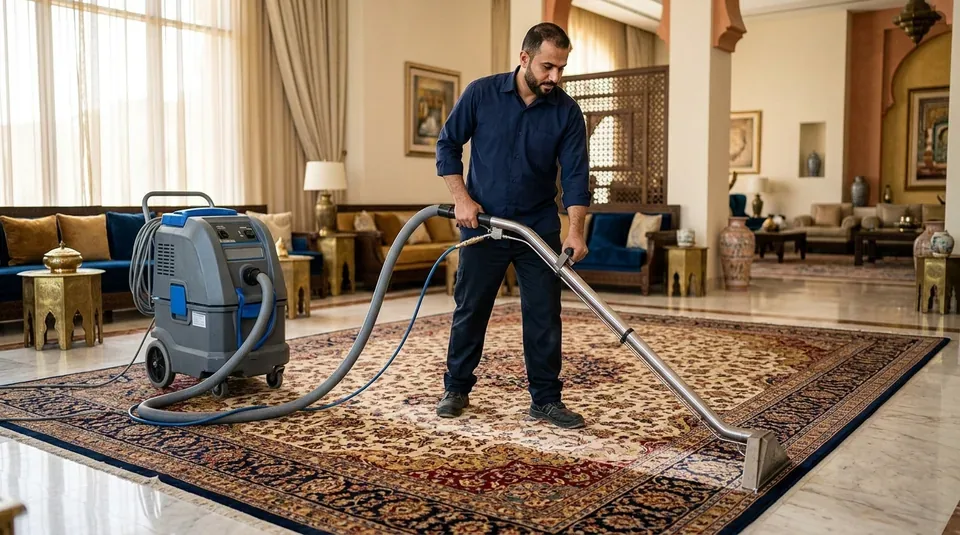
Extraction and vacuum equipment used for cleaning fitted carpet in a Jeddah home

Quick Summary

  • Vacuum regularly: fine sand slowly cuts the base of the fibres.
  • Humidity is the main enemy in Jeddah, so wet carpet should never sit closed up for a day.
  • Blot stains rather than scrubbing, and test any cleaner on a hidden corner first.
  • The underlay can hold water and odour even when the surface feels dry.
  • For heavy soiling or large areas, proper extraction beats hand washing.
Quick table

Quick reference: what you notice and the first step

Use this table to react calmly when something looks off. It does not replace checking the room yourself or asking a specialist.

What you seeLikely reasonFirst step
Grey or dark band along edges and doorwaysDust and soil carried in by shoes and settling at bordersDetailed edge vacuuming, then decide on extraction
Damp smell that grows in summerMoisture trapped in fibres or underlayVentilate, run the AC and control humidity before any washing
Dark spots that return after cleaningOld stain wicking up from below when wetBlot well, then re-treat using less water
Flattened fibres on walking pathsFoot pressure and packed-in gritVacuum with a suitable rotating brush and rotate furniture
Raised edges or waves in the surfaceLoose stretching or moisture under the carpetDo not re-stretch it yourself; ask a fitter to inspect
Round ring after a spillCleaner residue or liquid that was not rinsedBlot with a white cloth and rinse lightly with clean water
Itchy eyes or sneezing in the roomFine dust or house dust mites in the pileVacuum with a good filter, ventilate, wash nearby soft furnishings
In detail

Caring for fitted carpet in Jeddah’s climate, step by step

Read the sections in order or jump to the one you need. Each one deals with a single point of fitted carpet care.

Basics

How fitted carpet differs from a loose rug

Fitted carpet is laid edge to edge and fixed to the floor, usually over a foam or fibre underlay, while a rug is a separate piece you can lift and move. That one difference changes almost every care decision.

Because you cannot lift it to shake it out or air it in the sun, vacuuming, ventilation and spot cleaning have to do all the work. Any moisture that gets in stays there until air movement dries it.

So treat the whole surface as a sensitive floor: not too much water, no harsh cleaners, and no dragging heavy furniture across the fibres without protection.

Dust

Why dust builds up faster in Jeddah carpets

Jeddah gets fine airborne dust and light sand that enters with the air and sticks to shoes. Those particles fall between the tufts and settle at the base, where a light vacuum never reaches.

Over time the sharp grains act like tiny sandpaper under every footstep, dulling the pile and flattening it. Regular vacuuming is therefore not just about cleanliness; it protects the life of the carpet.

The less dust that gets into the room, the less deep washing you need, so make the entrance and doormats your first line of defence, as covered in our guide on controlling dust at the door.

Vacuuming

How to vacuum fitted carpet properly

Vacuum in two directions, once along the room and once across it, and move slowly enough for the airflow to lift dust from deep in the pile. A quick pass only touches the surface.

Use a rotating brush suited to the pile height, and raise it slightly on thin carpets so you do not tug the fibres. Along the walls use the crevice tool, because dust collects right at the skirting line.

Empty the bin or change the bag before it is full. A clogged vacuum loses suction and blows some of the dust back into the air, so a washable or replaceable filter helps.

Humidity

Coastal humidity and carpet: a delicate relationship

When humidity climbs in summer or after rain, carpet can absorb moisture from the air and develop an old, stale smell even with no visible liquid. Ground-floor rooms and poorly ventilated rooms are the most exposed.

The best response is to manage the room: run the AC or a dehumidifier, open windows when outside air is drier, and avoid keeping a room closed for weeks. Check corners behind furniture that sits against walls.

If you see mould spots or a strong rotting smell, an air freshener will not fix it. That points to trapped moisture whose source may need to be found before any cleaning.

Stains

Handling fresh stains on fitted carpet

A fresh stain is blotted, never rubbed. Press a clean white cloth or paper towel from the edges toward the centre and swap the cloth as it picks up colour so you do not put the stain back.

After blotting, mist a small amount of lukewarm water with a drop of mild detergent, then blot again. Too much water pushes the stain into the underlay and it returns later as a dark ring.

Do not mix cleaning products, and never use bleach on coloured carpet. Testing on a hidden corner before any product is a step you should not skip.

Underlay

What the underlay does, and why it matters

Under fitted carpet there is usually a foam or fibre layer that gives softness and absorbs impact. It also absorbs liquid, so a large spill can reach it and stay there after the surface looks dry.

That explains why a smell or stain can come back days later. Drying an underlay needs moving air and time, not just a pass over the top.

When the underlay is soaked through, lifting part of the carpet to dry it, or replacing the underlay, may be more sensible than repeated cleaning. That is a decision to make after a real inspection.

Extraction

When vacuuming is enough and when to wash by extraction

If the room is reasonably clean, regular vacuuming is enough most of the time. If you see deep soiling, smell something, or a year or more has passed without a deep clean, extraction removes what a vacuum cannot reach.

Extraction sprays a light solution and pulls it back with the dirt under strong suction. When the water is well controlled, the carpet stays damp rather than wet. Washing by bucket and brush often leaves too much water behind.

This guide is not a substitute for a technician’s judgement. Fibre type, carpet age and underlay condition all affect which method is best.

Drying

How long fitted carpet takes to dry and how to speed it up

There is no fixed number. Drying depends on how much water was used, ventilation, outdoor humidity and the thickness of the underlay. Lightly damp carpet may dry in hours; a heavily wetted one can need a day or more in humid weather.

To speed it up, run the AC in dry mode, direct a fan across the floor, and open windows if the air outside is less humid. Do not close the room up straight after washing.

Keep heavy furniture and shoes out until you have checked several spots with the palm of your hand. Moisture trapped under a furniture leg causes stains and odour.

Odours

Removing carpet odour instead of covering it

A bad smell is usually organic residue or moisture, and perfume does not remove it. Fragrances may feel better for a short while, then blend with the original smell and make it heavier.

Start with a thorough vacuum, then sprinkle a little baking soda, leave it for several hours and vacuum it up. That helps light odours but it does not cure deep moisture.

If the smell remains, the cause is probably in the underlay or a nearby leak. A professional look is more useful than repeated experiments that can add more moisture.

Pets and kids

Fitted carpet with pets and young children

Children and pets raise the need for frequent vacuuming and quick clean-up of accidents. Hair and fluff tangle in the fibres, so a rotating brush or a rubber glove helps before vacuuming.

For liquid accidents, do not let the spot dry. Blotting straight away keeps it from reaching the underlay. Choose gentle cleaners, follow their instructions, and rinse well so no residue stays where a child will touch.

Avoid strong sprays in a room where children play, and keep them out until the area is dry and the air has refreshed.

Furniture

Moving furniture and avoiding dents

Metal furniture feet leave deep dents. Use wide cups under legs and shift pieces a little every few months so pressure is spread out.

When you move a heavy piece, notice the patch beneath it. It is often cleaner and denser than the surroundings, which is normal. Crushed fibres can be refreshed with gentle steam or light brushing once dry.

Never drag heavy furniture across the carpet; it can pull loops of pile or lift an edge and leave a wave.

Renting

Fitted carpet when moving in or out

If you are taking over a flat with fitted carpet, or handing one back, photographing its condition protects both sides. Cleaning before handover or after move-in is a practical way to avoid arguments about condition.

On move-in the carpet may hold old dust or a stale air-conditioner smell, so get it assessed before furniture goes in. Washing an empty room is far easier.

This does not replace the tenancy contract. Responsibility for carpet condition depends on what the parties agreed; we are only talking about cleanliness.

Decision

When to replace carpet instead of cleaning it

Cleaning cannot restore a carpet whose surface fibres are worn away, whose backing has torn, or which has rotted. Wide mould patches or a persistent swelling with odour usually mean moisture in the floor, not just the surface.

Likewise, if fibres are crushed flat in the walkways with a permanent colour change, cleaning will make it clean but will not return the original look. The key is to set realistic expectations.

You can send clear photos of the room, edges and any stains over WhatsApp and we will explain what cleaning can improve and what may need another solution.

Routine

A simple care schedule for fitted carpet

Every day or two: vacuum the walkways and entrances. Weekly: vacuum the whole room in both directions, including edges. Monthly: move light furniture, vacuum beneath it, and check corners and humidity.

Seasonally: look over the room before summer and after rain, and decide whether it needs deeper cleaning. Yearly or as needed: full extraction depending on traffic, children and pets.

These are guide intervals that change with your home. A busy household in a dusty area needs more than a quiet one.

Common questions

Fitted carpet cleaning FAQ

Short answers to the questions Jeddah homeowners ask most about wall-to-wall carpet.

Can I wash fitted carpet myself at home?+

You can handle small stains and regular vacuuming yourself. A full wash needs control of how much water goes in and how it is pulled out. Heavy hand washing can leave the underlay wet and cause smell, so proper equipment suits large areas better.

How often does fitted carpet need a deep clean?+

There is no single interval. A home with children, pets or lots of dust may need it every few months to a year, while a rarely used room may manage with regular vacuuming and a less frequent deep clean.

Why does my carpet smell damp even though it looks clean?+

Moisture may be in the underlay, the floor beneath, or the trapped air in the room. Improving ventilation and humidity control is the first step, and if the smell stays, ask for the source to be inspected.

Will hot steam damage fitted carpet?+

It depends on the fibre and backing. Many carpets tolerate moderate heat, but some fibres and adhesive backings can be damaged by high heat. Check with the manufacturer or a technician before using steam.

How long does fitted carpet take to dry after washing?+

From a few hours to a day or more, depending on water used, ventilation and humidity. Use the AC and a fan, and test several spots by hand before putting furniture back.

Should I move furniture before cleaning?+

Yes. Light pieces should be moved out and heavy ones protected under the feet. Cleaning around furniture leaves visible borders, and moving it allows a cleaner result and avoids rust and moisture marks.

Can carpet be cleaned in the humid season?+

It can, as long as there is good ventilation and air conditioning afterwards to speed drying. On very humid days it helps to use less water and to postpone small poorly ventilated rooms if possible.

How do I know if your service suits my carpet?+

Send photos of the room, the edges and any stains or damp areas with a short description. We will explain what can be done and what we would not recommend. The final decision depends on the actual condition of the carpet.

Want your bedroom or majlis carpet assessed in Jeddah?

Send clear photos of the room, edges and any stains or smells, and we will suggest the right cleaning or care step.

CallWhatsAppGet Quote