
Serving Jeddah & Makkah
Structural Wood & Sub-Slab Diagnostic Guide — Jeddah & Makkah15 min structural diagnostic readJeddah & Makkah

Early Signs of Subterranean Termites in Wooden Door Frames and Baseboards: How to Detect Hidden Damage Before Replacing Wood

A field-tested diagnostic manual explaining how subterranean termites invade door frames and skirting boards from beneath floor tiles, how to recognize mud tubes and hollow wood, and why sub-slab soil treatment is mandatory.

Subterranean termites—widely known across Jeddah and Makkah as "Al-Ardah" (الأرضة)—are rightly called the silent destroyers of residential woodwork. Operating entirely out of sight from vast colonies deep within the sandy sub-base beneath villa foundations and ground-floor slabs, worker termites can hollow out solid wooden door frames (bucks), skirting baseboards, parquet flooring, and built-in wardrobes for months without leaving a single visible hole on the painted exterior. All too often, homeowners discover the infestation only when a thumb accidentally pokes straight through a paper-thin veneer of blistered paint, or when a heavy bedroom door sags off its upper hinge.

This extreme concealment is driven by subterranean termite physiology: worker termites are blind, soft-bodied insects with a delicate, non-waxy cuticle that rapidly desiccates and dies if exposed to dry indoor air-conditioning or direct light. Consequently, termites ascend from sub-slab soil through microscopic concrete shrinkage cracks, plumbing pipe penetrations, and untiled door-frame bases, consuming the soft cellulose springwood from the inside out while preserving a 1-millimeter outer shell of paint or varnish to seal in humidity.

This structural diagnostic guide gives you a systematic field inspection method to catch termite activity early in Jeddah and Makkah properties. You will learn how to identify mud shelter tubes, perform acoustic tap-testing on door frames, distinguish subterranean termites from foraging ants and powderpost beetles, understand why bathroom door jambs fail first, and see why replacing damaged wood without executing a sub-slab soil barrier injection guarantees rapid re-infestation.

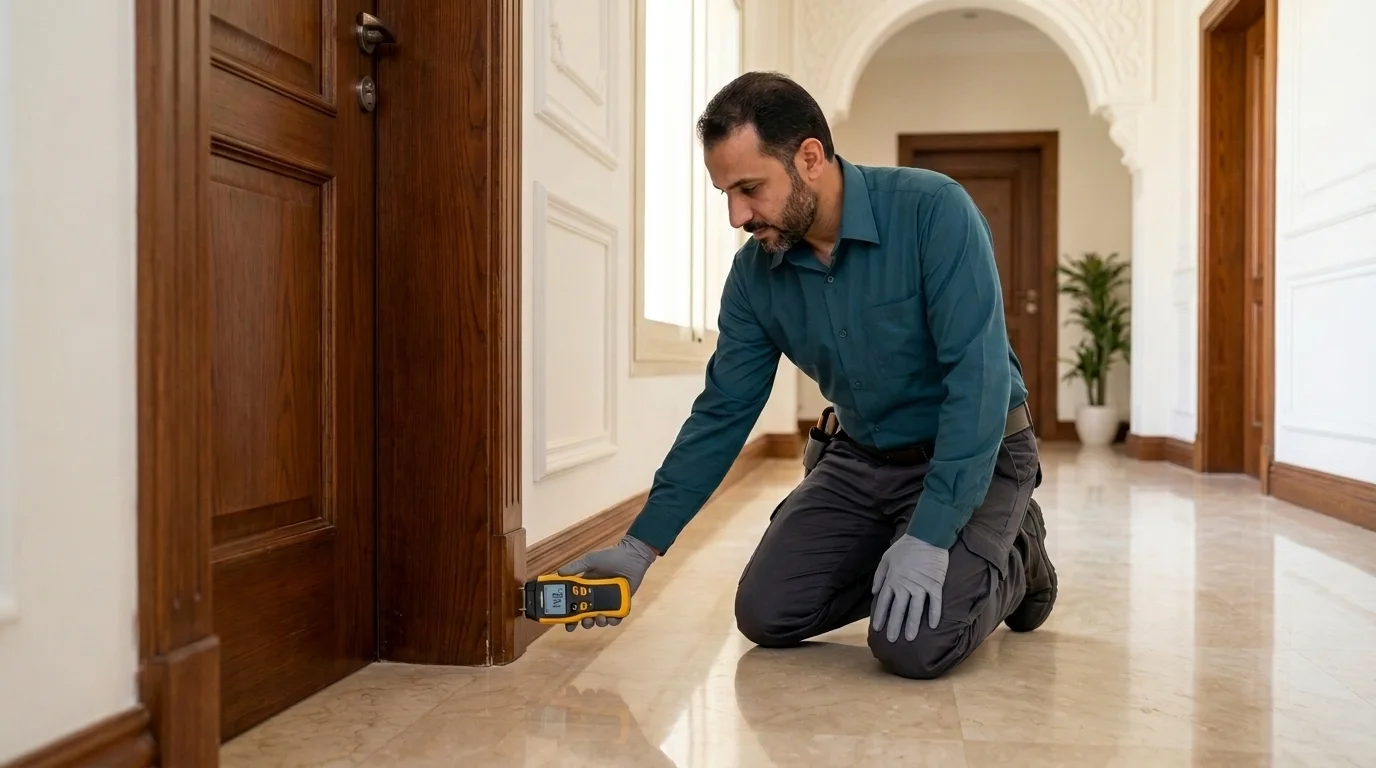
Structural inspection of a wooden door frame and baseboard checking for subterranean termite mud tubes and moisture in Jeddah and Makkah

Executive Summary — Key Takeaways in This Guide:

  • Subterranean termites excavate wood from the inside out, leaving the outer paint film intact to retain moisture—meaning visual glances miss early damage unless paired with acoustic tap-testing.
  • Discovering pencil-thick earthen "mud shelter tubes" climbing from floor tile joints behind door casings or skirting boards is 100% confirmation of active subterranean termites.
  • Ground-floor bathroom and kitchen door frames are the #1 initial attack point because traditional timber door bucks are often embedded directly into damp sub-tile sand fill.
  • Termites differ anatomically from ants by having a thick, broad waist (no pinch), straight beaded antennae, and four wings of equal length that shed in piles near lights.
  • Spraying aerosol on damaged wood or installing a new wooden door without sub-slab soil injection fails completely, as the queen and millions of workers live beneath the concrete floor.
Technical Analysis Matrix

Structural Pest Identification Matrix: Subterranean Termites vs. Foraging/Winged Ants vs. Powderpost Beetles

Distinguishing these three wood and floor pests prevents costly misdiagnosis, as each leaves a distinct physical signature.

Diagnostic CriterionSubterranean Termites (الأرضة)Household / Carpenter Ants (النمل)Wood-Boring Beetles (سوس الخشب)
Mud Tubes vs. Sawdust / Frass SignatureConstructs pencil-wide brown earthen mud shelter tubes out of soil and saliva along walls and behind trim; packs hollowed wood galleries with damp mud.Never builds mud tubes; ejects loose piles of dry sand granules and insect fragments from tile grout joints (or coarse, clean wood shavings without mud).No mud tubes; produces tiny 1–2 mm round "shotgun" exit holes on wood surfaces spilling ultra-fine, flour-like wood powder (frass).
Insect Body Anatomy & ColorWorkers are creamy-white, soft-bodied; waist is broad and straight (no narrow pinch between thorax and abdomen), with straight beaded antennae.Hard dark brown, black, or reddish exoskeleton; features a sharply pinched, narrow wasp-like waist and distinctly elbowed (bent) antennae.Tiny cylindrical reddish-brown beetles (2–5 mm); C-shaped grubs tunnel entirely inside dry seasoned lumber without any soil connection.
Winged Swarmers Comparison (Alates)Possesses four translucent milky-white wings of strictly equal length and shape (twice as long as the body) that detach easily around windowsills.Possesses four unequal wings (front wings are significantly longer and larger than hind wings), clear to brownish, remaining firmly attached.Flies occasionally as a tiny hard-shelled beetle attracted to lights; never sheds piles of wings.
Behavioral Response to Light & ExposureWorkers never forage openly on exposed floor tiles or counters; they are seen only when you break open a mud tube or pry back damaged wood trim.Forages openly in visible trails across floor tiles, kitchen counters, and patio walls day and night searching for sugars and proteins.Larvae never leave the interior of the wood; homeowners only notice fresh cones of fine powder accumulating beneath the timber.
Internal Wood Excavation PatternConsumes soft springwood along the grain, leaving layered galleries heavily plastered with dried mud and soil speckles behind a paper-thin paint skin.Carpenter ants excavate smooth, sandpaper-clean galleries inside water-damaged wood solely for nesting (they do not eat wood) with zero mud lining.Crisscrossing pinhole tunnels inside dry hardwood veneers or plywood packed tightly with talcum-like wood flour.
Required Engineering Treatment ProtocolPrecision sub-slab drilling along perimeter walls and door frames followed by high-volume pressurized injection of a non-repellent termiticide into the soil.Colony-transfer ant gel and granular baiting combined with perimeter grout and crevice treatment—no concrete slab drilling required.Localized wood-borer borate/insecticide injection directly into affected timber panels or replacement of infested plywood.

Early Termite Detection Checklist: 6 Structural Tests for Doors, Baseboards & Wardrobes

Inspect your ground-floor door frames, bathroom thresholds, and skirting boards using these six diagnostic tests.

Indicator #1Critical (100% Confirmed Active Termites)

Brown earthen mud lines or tubes emerging from tile grout seams behind door casings or baseboards

Root Cause: Subterranean termite foraging shelter tubes built to maintain 90%+ relative humidity while traveling from sub-slab soil into timber.

Scrape open a 2 cm section of the mud tube to observe creamy-white workers (or check if termites rebuild the breach within 24–48 hours) and book Termite Control.
Indicator #2Critical (Advanced Internal Structural Damage)

Hearing a dull, papery, or hollow drum sound when tapping the lower 50 cm of a wooden door frame

Root Cause: Termites have hollowed out the structural interior timber along the grain, leaving only a thin outer paint skin.

Do not replace the door frame yet; execute sub-slab soil injection and frame treatment first so the colony is eliminated before installing new timber.
Indicator #3High (Active Sub-Surface Feeding)

Blistering, rippling, or sunken bubbles in the paint of wooden door frames or skirting boards

Root Cause: High moisture and wet soil plastered by subterranean termites directly beneath the thin paint film, mimicking water damage.

Press gently on the blistered area; if the surface yields like hollow cardboard packed with dried mud specks, schedule professional termite remediation.
Indicator #4High (Structural Frame Weakening)

Doors suddenly sticking, rubbing against the latch, or sagging at the upper hinge screws

Root Cause: Structural compression and warping of the door buck as internal cellulose fibers holding the hinge screws are consumed.

Inspect the entire door perimeter and adjacent baseboards for mud galleries and apply a localized + perimeter termiticide injection.
Indicator #5Critical (Mature Sub-Slab Colony Present)

Piles of translucent, equal-length discarded wings on windowsills or near interior door frames

Root Cause: Reproductive alate swarmers emerging from a mature, well-established subterranean colony beneath the property to mate and shed their wings.

Save a sample of the shed wings for technician verification and schedule a full ground-floor perimeter inspection and soil barrier treatment.
Indicator #6Critical (Risk to Built-In Cabinetry & Stored Goods)

Crumbling rear backing boards inside built-in wardrobes or buckling wooden parquet floorboards

Root Cause: Termites advancing concealed behind wall skirting boards or through slab cracks directly into MDF wardrobe backings abutting bathroom walls.

Empty the wardrobe of clothing and cardboard boxes immediately, inspect the rear wall junction, and inject the sub-slab perimeter line.
In-Depth Technical Guide

Deep Engineering & Entomological Analysis: How Subterranean Termites Breach Concrete Villas & How Soil Barriers Work

Five technical modules explaining Saudi door-frame construction vulnerabilities, moisture triggers, and precision drill-and-inject soil barriers.

Module 1: Engineering Module 01

The Mechanics of Silent Destruction: Why Subterranean Termites Leave the Outer Paint Shell Intact

To understand why subterranean termites (including genera such as Psammotermes, Microcerotermes, and Heterotermes native to Western Saudi Arabia) cause such severe structural damage, homeowners must grasp one foundational reality: the termites found inside a wooden door frame are not the nest itself. They are merely a foraging workforce commuting back and forth from a central subterranean colony located 1 to 3 meters deep inside the damp sand fill beneath the building’s concrete slab. Deep underground resides the queen, laying thousands of eggs alongside soldiers and hundreds of thousands of workers.

Unlike dark, hard-bodied household ants, subterranean termite workers are blind, soft-bodied insects lacking a waterproof epicuticular wax layer. If exposed to dry indoor air-conditioning or ambient light, a worker termite rapidly loses body moisture and dies within hours. To maintain their mandatory 85%–95% relative humidity microclimate, workers construct enclosed mud shelter tubes out of soil particles cemented with saliva and fecal mortar, and strictly avoid chewing through the outermost surface of the wood.

As they excavate a door frame or skirting board, workers selectively consume the softer cellulose springwood layers along the grain while leaving a razor-thin 0.5 mm to 1 mm outer veneer of wood and paint completely unpunctured. This intact paint shell acts as an airtight environmental seal that traps humidity inside the timber while hiding the devastation from the homeowner’s eyes until the hollowed frame collapses under mechanical stress.

Five Core Realities of Subterranean Termite Behavior:

  • The reproductive queen and central nest reside in the soil beneath the concrete floor slab—never inside the door frame itself.
  • Termite workers preserve an unbroken outer paint skin because dry room air and light are fatal to their soft bodies.
  • Foraging workers transport digested wood cellulose back down into the sub-slab soil to feed the queen, larvae, and soldiers.
  • Subterranean termites can squeeze upward through concrete slab shrinkage cracks or pipe gaps as narrow as 1.5 millimeters.
  • Leaving one infested door jamb untreated allows foraging galleries to spread laterally behind baseboards into wardrobes and adjacent rooms.
Field Specialist Pro-Tip:

The Screwdriver-Handle Tap Test: Rap the plastic handle of a heavy screwdriver systematically along the bottom 100 cm of every ground-floor wooden door frame; solid timber produces a sharp thud, whereas termite-hollowed wood emits a dull, papery resonance.

Important Safety Caution:

Inspection Caution: If you discover an active mud tube or blistered door trim, do not rip off the entire casing or spray repellent aerosol inside; chemical repulsion causes termites to seal off that gallery and reroute their attack to nearby wardrobes or parquet.

Module 2: Engineering Module 02

Architectural Vulnerability: Why Bathroom Door Frames and Ground-Floor Baseboards Are Attacked First

Homeowners across Jeddah and Makkah frequently ask why subterranean termites almost always strike bathroom, laundry, and kitchen wooden door frames before any other room. The answer lies in a widespread construction detailing flaw known as direct sub-tile door-buck embedding. During villa and apartment finishing, carpenters typically anchor rough wooden sub-frames (or main solid timber jambs) directly onto the raw concrete slab before the tiler lays the sand-cement screed bed and floor porcelain. Consequently, the bottom 5 to 10 cm of the wooden door frame remains buried below the finished tile line, sitting in direct, unsealed contact with the damp sand fill beneath the floor.

When this buried timber end-grain is combined with sub-tile moisture—fed by routine wet floor washing, degraded grout joints around bathroom thresholds, condensation on buried cold-water pipes, or slow drain leaks—the sand pocket beneath the doorway becomes perpetually humid. Damp wood undergoing early fungal softening emits volatile chemical cues that actively attract foraging subterranean termites from meters away beneath the foundation.

Once termites breach the buried foot of a door frame, they expand along two concealed structural highways: vertically up the hollow gap behind the door architrave (casing), and horizontally behind perimeter skirting baseboards. Because tile installers leave a 5 to 10 mm expansion gap where floor tiles meet plastered block walls—which is subsequently covered by wooden, MDF, or PVC baseboards—termites use the dark channel behind the baseboards as an armored perimeter tunnel to reach built-in bedroom wardrobes and parquet flooring completely unseen.

Five Structural Vulnerabilities That Invite Subterranean Termites Indoors:

  • Wooden door-frame legs extending below the finished floor tile line into direct contact with damp sub-slab sand.
  • Missing or cracked tile grout along bathroom and kitchen thresholds allowing wash water to seep into the sand bed.
  • The concealed horizontal expansion gap running behind wooden, MDF, or PVC skirting baseboards along perimeter walls.
  • Unsealed annular gaps around plumbing drainpipes and electrical conduits penetrating the ground-floor concrete slab.
  • Cellulose construction debris (formwork timber scraps, stakes, and cardboard) left buried inside sub-floor backfill during construction.
Field Specialist Pro-Tip:

Architectural Renovation Tip: Whenever installing or replacing a bathroom or ground-floor wooden door frame after termite treatment, instruct the carpenter to stop the timber jamb above the finished floor tile line on a waterproof masonry or polymer plinth—never burying bare wood into the sub-tile sand.

Important Safety Caution:

Baseboard Material Myth: Replacing wooden skirting boards with ceramic tile or PVC baseboards does not stop subterranean termites; termites simply tunnel through the mortar void behind the tile baseboard to reach wooden doors, wardrobes, and drywall paper.

Module 3: Engineering Module 03

Why Surface Spraying and Premature Door Replacement Fail Without Sub-Slab Soil Injection

One of the costliest mistakes homeowners in Jeddah and Makkah make is immediately hiring a carpenter to rip out a termite-damaged door frame and install a brand-new wooden door—or merely brushing surface insecticide onto the wood—without treating the sub-slab soil. The outcome is predictable and devastating: within 4 to 8 weeks, the untouched subterranean colony living in the sand bed directly beneath the threshold surges upward into the fresh, untreated timber frame, destroying the new door investment.

Similarly, spraying surface aerosols, kerosene, or repellent pyrethroid liquids onto damaged woodwork fails for two fundamental engineering reasons. First, topical sprays cannot penetrate painted timber or reach through the concrete floor slab to impact the queen and the 95% of the colony residing underground. Second, conventional smelly pesticides act as localized repellents: when foraging workers detect the repellent chemical inside a door jamb, they plug that specific gallery with mud and detour beneath the floor tiles to attack an adjacent built-in wardrobe, parquet floor, or bedroom door.

The only scientifically validated engineering solution for existing buildings (post-construction remediation) is establishing a continuous Sub-Slab Chemical Soil Barrier. Technicians drill precise, micro-diameter holes (6 to 10 mm) strictly along the tile grout lines flanking perimeter walls and door bucks, then use pressurized sub-slab injectors to saturate the underlying sand fill with an SFDA-registered non-repellent termiticide—severing the subterranean supply line and eliminating the colony.

Why Non-Repellent Sub-Slab Injection Is Mandatory:

  • Replacing a damaged door before sub-slab soil injection simply feeds fresh timber to an active underground colony.
  • Pouring diesel or spraying repellent aerosols into wood flushes termites laterally into nearby wardrobes and rooms.
  • Modern SFDA-registered non-repellent termiticides (e.g., fipronil or imidacloprid formulations) are undetectable to termites, enabling colony-wide transfer.
  • Precision drilling directly inside tile grout lines preserves porcelain and marble slabs and is sealed afterward with color-matched grout.
  • Effective containment requires treating the full room perimeter and adjacent door frames rather than spot-treating a single jamb.
Field Specialist Pro-Tip:

Carpenter Coordination Rule: If a door frame is too structurally compromised to save, schedule termite soil injection **before** installing the new frame—or have the pest control team treat the exposed sub-threshold sand pit the exact day the old buck is removed.

Important Safety Caution:

Chemical Safety Warning: Never allow unlicensed laborers to inject foul-smelling agricultural organophosphates (such as chlorpyrifos) beneath indoor living room tiles; such compounds off-gas hazardous vapors for months, whereas SFDA-registered residential termiticides are low-odor and engineered for indoor sub-slab safety.

Module 4: Engineering Module 04

Inside the Precision Drill-and-Inject Protocol: Treating Beneath Porcelain and Marble Floors

Many villa owners in Jeddah and Makkah hesitate to book subterranean termite control out of fear that drilling will crack or ruin expensive marble and porcelain flooring. Modern Precision Drill-and-Inject engineering eliminates this risk: technicians utilize specialized 6 mm to 8 mm carbide or diamond-core bits positioned strictly inside the existing grout joint intersections (10 to 15 cm off the baseboard at 30 to 40 cm intervals), drilling smoothly through the mortar bed into the underlying sand fill without fracturing tile faces.

Once the injection ports are prepared, technicians insert pressurized sub-slab injectors equipped with expanding rubber seals to deliver a calibrated volume of SFDA-registered non-repellent termiticide emulsion into the sand layer. This sub-slab dispersion creates a continuous, overlapping horizontal treated zone beneath the floor perimeter and around all door-buck footings. Simultaneously, micro-injectors (2–3 mm) introduce specialized wood-penetrating formulations directly into affected wooden door frames and architraves to eliminate foraging workers already inside the timber.

Because advanced non-repellent termiticides do not trigger avoidance behavior, termites continue tunneling through the treated sub-slab soil completely unaware. As workers contact the treated sand, the slow-acting active ingredient adheres to their cuticles and is passed horizontally to nestmates, soldiers, and the reproductive core deep underground through mutual grooming and trophallaxis (mouth-to-mouth feeding). Finally, every grout hole is cleanly plugged and color-matched to the existing floor joint.

Five Engineering Standards of a Professional Termite Injection Service:

  • Small-bore 6–8 mm drilling is executed inside tile grout lines to protect porcelain and marble aesthetics.
  • Injection ports are spaced every 30 to 40 cm along walls to ensure overlapping sub-slab chemical lateral spread.
  • High-priority cluster injection surrounds both legs of every wooden door frame where timber meets sub-floor sand.
  • Non-repellent delayed transfer chemistry eradicates the subterranean colony rather than merely trapping workers.
  • All injection ports are sealed flush with color-matched tile grout upon completion.
Field Specialist Pro-Tip:

Zero-Visibility Marble Trick: In luxury halls with laser-cut, butt-jointed marble slabs where drilling grout lines is undesirable, technicians can carefully detach the wall skirting baseboard, drill and inject underneath the baseboard line, and re-attach the skirting so zero holes are visible on the floor.

Important Safety Caution:

Sub-Floor Utility Precaution: Prior to drilling near bathroom manifolds, kitchens, or main electrical distribution boards, plumbing and conduit layouts must be verified to prevent puncturing shallow pipes buried in the floor screed.

Module 5: Engineering Module 05

Sub-Slab Moisture Management & Long-Term Prevention for Jeddah and Makkah Villas

Subterranean termite foraging intensity is directly proportional to sub-slab soil moisture. Wherever hidden water leaks dampen the sand bed beneath a floor—or seep into block walls—termite colonies thrive and can even extend their mud galleries up inside wall cavities to second-floor rooms. Across numerous inspections in Jeddah and Makkah, severe door-frame and wardrobe termite attacks trace directly back to unsealed shower floor grout in an adjacent bathroom, a weeping buried hot-water pipe, or a concealed split-AC condensate drain line leaking inside the wall chase.

Comprehensive structural protection therefore combines chemical soil barriers with moisture source elimination: first, re-grouting bathroom thresholds and wet-zone floor tiles with waterproof epoxy or polymer-modified grout so wash water cannot percolate into the sub-floor sand; second, replacing traditional "bucket-flooding" floor washing near wooden door frames with damp microfiber mopping; and third, ensuring exterior garden irrigation emitters and courtyard drains do not saturate the soil directly against foundation grade beams.

Finally, for homeowners planning major renovations, tile replacement, or new villa construction, applying a full pre-tiling or pre-slab soil termiticide treatment—paired with installing moisture- and termite-proof WPC (Wood-Plastic Composite) door frames for bathrooms and wet rooms—provides decades of structural peace of mind.

Five Long-Term Prevention Rules Against Subterranean Termites:

  • Seal bathroom tile grout and repair weeping AC condensate or plumbing lines to starve subterranean colonies of sub-slab moisture.
  • Avoid flooding interior floors with standing water around wooden door jambs during routine house cleaning.
  • Never store corrugated cardboard boxes or scrap lumber directly on ground-floor storeroom tiles or unpaved courtyard soil.
  • Keep heavy garden planters and drip irrigation lines at least 50 cm away from exterior villa foundation walls.
  • Perform an annual flashlight and screwdriver tap-test across all ground-floor door frames and skirting boards.
Field Specialist Pro-Tip:

Post-Construction Handover Tip: Before moving into a newly built or renovated villa, remove all scrap formwork wood and cardboard from utility trenches and ensure perimeter grout joints around every door frame are completely sealed during post-construction floor cleaning.

Important Safety Caution:

Built-In Wardrobe Precaution: When installing custom built-in wardrobes in ground-floor bedrooms—especially against walls shared with bathrooms—verify the wall is dry and treat the sub-floor perimeter before anchoring MDF backing panels.

Hyperlocal City Adaptation

Geological & Architectural Termite Pressure in Jeddah and Makkah

How Jeddah’s high coastal water table and sand backfill compare with Makkah’s sandy wadi pockets and foundation designs.

Jeddah GovernorateJeddah Sectors Hub

Jeddah Structural Context: High Water Tables, Humid Sand Fill, and Coastal Villas

Jeddah’s coastal geology and climate create year-round subterranean termite pressure. Three converging environmental factors drive this activity: a shallow water table that keeps sub-foundation soil perpetually moist; the standard construction practice of backfilling foundation grade beams (meedahs) with loose sand beneath ground-floor slabs; and warm Red Sea humidity that prevents soil desiccation.

In Jeddah villas featuring irrigated garden perimeters, swimming pools, and decorative wooden pergolas or parquet flooring, subterranean colonies frequently migrate from damp landscape beds through expansion joints and slab-edge cracks straight into interior door frames and built-in cabinetry. Consequently, our Jeddah protocols emphasize full perimeter barrier trenching/injection outdoors paired with precision interior grout-line injection around every ground-floor door buck and wet wall.

  • North & Coastal Jeddah (Obhur, Al-Shati, Al-Murjan, Al-Basateen, Al-Mohammedia): Luxury villas with interior wood wall cladding, parquet flooring, and irrigated gardens require meticulous sub-slab perimeter injection and hidden-frame moisture checks.
  • Central Jeddah Districts (Al-Rawdah, Al-Salamah, Al-Zahra, Al-Faisaliyah): Ground-floor apartments and renovated villas often experience termite outbreaks triggered by aging sub-floor bathroom plumbing leaks, requiring combined moisture diagnosis and grout-line injection.
  • East Jeddah Growth Sectors (Al-Samer, Al-Tayseer, Al-Manar, Al-Ajwad, Al-Hamdaniyah): Newer builds constructed over sandy wadi beds benefit from early inspection of bathroom door frames where construction backfill timber may attract colonies.
  • South Jeddah & Established Districts (Al-Balad, Al-Naseem, Bani Malik, Al-Wurood): Seasoned structural woodwork and high ambient soil moisture require comprehensive sub-slab barrier restoration before carpenter repairs.

Makkah Structural Context: Sand Backfill Over Rock Beds, Wadi Channels, and Tank Moisture

A common misconception in Makkah is that rocky mountain terrain prevents subterranean termites. In engineering reality, the opposite often occurs: even when villa foundations are excavated into solid rock, builders backfill the foundation grade beams and sub-tile leveling beds with truckloads of imported wadi sand—which frequently contains dormant termite colonies or organic root debris. Worse, because solid bedrock beneath the foundation prevents downward drainage, any slight seepage from underground water tanks, plumbing lines, or courtyard washing becomes trapped inside the enclosed sand basin beneath the floor tiles.

This perched sub-slab moisture pocket turns the sand bed beneath Makkah villas and ground-floor apartments into a permanent subterranean termite incubator—driving intense attacks on wooden door frames, majlis baseboards, and storage rooms. Our Makkah termite protocols specifically target these trapped sand basins through deep perimeter and doorway injection.

  • Southern & Western Makkah (Al-Shawqiyyah, Al-Kakiyyah, Batha Quraish, Wali Al-Ahd): Villas and residential buildings built over deep sand backfill require proactive inspection and sub-slab injection around ground-floor door frames and annexes.
  • Eastern Makkah & Elevated Sectors (Al-Awali, Al-Sharayea, Al-Rashidiyah, Al-Naseem): Terraced villas where irrigation moisture pools atop underlying rock layers require targeted perimeter and retaining-wall injection.
  • Central & Al-Aziziyah Districts (Al-Aziziyah, Al-Shishah, Al-Rawdah): Multi-story buildings with large underground water tanks and damp basement utility shafts require barrier injection along adjacent ground-floor rooms.
  • Northern Makkah Sectors (Al-Taneem, Al-Nooriyah, Al-Umrah, Al-Buhairat): Properties situated along historic sandy wadi corridors experience high native subterranean termite pressure, demanding continuous sub-slab chemical barriers.
Illustrative Service Scenario — For Educational Reference

Diagnostic & Remediation Scenario: Hidden Bathroom Door-Frame Termites Spreading into a Master Wardrobe

Property Context & Initial Challenge:

Ground floor of a residential villa finished with porcelain floor tiles, solid timber interior doors, and a built-in master bedroom wardrobe sharing a plumbing wall with the en-suite bathroom.

The homeowner noticed slight paint blistering near the base of the master bathroom door casing; pressing on it broke through a paper-thin paint shell filled with dried mud. Before calling a carpenter to replace the door, they noticed mud lines inside the adjacent built-in wardrobe.

Outcome & Long-Term Prevention:

Complete cessation of termite foraging with zero mud-tube reconstruction upon follow-up inspection, allowing the carpenter to safely restore the door casing and wardrobe backing over a treated, moisture-sealed foundation.

Diagnostic Inspection Findings:

  • Acoustic tap-testing revealed hollow internal galleries extending 65 cm up both legs of the bathroom door frame despite an intact exterior paint coat.
  • Flashlight inspection behind the bedroom skirting board uncovered an active earthen mud tube emerging from the floor-wall joint and climbing into the rear MDF panel of the built-in wardrobe.
  • Moisture inspection at the bathroom threshold confirmed eroded tile grout allowing shower wash water to saturate the sub-tile sand where the wooden door buck was buried.
  • A full ground-floor sweep detected early-stage mud spotting at the base of the nearby guest washroom door frame, while living room doors remained unaffected.

Technical Protocol Applied:

  • Precision Port Preparation: Drilled 6 mm ports strictly inside the porcelain tile grout lines surrounding the bathroom, bedroom, and washroom door frames, and every 30 cm along the shared bathroom-wardrobe wall without chipping any tiles.
  • Sub-Slab Barrier Injection: Pressurized injection of an SFDA-registered non-repellent termiticide into the damp sub-floor sand bed to establish a continuous chemical zone and trigger colony-wide horizontal transfer.
  • Timber Gallery Treatment: Injected specialized liquid formulation directly into the hollowed door-buck cavities and behind the bedroom baseboard channel to eliminate active foraging workers.
  • Cosmetic Restoration & Moisture Sealing: Plugged all grout holes with color-matched mortar and sealed the bathroom threshold joint with waterproof epoxy grout prior to carpentry frame restoration.
Safe Decision Boundaries

Safe Homeowner Monitoring vs. When to Call a Termite Control Specialist Immediately

Clear engineering boundaries separating routine moisture prevention from active subterranean infestations requiring sub-slab equipment.

Safe Preventive Actions & Inspections You Can Perform Yourself:

  • Performing biannual flashlight inspections and screwdriver-handle tap tests along ground-floor door frames and baseboards.
  • Maintaining waterproof tile grout around bathroom thresholds, shower floors, and kitchen perimeters to keep sub-slab sand dry.
  • Storing cardboard boxes, paper archives, and luggage on elevated metal or plastic shelving rather than directly on floor tiles.
  • Routing AC condensate drain lines and garden drip irrigation away from exterior foundation walls.
  • Photographing suspect mud tubes or discarded wing piles before disturbing them so a specialist can verify the species.

Critical Triggers Requiring Immediate Professional Sub-Slab Intervention:

  • Spotting even a single brown mud shelter tube emerging from floor grout joints, wall cracks, door casings, or skirting boards.
  • Discovering hollow-sounding timber or mud-packed honeycomb galleries inside a door frame, baseboard, or built-in wardrobe.
  • Observing creamy-white, soft-bodied worker termites inside wood crevices when peeling back blistered paint.
  • Finding indoor termite swarmers or piles of shed, equal-length translucent wings near windows and door thresholds.
  • Planning to install new wooden doors, parquet flooring, or custom cabinetry in a property with past untreated termite damage.

Honest Engineering Scope Note: Subterranean termite control in existing buildings cannot be achieved with surface sprays or gel drops; it is a specialized structural procedure requiring sub-slab drilling and pressurized soil injection using SFDA-registered termiticides in alignment with municipal standards. While treatment halts active feeding and protects remaining and replacement woodwork, severely hollowed structural timber must subsequently be repaired or replaced by a carpenter.

Frequently Asked Questions

Frequently Asked Questions About Termites in Wooden Doors & Sub-Slab Injection

Direct technical answers addressing porcelain drilling, carpenter timing, odor safety, and long-term protection.

Will drilling for subterranean termite injection crack or ruin my porcelain and marble floors?+

No. Professional technicians never drill through the center face of porcelain or marble tiles. Instead, micro-diameter bits (6 to 8 mm) are drilled strictly inside the grout joint line 10–15 cm from the wall—or concealed entirely underneath removed skirting baseboards. Afterward, the ports are filled flush with color-matched tile grout.

Only one bathroom door frame shows termite damage; is it enough to inject just that single doorway?+

Spot-treating only two holes beside a single damaged door frame carries a high risk of lateral shifting. Because the subterranean colony networks across the underlying sand bed, proper containment requires injecting both sides of the affected wall, surrounding door frames, and the perimeter of the affected room to lock down the foraging zone.

Should I have the carpenter replace the damaged wooden door frame before or after termite treatment?+

Always execute termite soil injection **before** installing the new wooden door frame—or schedule the injection on the exact day the carpenter removes the rotted buck so the technician can saturate the exposed sub-threshold sand pit directly before the new frame is anchored.

How can I tell if a mud tube on my door frame or wall is currently active or old?+

Use the 48-hour breach test: scrape away a 2 to 3 cm section in the middle of the mud tube with a screwdriver tip. If you see creamy-white worker termites retreating inside, it is immediately active. Even if the tube appears empty at that moment, check it again in 24 to 48 hours—if termites repair and reseal the broken gap with fresh, dark wet mud, the gallery is actively used.

What is the difference between subterranean termites (Al-Ardah) and wood-boring beetles that leave fine powder?+

Subterranean termites ascend from sub-slab soil, construct brown mud tubes, and pack hollowed wood with soil—they never push fine flour-like powder out of pinhole openings. Powderpost beetles live entirely inside dry lumber without soil contact, creating 1–2 mm round exit holes that spill talcum-fine wood flour, and are treated via direct timber injection rather than sub-slab drilling.

Do modern termite injection treatments have strong toxic odors requiring multi-day home evacuation?+

No. Modern SFDA-registered water-based, non-repellent termiticides are engineered specifically for residential sub-slab application with virtually zero volatile solvent odor—unlike banned agricultural organophosphates of the past. Because the emulsion is injected beneath the slab and sealed immediately with grout, multi-day evacuation is unnecessary.

Can subterranean termites reach wooden doors on the second floor of a villa or apartment building?+

Yes. While colonies originate in the soil beneath the ground floor, subterranean termites can follow damp plumbing risers or hollow block wall cavities upward to second-floor bathroom door frames if an upper-floor water leak provides sufficient moisture. Remediation involves treating both the ground-floor soil entry point and the upper-floor moisture pocket.

Unified Service Request Builder

Share Your Request Details for Scheduling & Transparent Pricing

Enter your basic contact details, select your city (Jeddah or Makkah), and choose the service you need. This form organizes your inquiry for immediate coordination.

We respect your privacy. Your information is used strictly to respond to your service inquiry.
CallWhatsAppGet Quote