
Serving Jeddah & Makkah
Kitchen Deep-Care Technical Guide10 min readJeddah & Makkah

Safe Kitchen Degreasing, Range Hood & Cabinet Deep Cleaning Guide for Jeddah & Makkah Homes

Technical protocol for emulsifying polymerized cooking grease from aluminum, cladding, wood, and acrylic kitchen cabinets, range hoods, and ovens without surface damage.

In Jeddah and Makkah households, the family kitchen operates intensively throughout the week and during peak hospitality seasons. Over time, airborne cooking aerosols rich in oils and spices settle onto upper cabinet crowns, range hood baffles, backsplash grout lines, and inner door hinges. When exposed to ambient heat, oxygen, and fine dust, these oils oxidize and polymerize into a tacky, amber-colored resin film that standard dish soap and damp cloths simply smear around.

A common and costly mistake occurs when homeowners or untrained workers apply undiluted caustic oven sprays, chlorine bleach mixtures, or abrasive metal scrubbers across delicate kitchen surfaces. Within minutes, harsh alkalis can permanently cloud high-gloss acrylic doors, pit anodized aluminum profiles, strip protective lacquer from wooden cabinetry, and corrode brushed stainless-steel appliance panels.

In this comprehensive field guide by Al Awael, we break down the professional protocol for emulsifying polymerized kitchen grease safely using controlled high-temperature steam and surface-matched degreasers—restoring hygiene across every zone while eliminating the hidden organic deposits that attract kitchen pests.

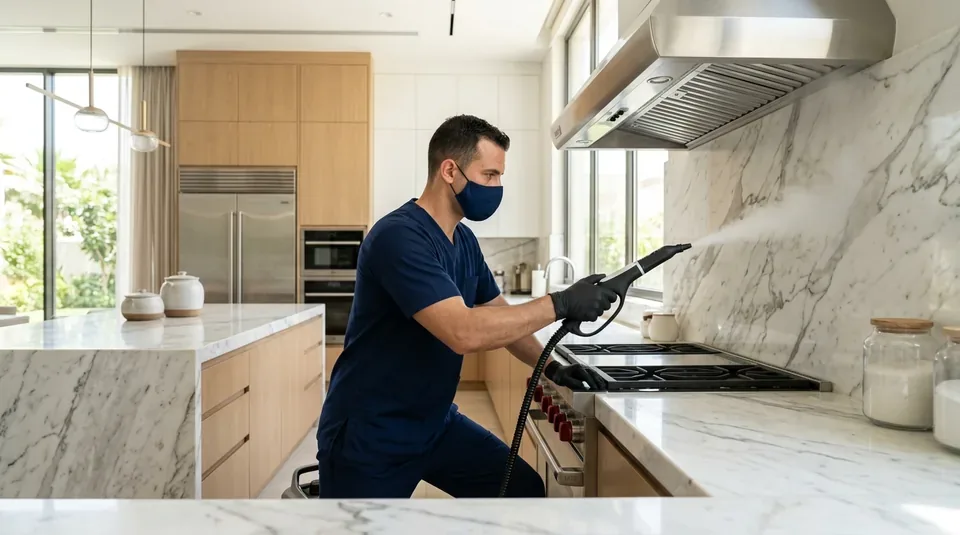
Professional deep-cleaning technician using precision steam to degrease kitchen countertops and range hood in a modern Saudi home

Executive Summary — Key Takeaways in This Guide:

  • Why airborne cooking oils combine with coastal humidity and fine dust to form polymerized resin layers.
  • Compatibility matrix matching safe degreasing chemistry and pads to aluminum, cladding, wood, acrylic, marble, and stainless steel.
  • Step-by-step protocol for degreasing range hood baffle filters, exhaust blowers, and oven interiors without damaging heating elements or sensors.
  • Why cleaning concealed zones (under refrigerators, behind stoves, and inside cabinet hinges) is critical to preventing German cockroach infestations.
  • Clear criteria distinguishing routine weekly kitchen upkeep from professional steam-assisted deep degreasing.
Technical Analysis Matrix

Kitchen Surface & Cabinet Material Degreasing Compatibility Matrix

Matching the right emulsification method and non-scratch tool to each kitchen surface material

Surface / Material TypeSafe Professional MethodForbidden Chemicals & ToolsProtection Note
Aluminum & ACP Cladding CabinetspH-balanced citrus/surfactant degreaser, directed steam, soft microfiber pad, and immediate buff-dryCaustic soda oven sprays, concentrated bleach, and steel woolStrong alkalis cause permanent gray oxidation and spotting on anodized aluminum frames
High-Gloss Acrylic & UV Lacquer DoorsNon-solvent gentle emulsifying foam applied with ultra-plush microfiber clothsGreen abrasive scouring pads, acetone/alcohol solvents, or gritty scouring powdersAbrasive scrubbing leaves permanent micro-swirl scratches that ruin the mirror-like gloss
Treated Wood, Veneer & PVC-Wrapped MDFLow-moisture surfactant wipe with immediate drying; avoid prolonged direct steam on edge bandingFlooding cabinets with water or blasting high-heat steam directly onto PVC edge seamsMoisture penetration into seams swells MDF cores and delaminates veneer edges
Stainless Steel Range Hoods & Baffle FiltersDismantle filters for thermal degreasing immersion; wipe hood exterior strictly along the metal grainSpraying liquid directly into the motor housing or scrubbing stainless steel in circular motionsElectrical switches and blower motors must be isolated before degreasing the inner hood canopy
Natural Marble, Granite & Quartz CountertopspH-neutral stone cleaner (pH 7) paired with surface steam around cooking hobsVinegar, lemon acid, acidic descalers, or harsh bleachAcids etch calcium-based natural marble immediately, leaving dull rough patches
Oven Chambers, Glass Doors & RacksRemove racks for soaking, soften carbonized grease with non-caustic paste and steam, and scrape glass with a 30-degree specialty bladeSpraying caustic aerosols onto heating elements, thermostats, or convection fan intakesCaustic residue on heating elements emits toxic fumes and acrid odors when the oven is next heated

Field Diagnostic Checklist for Kitchen Grease & Hygiene Issues

Practical indicators revealing grease polymerization depth and secondary hygiene risks

Indicator #1Medium–High (Progressive finish degradation)

Sticky, tacky amber film on top of upper cabinets and hood handles that resists normal wiping

Root Cause: Airborne cooking oil vapors oxidizing with fine dust into a cross-linked polymerized resin

Apply controlled steam softening and material-safe emulsifying cleaner followed by microfiber extraction
Indicator #2High (Fire hazard & motor strain)

Weak range hood suction, lingering frying odors in living areas, and amber oil droplets dripping from baffles

Root Cause: Saturated mesh/baffle filters and grease buildup weighing down the internal blower wheel

Dismantle filters for hot alkaline-safe soaking and carefully degrease the internal blower housing
Indicator #3High (Active pest breeding harborage)

Sightings of small German cockroaches near cabinet hinges or under the stove despite visibly mopped floors

Root Cause: Warm grease films and food crumbs trapped underneath heavy appliances and inside concealed hinge cups

Pull out appliances for deep steam degreasing and coordinate targeted gel baiting in hinges
Indicator #4Medium (Visual discoloration & bacterial biofilm)

Darkened, stained tile grout lines on the backsplash behind the stove and around the sink basin

Root Cause: Porous cementitious grout absorbing oil splatters and moisture biofilm forming along silicone joints

Detail-brush grout lines using pressurized steam and alkaline stone-safe cleaner without raw acid
Indicator #5High (Indoor smoke & flavor contamination)

Acrid smoke or burning smell whenever the gas or electric oven is preheated

Root Cause: Carbonized fat splatters baked onto the oven floor, inner glass door, and wire racks

Apply non-caustic carbon-lifting paste, safely blade-scrape tempered glass, and rinse thoroughly
Indicator #6Medium–High (Odors & drain pest attraction)

Persistent foul odor rising from the kitchen sink drain and floor trap even after washing dishes

Root Cause: Congealed cooking fats and organic sludge coating the inner walls of the sink P-trap and floor drain

Flush and sanitize strainer baskets, P-traps, and floor drains using steam and pipe-safe enzymatic degreasers
In-Depth Technical Guide

In-Depth Technical Guide: Professional Kitchen Degreasing Step by Step

Comprehensive methodology covering cabinetry, extraction hoods, ovens, backsplashes, and under-appliance zones

Module 1: 1. Chemistry of Kitchen Grease

Why Cooking Vapors Transform into Stubborn Polymerized Resin Layers

During high-heat frying, grilling, and simmering, microscopic lipid droplets become aerosolized in rising steam plumes and settle onto upper cabinet ledges, range hood canopies, and wall tiles. Within the first 24 hours, fresh oil film is liquid and easily wiped away. However, when left exposed to kitchen heat and oxygen over weeks, unsaturated fatty acids undergo thermal oxidation and cross-linking polymerization—hardening into a tenacious, varnish-like resin that traps airborne dust.

In Jeddah, elevated coastal humidity accelerates the bonding of fine dust into this sticky lipid matrix, while in Makkah, intensive multi-course family cooking and seasonal hospitality routines build dense multi-layered deposits above cabinetry and around exhaust vents. Standard household dish soap lacks the surfactant strength to penetrate polymerized resin, often just smearing the tacky film across adjacent surfaces.

Professional remediation relies on thermal-chemical synergy rather than destructive abrasion. First, controlled high-temperature steam softens the cross-linked resin matrix; second, a material-matched emulsifying surfactant breaks the surface tension between the grease and the cabinet substrate, allowing complete suspension and removal with plush microfiber cloths.

Core Technical Principles:

  • Allow emulsifying cleaners 3–7 minutes of dwell time after steam softening before wiping polymerized grease.
  • Always spot-test any degreaser on an inconspicuous inner cabinet corner before treating front doors.
  • Follow a strict top-to-bottom sequence: cabinet crowns and hoods first, backsplashes and counters second, floors last.
  • Rotate clean microfiber cloths frequently to avoid re-depositing dissolved oils onto clean panels.
  • Buff surfaces dry immediately after rinsing to prevent water spotting and streak marks.
Field Specialist Pro-Tip:

Al Awael Pro Tip: After deep-cleaning the flat top ledges of high kitchen cabinets, keeping the upper surface dry and dust-free dramatically reduces future grease caking.

Module 2: 2. Cabinetry Material Care

Inside-Out Cleaning for Aluminum, Cladding, Wood & Acrylic Kitchen Cabinets

Modern kitchens across Jeddah and Makkah feature diverse cabinetry systems: moisture-resistant anodized aluminum with ACP cladding panels, mirror-finish high-gloss acrylic and UV lacquer boards, and natural wood veneer or PVC-wrapped MDF. Each substrate exhibits distinct chemical and mechanical sensitivities that dictate the cleaning protocol.

For aluminum and cladding kitchens, technicians use soft detailing brushes and precision steam nozzles to flush trapped crumbs and grease out of frame joints, drawer runners, and handle recesses—strictly avoiding caustic alkalis that etch anodized metal. For high-gloss acrylic doors, only non-solvent surfactant foams and high-GSM microfiber cloths are used to prevent micro-scratching.

For wooden and MDF cabinetry, moisture control is paramount. Shelves, interior walls, and door panels are cleaned using damp-wipe emulsification followed by immediate dry buffing. Special attention is dedicated to concealed cup hinges and soft-close dampers where grease and dust buildup often causes doors to sag or stick.

Cabinet Cleaning Checklist:

  • Clear or shield shelf contents to access interior corner seams and shelf-pin holes.
  • Degrease the upper cabinet crown ledge where the heaviest airborne oil and dust settle.
  • Detail-brush door handles, pulls, and finger-touch bevels using soft nylon bristles.
  • Sanitize cutlery drawers, dry-food pantry shelves, and the moisture-prone under-sink cabinet.
  • Clean and dry concealed metal hinges and drawer slides to prevent corrosion and pest harborage.
Important Safety Caution:

Critical Caution: Never scrub high-gloss acrylic or painted wood doors aggressively with melamine foam sponges, as they act as ultra-fine sandpaper and permanently dull the finish.

Module 3: 3. Range Hoods, Ovens & Appliances

Deep Degreasing Protocol for Range Hoods, Baffle Filters, Ovens & Microwaves

The kitchen range hood is the primary defense against indoor grease dispersion. Once its metal mesh or baffle filters become clogged with congealed fat, airflow drops drastically—forcing cooking vapors into adjacent hallways and living areas while straining the exhaust motor. During professional deep cleaning, filters are dismantled and immersed in a heated emulsifying bath that dissolves trapped grease inside every louver without warping the mesh.

With power safely isolated, technicians degrease the internal hood canopy and accessible blower housing to stop oil dripping onto the stove below, then polish the exterior stainless steel or tempered glass canopy. Built-in gas hobs, ceramic cooktops, and wall ovens receive equal precision: burner crowns, cast-iron grates, and oven racks are removed for separate soaking and carbon removal.

Inside the oven cavity and across the double-glazed viewing window, a non-caustic carbon-softening paste is applied and paired with steam and angled glass blades—strictly shielding heating elements, thermostat bulbs, and convection fan openings from moisture or chemical residue.

Appliance Detailing Checkpoints:

  • Clean gas burner ports and igniter electrodes carefully and dry completely to ensure an even blue flame.
  • Remove baked-on splatter from tempered oven door glass without scratching heat-reflective coatings.
  • Steam-sanitize microwave interiors using food-safe, odor-free methods.
  • Detail-clean refrigerator and freezer rubber door gaskets to remove crumbs and dark mold.
  • Polish dishwasher and refrigerator exteriors using fingerprint-resistant stainless steel care.
Module 4: 4. Backsplash, Stone & Drains

Restoring Backsplash Tiles, Grout Lines, Countertops & Sink Drains Safely

The backsplash wall behind the stove and the surrounding sink counter endure a dual assault: hot oil splatters on one side and hard-water limescale plus soap scum on the other. Because standard cementitious tile grout is porous, it absorbs cooking grease and turns dark brown or black, while white mineral scale encrusts faucet bases and sink rims.

Pouring raw hydrochloric acid (flash) onto countertops or stainless steel sinks to whiten grout is disastrous—instantly blackening stainless steel, peeling chrome faucet plating, and etching natural marble. Instead, Al Awael technicians pair pressurized steam nozzles and narrow grout brushes with stone-safe degreasers for backsplashes, using targeted non-corrosive descalers strictly on mineral deposits around sink fixtures.

Deep kitchen sanitation also addresses drainage hygiene: cleaning removable sink strainers, flushing the basin overflow channel, and treating the under-sink P-trap and floor drain grate to clear congealed grease and odor-causing biofilm.

Stone & Sink Protection Standards:

  • Strict prohibition of raw acids on natural marble, granite, quartz, and stainless steel sinks.
  • Deep steam sanitization of the perimeter joint around undermount and drop-in kitchen sinks.
  • Safe descaling and microfiber polishing of chrome and brushed-nickel kitchen faucets.
  • Scrubbing kitchen floor tiles, baseboards, and kick-plates beneath lower cabinets.
  • Full water recovery and floor drying prior to kitchen handover.
Module 5: 5. Kitchen Pest Prevention Synergy

How Deep Kitchen Degreasing Eliminates German Cockroach & Ant Attractions

Field inspections across Jeddah and Makkah consistently reveal that recurring German cockroach and household ant issues in kitchens are fueled by concealed grease deposits in zones daily mopping never reaches: beneath the refrigerator compressor, behind the stove, along dishwasher side gaps, and inside cabinet hinge cups. Not only do these lipid films feed pests, they also compete with professional gel baits and reduce bait uptake.

Furthermore, applying cockroach gel droplets onto greasy or dusty surfaces compromises adhesion and contaminates the bait matrix. When deep kitchen degreasing is performed prior to targeted pest control, competing food sources are eliminated and clean, dry micro-surfaces allow precision gel placements to work at peak effectiveness.

Accordingly, Al Awael cleaning teams systematically clean narrow side gaps beside ovens, vacuum and degrease under-appliance floor spaces, and dry damp under-sink cabinets—removing the triad of grease, warmth, and moisture that sustains kitchen pests.

Preventive Hygiene Integration:

  • Degreasing under refrigerators, stoves, and dishwashers removes primary hidden food sources.
  • Clean, grease-free cabinet hinges provide ideal surfaces if preventive gel baiting is needed.
  • Drying under-sink moisture and pipe condensation disrupts cockroach and ant survival.
  • Securing floor drain covers after sanitization blocks American cockroach entry from sewer lines.
  • When an active infestation exists, schedule deep kitchen degreasing before precision gel application.
Hyperlocal City Adaptation

How Jeddah & Makkah Environmental Conditions Impact Kitchen Hygiene

Adapting kitchen deep-cleaning protocols to Jeddah coastal humidity and Makkah hospitality intensity

Jeddah GovernorateJeddah Sectors Hub

Jeddah Kitchens: Coastal Humidity & Modern Open-Plan Layouts

Across Jeddah coastal, northern, and central districts, year-round high humidity binds with airborne cooking oils to create a dense, sticky film while accelerating surface oxidation on damp hinges and aluminum profiles. Additionally, the popularity of open-plan kitchens connected directly to living rooms in modern Jeddah apartments and villas means that clogged range hood filters quickly allow grease aerosols to settle onto nearby sofas, curtains, and split AC intakes.

In Jeddah, our teams prioritize restoring full range hood extraction efficiency, safely degreasing high-gloss acrylic and cladding cabinetry, and thoroughly drying metal fittings to prevent coastal corrosion.

  • North & Coastal Jeddah: Specialized care for open-plan kitchens, high-gloss acrylic doors, and marble islands.
  • Central Jeddah: Deep appliance and cabinet degreasing for busy family apartments and furnished units.
  • East Jeddah: Removing dust-bound grease films from upper cabinet crowns and window tracks.
  • South Jeddah: Full-scale sanitation for spacious family kitchens, pantries, and floor drains.

Makkah Kitchens: High-Volume Family Cooking & Seasonal Hospitality

Residences and family villas in Makkah frequently feature spacious main cooking kitchens alongside secondary prep kitchens that experience heavy culinary output—especially ahead of and during Ramadan, Eid, Hajj, and Umrah hospitality seasons. Extended daily stove and oven operation builds thick grease layers across multi-burner ranges, large exhaust hoods, tiled walls, and storage cabinets.

In Makkah, Al Awael protocols focus on heavy-duty steam degreasing for both main and prep kitchens, sanitizing bulk pantry shelving, and clearing floor drains to keep high-capacity kitchens spotless.

  • Al-Shawqiyyah & Southern Makkah: Intensive deep cleaning for large family and secondary prep kitchens.
  • Al-Awali & Eastern Makkah: Precision care for modern villa kitchens, built-in ovens, and stone counters.
  • Al-Aziziyah & Central Sectors: Efficient turnaround kitchen sanitization for residential and seasonal units.
  • Al-Taneem & Northern Makkah: Removing heavy grease and fine dust from upper cabinetry and exhaust fans.
Illustrative Service Scenario — For Educational Reference

Restoring a Family Kitchen with Polymerized Cabinet Grease & Clogged Range Hood Before Move-In

Property Context & Initial Challenge:

24 sqm main kitchen in a residential villa featuring aluminum-and-cladding cabinetry, granite countertops, and built-in appliances

Heavy amber resin buildup across upper cabinet crowns and door pulls, grease-logged range hood baffles, and baked-on carbon inside the wall oven, with the owner concerned about scratching the glossy cladding panels.

Outcome & Long-Term Prevention:

Cladding panels and stainless steel appliances regained their original streak-free finish without scratches, range hood suction was fully restored, and hidden pest attractants were eliminated.

Diagnostic Inspection Findings:

  • Thick oxidized lipid-and-dust layer covering the top crown ledges of upper wall cabinets.
  • Saturated stainless steel range hood baffles restricting airflow and causing vapor blowback onto adjacent doors.
  • Accumulated food crumbs and grease film underneath the refrigerator and inside lower cabinet hinges.
  • Darkened backsplash grout lines directly behind the 5-burner gas cooktop.

Technical Protocol Applied:

  • Dismantled hood baffles and oven racks for thermal emulsifying immersion while detailing the inner hood canopy.
  • Degreased upper cabinet crowns, glossy cladding doors, handles, and interior shelves using pH-balanced surfactant foam and plush microfiber.
  • Softened and lifted baked-on oven carbon using non-caustic paste, steam, and angled glass blades.
  • Steam-detailed backsplash grout lines, pulled out appliances to degrease floor spaces underneath, and sanitized the sink and floor drain.
Safe Decision Boundaries

When Routine Home Upkeep Suffices vs. When to Book Professional Deep Cleaning

Practical boundary criteria to help you decide the right level of kitchen care

Scenarios Suitable for Routine Home Cleaning:

  • Wiping fresh cooking oil splatters immediately after meal prep using warm water and mild dish soap.
  • Washing removable metal range hood filters every 2–3 weeks before grease oxidizes and hardens.
  • Daily wiping of countertops and sink basins followed by drying around faucet bases.
  • Light steam-loosening inside microwaves after heating a bowl of water.
  • Emptying kitchen waste bins daily and clearing sink strainer baskets after dishwashing.

Triggers Requiring Professional Deep Kitchen Cleaning:

  • Sticky, amber polymerized grease coating upper cabinet crowns, doors, and hood canopies.
  • Moving into a previously occupied villa or apartment requiring complete kitchen sanitization before storing cookware.
  • Heavy carbonized fat inside ovens, clogged range hood blowers, and grease buildup under heavy appliances.
  • Preparing large main and prep kitchens ahead of Ramadan, Eid, or seasonal hosting.
  • Performing foundational kitchen degreasing to eliminate food sources alongside cockroach or ant control.

Professional Scope Note: Deep kitchen cleaning safely removes polymerized grease, carbon, and mineral scale, but does not repaint previously peeled cabinet finishes or repair mechanical/electrical faults in oven heating elements or hood motors.

Frequently Asked Questions

Frequently Asked Questions About Kitchen Deep Degreasing

Clear technical answers on degreasing safety, visit duration, and appliance protection

Do I need to empty all kitchen cabinets before the cleaning team arrives?+

If you only require exterior cabinet degreasing, upper crowns, range hood, oven, and backsplash cleaning, cabinets can remain stocked. For full interior shelf and drawer sanitization, emptying items beforehand or coordinating section-by-section clearing with our crew ensures thorough corner access.

Will degreasing solutions dull high-gloss acrylic doors or discolor aluminum frames?+

No. We strictly prohibit caustic soda sprays and raw acids on cabinetry. Instead, we match pH-balanced surfactant emulsifiers and controlled steam to each material type, wiping only with non-scratch microfiber to preserve acrylic gloss and anodized aluminum.

Does the cleaning leave strong chemical fumes inside the oven or kitchen?+

No. By using non-caustic carbon pastes, high-temperature steam, and thorough fresh-water rinsing across oven cavities, microwaves, and countertops, the kitchen is left odor-free and ready for food preparation.

How long does a deep kitchen cleaning session take in Jeddah or Makkah?+

Duration depends on kitchen size, cabinet count, grease thickness on hoods and ovens, and whether interior shelving is included. We assign an appropriately sized crew to complete the entire kitchen within a single scheduled visit.

Do technicians pull out the refrigerator and stove to clean underneath and behind them?+

Yes, whenever appliances are freestanding and utility connections allow safe movement without straining gas lines or plumbing, our team pulls them forward to degrease the floor and wall behind them.

If I have small kitchen cockroaches, should I book deep cleaning or pest control first?+

Technically, performing deep kitchen degreasing first followed by targeted gel baiting yields the best results. Removing grease eliminates competing food sources so cockroaches readily consume the gel bait, and prevents fresh bait placements from being washed away during scrubbing.

Can deep kitchen degreasing be booked as part of a full home or villa cleaning package?+

Absolutely. Deep kitchen degreasing is a core pillar of our full home and villa deep-cleaning services in Jeddah and Makkah, and the scope can be tailored to prioritize your kitchen, majlis, and bathrooms.

Unified Service Request Builder

Share Your Request Details for Scheduling & Transparent Pricing

Enter your basic contact details, select your city (Jeddah or Makkah), and choose the service you need. This form organizes your inquiry for immediate coordination.

We respect your privacy. Your information is used strictly to respond to your service inquiry.
CallWhatsAppGet Quote