
Serving Jeddah & Makkah
Home care guide11 min readJeddah

Oud and Bakhoor Smoke Residue: Ceilings, Curtains, Sofas and Walls in Jeddah

Burning incense is a lovely habit in many homes, but its smoke leaves a grey film and a heavy scent on surfaces and fabrics if they are not cared for.

Many families in Jeddah scent their homes daily or for occasions, a habit tied to hospitality, cleanliness and pleasant fragrance. But oud and bakhoor smoke carries tiny particles that settle over time on ceilings, curtains, walls and sofas, leaving a faint yellow or grey tint in the corners above the burner and a strong scent in fabrics.

This guide differs from our after-hosting guide because it focuses on the slow build-up in homes that use incense regularly: how to clean each surface the right way and how to reduce the build-up at the source by adjusting how you burn incense and ventilate. It does not promise to remove every trace in every case, since some fabrics and paints may keep a little tint or scent.

Our service is cleaning, not repainting or repairing damaged fabrics. If yellowing is deep in the paint, the wall may need repainting, and at the inspection we will tell you honestly what can be cleaned and what cannot.

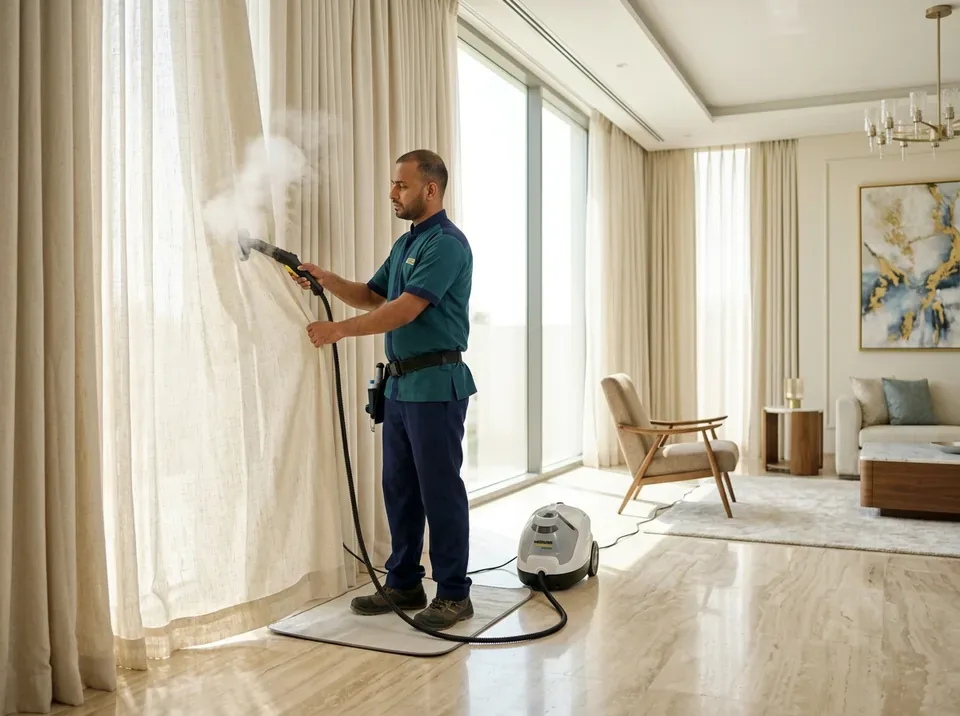
Living room in a Jeddah home after cleaning oud and bakhoor smoke residue

Quick Summary

  • Smoke collects most on the ceiling above the burner and on curtains near it
  • Start with ventilation and less smoke at the source so build-up does not return quickly
  • Painted walls are wiped with a slightly damp cloth after testing a hidden spot
  • Fabrics and sofas need airing and cleaning suited to the fabric, not perfume spraying
  • Place the burner on a heat-resistant surface away from curtains for safety and cleanliness

The ceiling and upper corners

Smoke gathers high above the burner and in ceiling corners where air is still, giving a grey or yellowish tone. Start by dusting dry with a long soft duster or a vacuum with a soft brush, so you do not turn dust and soot into mud when you wipe with water.

Then wipe with a microfibre cloth lightly dampened in lukewarm water with a very small drop of mild liquid soap, followed by a second clean cloth with plain water. Work in small sections and dry each with a dry cloth so rings and streaks do not form on the paint.

Always test a small hidden spot first, because some matt paints react to rubbing and show shiny patches. If yellowing remains after gentle cleaning, the smoke has probably soaked into the paint itself and repainting may be needed.

Remember that ladders or step stools used to reach the ceiling must be stable and suited to the height, and the work should be done in short stages so you do not strain your shoulders and neck. If the ceiling is high, as in villas with double-height halls, it is better to use a trained team than to climb alone.

Before wiping paint

  • Dust dry first
  • Test a hidden spot with a barely damp cloth
  • Work in small sections and dry each one
  • Avoid hard rubbing and abrasive products

Walls, frames and nearby shelves

Walls near the burning area collect a thin greasy film of smoke that catches dust easily. Wipe them from top to bottom the same way, and treat each wall separately so you do not carry dirt from one to another.

Frames, shelves and ornaments near the burner need a wipe with a barely damp cloth and then drying, taking care with wooden and gilded items that cannot tolerate much water. For polished wood use only a nearly dry cloth.

Mirrors and glass close to the burner can develop a cloudy greasy film. Use lukewarm water with a little white vinegar and dry with a clean cloth to prevent streaks, as in our streak-free glass guide.

Curtains near the burner

Curtains hold the scent most because of their large area and direct exposure to smoke. The first step is to take them down and air them outdoors, away from direct sun, for several hours. In many cases this alone lifts part of the scent.

Read the care label before washing. Some curtains tolerate a gentle machine wash in cold water on a light cycle, others need dry cleaning or steam. Heavy fabrics, velvet and embroidered curtains should not be washed at home unless the label clearly allows it.

Do not spray perfume or fabric fresheners on curtains to cover the smell. Mixing scents can make them heavier, and perfumes may mark some fabrics. Airing and suitable washing are better and safer.

Sofas, cushions and rugs

Smoky dust can be removed from sofas with a vacuum and soft brush, then airing detachable cushions in a shaded place. Do not soak the sofa, because extra moisture in Jeddah can leave a musty smell instead of a smoke smell, as we explained in our guide on damp smell after cleaning.

A thin layer of baking soda can be sprinkled on suitable fabric, left for an hour and vacuumed up to absorb some of the scent. Test a small spot first and avoid this method on velvet and leather.

For heavier cases where the scent has settled into the padding, deep extraction cleaning may suit after inspecting the fabric, and we will tell you what to expect without exaggerated promises.

Do not forget pillow covers, throws and small rugs near the burning area, since they absorb scent quickly. Wash those that can be washed according to the care label, and air the rest on a balcony or roof for a few hours when the air is not dusty.

How and where you burn

Choose a spot for the burner away from curtains, sofas and low ceilings, ideally a stable heat-resistant surface out of children’s reach. This protects your home from heat and reduces smoke reaching fabrics.

Use a moderate amount of incense rather than large quantities, and open a window or run the extractor during burning and for half an hour afterwards. Ventilation draws out many fine particles before they settle on surfaces.

It is best to avoid burning incense in closed bedrooms or near infants or anyone with a respiratory sensitivity, and if you notice coughing or shortness of breath, speak to a doctor. This is general advice, not medical advice.

You can also dedicate one corner of the home to burning incense instead of moving the burner between rooms. This confines smoke traces to one easy-to-clean place and protects other rooms, especially bedrooms and living areas, from gradual build-up of soot and scent.

A simple maintenance routine

Set one week a month for dusting ceilings and upper corners and wiping nearby shelves and frames, and another week for airing curtains and cushions outdoors. Splitting the jobs makes them easier than an exhausting deep clean every few months.

Washing light curtains two or three times a year in homes that burn incense often prevents a heavy film from building up, and sticking to the schedule means the fabric colour does not change.

If you use electric burners instead of charcoal there may be less soot, but scent and particles remain, so ventilation and regular cleaning are still needed.

Plan

Quick table for incense residue cleaning

A simple table that organises what to clean and how in homes that burn incense often.

SurfaceMethodSuggested frequency
Ceiling and cornersDry dust then barely damp wipeMonthly
Nearby wallsGentle top-to-bottom wipeEvery two months
Frames and shelvesWipe and dryEvery two weeks
CurtainsAiring and washing or cleaning by fabric2 to 3 times a year
Sofas and cushionsVacuum, air, baking soda if suitableMonthly
Mirrors and glassWater, light vinegar, dryEvery two weeks
FAQ

Common questions about incense smoke residue

Short answers to what homeowners ask most.

Can ceiling yellowing be removed completely?+

Sometimes it fades a lot with gentle cleaning, but if smoke has soaked into the paint it may need repainting.

Should I spray perfume on curtains to hide the smell?+

We advise against it. Airing and suitable washing are better, and perfume can stain or make the scent heavier.

Can I machine wash my curtains?+

Only if the care label allows it, in cold water on a light cycle. Otherwise dry cleaning or steam is more suitable.

How often should I clean the ceiling and walls?+

In homes that burn incense often, roughly monthly for the ceiling and every two months for nearby walls.

Is baking soda suitable for sofas?+

It can help on some light fabrics after a spot test. Avoid it on velvet and leather.

Do you guarantee the smell will be completely removed?+

We do not promise to remove every trace, as some fabrics keep a faint scent. We tell you what is possible at inspection.

Do you offer repainting?+

No, our service is cleaning. Repainting needs a painting specialist.

Need help cleaning your home in Jeddah?

Send us the property type, size and what you want cleaned on WhatsApp and we will arrange the details and preparation that suit you.

CallWhatsAppGet Quote