
Serving Jeddah & Makkah
Structural Rodent Diagnostics & Exclusion Guide — Jeddah & Makkah14 min diagnostic & action guideJeddah & Makkah

Rodent Sounds in False Ceilings & Courtyards: Accurate Identification & Odor-Free Structural Exclusion

A complete field guide for villa and apartment owners in Jeddah and Makkah to pinpoint nocturnal ceiling scratching, differentiate roof rats from sewer rats and house mice, and implement safe mechanical trapping and exclusion.

Hearing distinct scratching, rapid scurrying, or rhythmic gnawing directly above gypsum board false ceilings after midnight is one of the most distressing household problems reported across villas and residential buildings in Jeddah and Makkah. The concealed plenum space between the structural concrete slab and decorative suspended drywall creates an undisturbed sanctuary for climbing rodents—offering thermal insulation, total darkness, protection from human activity, and an interconnected highway linking bedrooms, lounges, and kitchens via central AC ducts and electrical cable trays.

The severity of a false-ceiling rodent intrusion stems from two compounding hazards. First is the immediate physical and sanitary risk: rodents continuously gnaw on PVC electrical wire insulation inside ceiling voids to wear down their ever-growing incisors, creating serious short-circuit and fire hazards while contaminating ceiling panels and air pathways with urine and droppings. Second is the widespread DIY mistake of tossing loose poison pellets or wax blocks through spotlight cutouts—a practice that almost guarantees a rodent will die deep inside an inaccessible gypsum cavity, subjecting the family to weeks of putrid decomposition odors and secondary blowfly infestations.

This comprehensive diagnostic guide equips homeowners and facility managers in Jeddah and Makkah with a structured, field-tested methodology. You will learn how to identify the exact rodent species by acoustic cues and dropping morphology, locate hidden architectural entry points around split-AC wall sleeves and courtyard trees, and understand why professional Integrated Pest Management (IPM) strictly separates indoor mechanical trapping from exterior key-locked tamper-resistant bait stations and permanent structural exclusion.

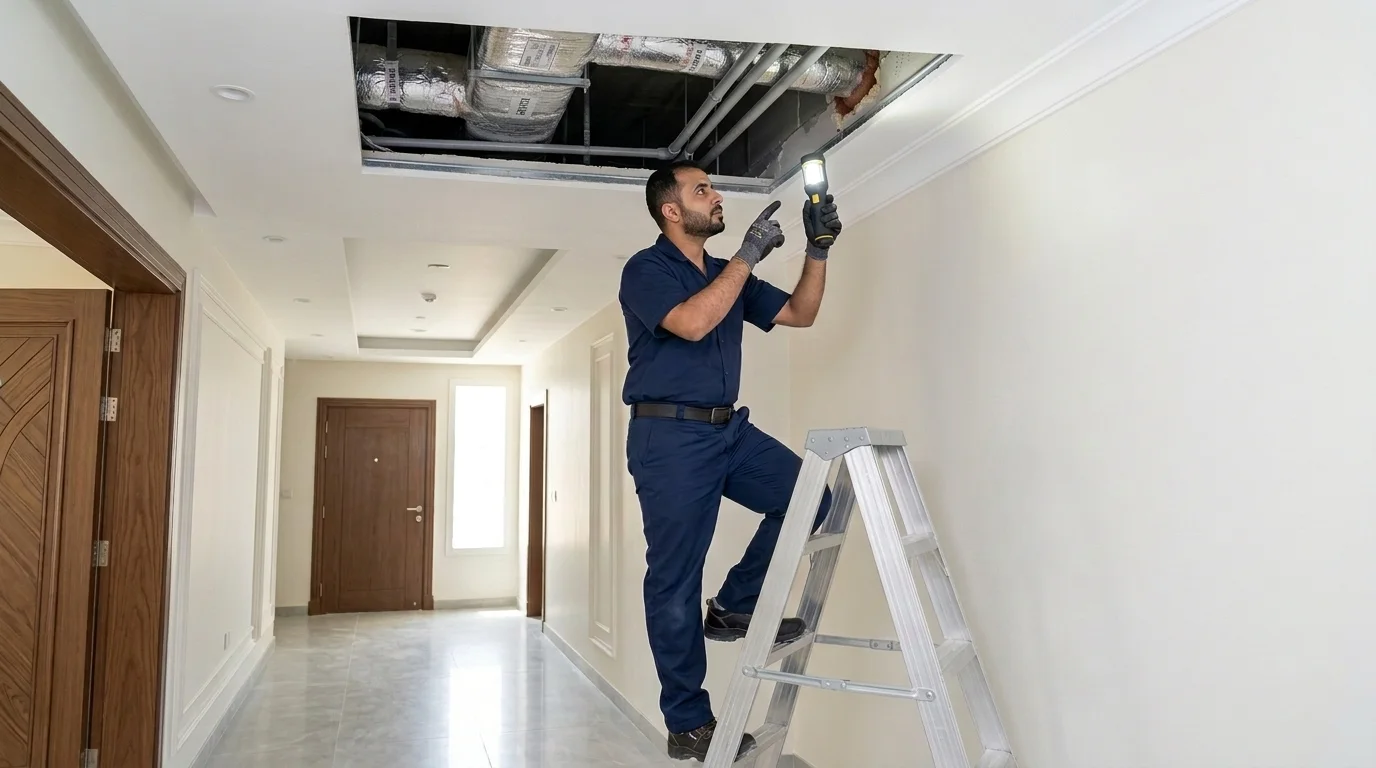
Technical inspection of false ceiling access panels and AC conduit entry points for rodent exclusion in a Jeddah villa

Executive Summary — Key Takeaways in This Guide:

  • Acoustic & Behavioral Identification: Nocturnal movement inside suspended ceilings and upper utility shafts almost always points to the agile Roof Rat (Rattus rattus), whereas soil burrows under patio pavers and inspection chambers indicate the heavy Norway Rat (Rattus norvegicus).
  • Strict Ceiling Rule: Never place chemical rodenticide baits inside enclosed gypsum ceilings, drywall partitions, or AC plenums; poisoned rodents retreat to tight crevices before dying, creating severe odor crises that often require cutting open ceiling boards.
  • Primary Architectural Entryway: Over 80% of false-ceiling rodent intrusions in Jeddah and Makkah villas originate from unsealed annular gaps around split-AC copper refrigerant pipes, open roof pergola conduits, or tree branches overhanging the parapet wall.
  • Child & Pet Safety Standard: In exterior courtyards and perimeter setbacks, SFDA-registered rodenticides must only be deployed inside heavy-duty, key-locked tamper-resistant bait stations anchored securely to walls or paving.
  • Permanent Structural Exclusion: Trapping existing rodents without sealing entry holes using galvanized steel hardware cloth, copper mesh, and gnaw-resistant cementitious mortar leaves pheromone trails intact for new neighbourhood rodents to follow.
Technical Analysis Matrix

Diagnostic Identification Matrix: Differentiating the 3 Domestic Rodent Species

Identifying the exact species dictates trap selection, vertical vs. ground placement, and the minimum gap diameter required for structural sealing.

Diagnostic CriterionRoof Rat (Rattus rattus)Norway / Sewer Rat (Rattus norvegicus)House Mouse (Mus musculus)
Preferred Habitat & Travel RouteAgile aerial climber; inhabits gypsum false ceilings, upper utility shafts, palm crowns, pergolas, and roof gables.Ground burrower; lives in sewer networks, inspection chambers, beneath patio pavers, ground-floor storerooms, and garden beds.Indoor nesting specialist; hides behind refrigerators, inside lower kitchen cabinets, cardboard storage boxes, and appliances.
Nocturnal Acoustic SignatureBrisk, light-footed scurrying interspersed with hops and sharp gnawing directly on drywall panels between 11 PM and 4 AM.Heavier, thudding footsteps, soil digging noises, or aggressive gnawing on plastic drain grates and lower door thresholds.Faint, rapid pattering accompanied by high-frequency nibbling inside cabinetry, pantry drawers, or hollow partition walls.
Dropping Size & Morphology12–13 mm long, spindle-shaped and slightly curved with pointed ends; scattered along overhead beams and ceiling ledges.18–20 mm long, thick capsule-shaped with blunt, rounded ends; deposited in distinct clusters along ground-level walls.3–6 mm long, tiny dark rod-shaped pellets with pointed tips (resembling black rice grains); found near food packages.
Minimum Entry Aperture12 mm (approx. 1/2 inch) annular gap around split-AC copper lines, roof eaves, or ventilation louvers.15–18 mm gap beneath exterior courtyard doors, cracked manhole covers, or subsided perimeter tile joints.6 mm (approx. 1/4 inch—pencil width) gap under interior doors, around electrical conduits, or cabinet kickplates.
Reaction to New Objects (Neophobia)Highly neophobic; actively avoids newly placed traps or bait stations for several days until acclimated to their presence.Strongly suspicious of unfamiliar objects along ground runways; prefers high-protein, moist, or greasy food attractants.Naturally curious explorer; investigates new traps within hours of placement and feeds frequently on seeds and cereals.
Primary Control & Exclusion ProtocolPre-baited mechanical snap/multi-catch traps inside ceiling voids + branch trimming + sealing split-AC wall penetrations.Exterior key-locked tamper-resistant stations + one-way sewer backflow valves + collapsing and concreting ground burrows.Enclosed mechanical or adhesive traps behind appliances + strict food container sealing + interior crevice proofing.

Field Diagnostic Checklist for Ceiling & Courtyard Rodent Infestations

Evaluate these six physical indicators to determine risk severity and select the appropriate corrective response.

Indicator #1High (Immediate risk to lighting & AC wiring)

Scratching and rapid scurrying above gypsum boards starting shortly after lights-out along a fixed overhead path

Root Cause: Active Roof Rat foraging or nest-building inside the ceiling plenum after entering via an elevated exterior breach.

Inspect via the nearest AC access hatch or spotlight cutout and deploy pre-baited mechanical traps—never loose poison.
Indicator #2High (Confirmed active highway and entry point)

Dark, greasy smudge marks (sebum rub marks) around split-AC wall penetrations, pipes, or utility shaft ledges

Root Cause: Repeated physical contact of oily rodent fur and body dirt rubbing against the exact same structural entry hole nightly.

Verify whether rodents are currently inside or outside, trap existing individuals, and seal the gap with steel mesh and mortar.
Indicator #3High (Structural tile subsidence & rapid breeding)

Freshly excavated soil mounds or sunken patio tiles along perimeter boundary walls and courtyard planter beds

Root Cause: Subterranean burrowing by Norway (sewer) rats constructing cool underground harborage beneath courtyard paving.

Deploy anchored, key-locked tamper-resistant bait stations along the perimeter wall and inspect sewer manholes before sealing.
Indicator #4Critical (Active indoor breeding & litter production)

Shredded fiberglass insulation, foam crumbs, or gypsum dust trickling down from spotlight fixtures or cove lighting

Root Cause: Pregnant female rodents tearing up thermal or acoustic insulation inside the ceiling void to line a maternal nest.

Urgent professional trapping to capture breeding adults, extract nesting material, and sanitize the cavity before juveniles disperse.
Indicator #5Critical Sanitary Hazard (Airborne allergen & pathogen risk)

Sharp, musky ammonia-like urine odor noticeable when central AC starts or inside upper kitchen cabinetry

Root Cause: Accumulation of rodent urine pillars and droppings soaking into porous gypsum boards near return-air plenums.

Eliminate the rodent population mechanically, seal the ceiling envelope, and perform professional disinfection and odor neutralization.
Indicator #6Moderate to High (Imminent indoor breach)

Fresh parallel incisor gnaw marks (2–4 mm wide) on lower wooden annex doors or plastic courtyard drain grates

Root Cause: Rodents actively enlarging structural gaps to gain access to indoor food storage or plumbing moisture.

Replace plastic drain covers with heavy brass/stainless-steel grates and install galvanized metal door sweeps on exterior doors.
In-Depth Technical Guide

In-Depth Engineering & Field Protocols for Ceiling & Courtyard Rodent Management

Five technical modules detailing rodent biology in Saudi architecture, why loose ceiling poison fails, and permanent structural exclusion.

Module 1: Module 1: Building Physics & Rodent Behavior

Why Gypsum False Ceilings Become Prime Sanctuaries for Roof Rats

To understand why nocturnal scratching concentrates above bedrooms and family lounges, one must examine modern suspended ceiling architecture in Jeddah and Makkah through the lens of rodent ecology. The concealed plenum void between the structural reinforced concrete slab and decorative gypsum board typically spans 25 to 60 centimeters in height. This enclosed cavity is pitch-dark, completely shielded from human foot traffic and outdoor predators like stray cats, and thermally moderated by cool air radiating from central AC ductwork—offering a climate-controlled refuge when outdoor Saudi summer temperatures exceed 42°C.

Biologically, the Roof Rat (Rattus rattus) is an evolved arboreal climber. Equipped with a prehensile-like tail longer than its combined head and body for counterbalance, alongside specialized plantar footpads and sharp claws, it effortlessly traverses overhead galvanized suspension wires, electrical cable trays, and flexible HVAC ducts, and can scale rough stucco walls or vertical plumbing stacks at a 90-degree angle. Once a single roof rat breaches the ceiling void of one room, it utilizes unsealed fire-stop penetrations and utility pass-throughs above partition walls to roam across the entire floor plate without ever descending into living spaces during daylight hours.

Compounding the structural threat is the physiological reality of rodent dentition: a rat’s four open-rooted incisors grow continuously throughout its life at a rate of roughly 10 to 12 centimeters per year. To keep these chisels worn down and sharp, rodents engage in compulsory gnawing on hard substrates inside the ceiling void. Inside a gypsum plenum, the primary targets of this incessant gnawing are PVC electrical wire jackets, spotlight transformer cables, elastomeric AC refrigerant insulation, and condensate drain pipes—explaining why ceiling rodent infestations frequently trigger unexplained breaker trips, flickering LED spotlights, or sudden ceiling water stains.

Key Structural Takeaways on False Ceiling Intrusions

  • The 25–60 cm plenum between concrete slabs and gypsum boards offers an insulated, dark microclimate safe from extreme heat and predators.
  • Roof rats possess specialized footpads and long balancing tails that allow effortless travel along suspension wires and ductwork.
  • Unsealed utility pass-throughs above interior partition walls turn the ceiling void into a continuous highway across the entire home.
  • Relentless gnawing inside the ceiling is a biological necessity to wear down continuously growing incisors, not merely food foraging.
  • Sudden spotlight failures, tripped electrical breakers, or condensate leaks often stem from rodent damage to hidden ceiling utilities.
Field Specialist Pro-Tip:

Diagnostic Pro Tip: If scratching sounds consistently travel toward an exterior wall around 11 PM–1 AM and return inward near dawn, the rodent is using your ceiling solely as a daytime dormitory while foraging outdoors in the courtyard or shaft at night.

Important Safety Caution:

Electrical Safety Warning: If ceiling spotlights flicker or trip a circuit breaker alongside audible scratching, switch off that lighting sub-breaker immediately and inspect the wiring harness through an access hatch to prevent short-circuit fires.

Module 2: Module 2: Architectural Entry Pathways

How Do Rodents Reach the Ceiling? The 6 Most Common Architectural Breaches in Jeddah & Makkah

Homeowners frequently ask in disbelief: "All our villa doors and windows have tight screens and remain shut—how did a rat get inside the second-floor gypsum ceiling?" Field inspections across Jeddah and Makkah reveal that roof rats rarely enter through ground-level living areas. Instead, they scale exterior elevations and utility shafts to breach the ceiling plenum directly from the outside. The number-one culprit is the annular wall penetration drilled for split-unit air conditioners. During AC installation, technicians core a 60–80 mm hole through the exterior block wall to pass copper refrigerant lines and condensate hoses. Because indoor evaporator units are mounted high near the ceiling cornice, these holes frequently intersect the gypsum cavity and are either left wide open or plugged with soft polyurethane expanding foam that a rat chews through in minutes.

The second major infiltration highway is the vertical plumbing and ventilation shaft (service duct or manwar). Exposed PVC drainage stacks, water supply risers, and AC trunking mounted along interior courtyard shafts act as vertical ladders. A rat climbing from a ground-level inspection chamber or courtyard floor uses the narrow gap between the pipe and the wall for back-leveraged climbing, entering the ceiling void via unscreened bathroom exhaust fan louvers or unsealed hot-water pipe sleeves above bathroom false ceilings—subsequently crossing over partition walls into master bedrooms.

In landscaped villas featuring clay roof tiles (qarmid), wooden pergolas, or mature perimeter trees, overhanging branches of ficus, bougainvillea, or date palms touching the facade serve as aerial bridges. Roof rats can leap horizontally up to one meter from a swaying branch onto a roof parapet or beneath curved Spanish roof tiles. Similarly, exterior electrical feeder cables, fiber-optic conduits, and unsealed structural expansion joints between adjacent buildings provide continuous vertical runways directly into upper roof eaves and false ceilings.

Top 6 Structural Entry Points to Inspect Around Your Property

  • Unsealed core-drilled wall holes around split-AC copper lines and drain hoses—especially those filled only with soft yellow foam.
  • Gaps around bathroom/kitchen exhaust fan ducts and water heater pipes opening into vertical service shafts above false ceilings.
  • Overhanging palm fronds, ficus limbs, and climbing vines growing within one meter of roof parapets, balconies, or window ledges.
  • Open decorative clay roof tile (qarmid) eaves and ridge caps lacking galvanized bird/rodent wire mesh barriers.
  • Cracked courtyard manhole covers and clearance gaps exceeding 12 mm beneath exterior annex and storage doors.
Field Specialist Pro-Tip:

The Pencil & Thumb Gauge Rule: Any gap that admits a standard pencil (6 mm) can pass a juvenile house mouse; any hole around an AC pipe wide enough to insert your thumb tip (12–15 mm) allows an adult roof rat to compress its ribcage and squeeze through.

Important Safety Caution:

Exclusion Timing Warning: Never permanently seal an exterior AC wall penetration before trapping and verifying that no live rodent remains trapped inside the ceiling void—a trapped rat will chew aggressively through drywall or wiring or die inside the cavity.

Module 3: Module 3: Critical Technical Warning

Why Tossing Loose Poison into False Ceilings Is a Costly Mistake—And How Mechanical Trapping Works

When confronted with midnight scratching overhead, many frustrated residents—and even untrained handymen—pull down a recessed spotlight fixture and toss loose rodenticide pellets, grain packets, or wax blocks into the gypsum void. From a building-hygiene standpoint, this is the single worst error one can make. Modern registered anticoagulant rodenticides are purposefully formulated with a delayed mode of action (taking 3 to 7 days to take effect) to prevent bait shyness among colony members. However, as an intoxicated rat begins experiencing internal lethargy around day four, its survival instinct drives it deep into the tightest, most inaccessible corner of the ceiling plenum, wall cavity, or insulation blanket to die.

When a 200-to-350-gram rat carcass decomposes inside an enclosed ceiling void under the warm ambient conditions of Jeddah or Makkah, the result is a severe indoor environmental crisis. Putrefaction begins within 24 hours, releasing volatile sulfur compounds, cadaverine, and putrescine that permeate porous gypsum board and circulate through central AC return plenums for two to four weeks. Worse still, decomposition odors attract blowflies and flesh flies from outdoors; within days, maggots may crawl through light fixtures followed by swarms of large metallic flies inside bedrooms—frequently forcing the homeowner to cut open and demolish expensive drywall sections just to locate and extract the decaying carcass.

Consequently, professional indoor and ceiling rodent management strictly prohibits loose chemical baiting inside structural voids, relying instead on Targeted Mechanical Trapping. Technicians inspect the plenum through AC maintenance hatches using endoscopic or angled inspection mirrors to locate active runways and rub marks. High-impact mechanical snap traps or enclosed capture devices are then positioned directly perpendicular to wall runways inside retrieval trays. To overcome roof rat neophobia, specialists often employ a "pre-baiting" phase—applying high-aroma non-toxic food attractants (such as peanut butter, oats, and dried fruit) to unset traps until confident feeding is established, then arming the traps for instantaneous, humane capture at a known, easily retrievable access point.

Why Mechanical Trapping Replaces Poison Inside Ceiling Voids

  • Delayed-action rodenticides cause rats to crawl into unreachable drywall corners or insulation pockets before dying.
  • A single decomposing rat inside a warm ceiling void generates unbearable putrid odors for 2–4 weeks and breeds blowflies.
  • Loose poison pellets above ceilings risk sifting through light cutouts or causing secondary poisoning if a sluggish rat stumbles into a pet area.
  • Mechanical traps tethered near AC inspection hatches ensure immediate capture at a known point for clean, odor-free removal.
  • Pre-baiting unset traps with targeted food attractants overcomes roof rat neophobia and maximizes rapid capture rates.
Field Specialist Pro-Tip:

Tethered Trap Retrieval Tip: Always tether ceiling snap traps with a thin braided wire anchored just inside the AC access hatch—allowing safe, effortless pull-back retrieval without reaching blindly into the dark plenum.

Important Safety Caution:

Critical Caution: Never place lightweight cardboard glue boards unsecured inside false ceilings for adult rats. A strong roof rat can drag an unanchored glue tray deep into an unreachable ceiling corner, dying out of reach and causing the exact odor problem you sought to avoid.

Module 4: Module 4: Courtyard Safety & Tamper-Resistant Stations

Protecting Children & Pets in Villa Courtyards: How Key-Locked Tamper-Resistant Stations Work

While chemical rodenticides have no place inside enclosed ceiling voids, controlling rodent pressure across exterior villa courtyards, side setbacks (irtidad), boundary walls, and sewer inspection zones requires a robust perimeter defense that intercepts rats before they scale the building facade. However, placing open trays of poisoned grain or loose wax blocks under garden shrubs or behind patio gas cylinders creates an unacceptable poisoning hazard for curious toddlers, domestic cats, and garden birds—while exposing the bait to rapid degradation from dust, humidity, and courtyard washdowns.

To reconcile effective exterior population suppression with strict household safety, professional public-health protocols mandate the exclusive use of heavy-duty, key-locked Tamper-Resistant Bait Stations. Constructed from impact-resistant, UV-stabilized polypropylene, these stations feature dual-stage locking mechanisms that can only be opened with a specialized technician key. Internally, the station incorporates an engineered labyrinthine baffle system: rodents enter through calibrated perimeter apertures and navigate an internal partition to reach the feeding chamber, making it physically impossible for a child’s fingers or a pet’s paw to reach the interior compartment.

Crucially, inside these locked stations, SFDA-registered rodenticide blocks or soft baits are never left loose; they are threaded onto secured internal steel or heavy polymer rods. This prevents rats from hoarding and carrying toxic bait chunks out into the open courtyard where children or pets could find them. Furthermore, each station is mechanically anchored to the perimeter paving or boundary wall so it cannot be tipped over during yard cleaning. Beyond active control, these stations serve as permanent perimeter monitoring points—allowing technicians during follow-up visits to inspect feeding marks and droppings to gauge exterior rodent pressure from neighboring vacant lots or municipal drains.

Safety Engineering of Exterior Tamper-Resistant Stations

  • Impact-resistant polypropylene housing secured with a dedicated lock that prevents accidental opening by children.
  • Internal baffle geometry blocks human fingers and pet paws from reaching the recessed baiting or trapping chamber.
  • Internal locking rods hold SFDA-registered bait blocks firmly in place so rats cannot carry poison into open yard areas.
  • Weatherproof enclosure shields attractants from courtyard water hosing, dust storms, and intense solar heat.
  • Versatile design allows technicians to load mechanical snap traps instead of chemical baits inside the locked box when preferred.
Field Specialist Pro-Tip:

Placement Geometry Tip: Rodents rely on whisker contact with vertical surfaces to navigate in the dark (thigmotaxis). Perimeter stations must be placed flush against boundary walls and building foundations—especially behind outdoor AC condensers and near utility shafts.

Important Safety Caution:

Household Safety Warning: Never permit loose grain baits, open poison trays, or unanchored wax blocks to be placed anywhere in an open courtyard—colored bait pellets resemble candy to young children and pose lethal secondary risks to neighborhood cats.

Module 5: Module 5: Structural Exclusion & Post-Infestation Sanitation

Permanent Structural Exclusion (Rodent-Proofing) & Bio-Contamination Cleanup

Capturing the individual rodents currently inhabiting your ceiling void or courtyard resolves only half the problem; the decisive phase that prevents new scratching sounds two months later is Permanent Structural Exclusion (rodent-proofing). As rats travel along pipes and squeeze through wall breaches, they deposit persistent urinary and sebaceous pheromone trails. Even after the original rat is removed, these chemical scent beacons remain active for months, guiding transient neighborhood rodents directly to the exact same unsealed split-AC sleeve or utility shaft opening.

Effective exclusion requires materials that defeat the 7,000+ psi bite force of rodent incisors. Stuffing holes with standard polyurethane expanding foam, newspaper, plastic window screen, or thin plaster alone will fail within days. Instead, technicians apply a composite barrier method: annular gaps around split-AC copper lines and plumbing risers are packed tightly with coarse stainless-steel wool or woven copper mesh (which snags and hurts rodent teeth), then capped externally and internally with cementitious mortar or elastomeric sealant. Larger ventilation louvers, bathroom shaft openings, and clay roof tile eaves are armored with heavy-gauge galvanized hardware cloth (maximum 6 mm mesh aperture) mechanically fastened into masonry.

Once zero rodent activity is confirmed and all entry points are sealed, sanitary remediation is essential to restore indoor hygiene. Dry rodent droppings, urine-soaked insulation, and nesting debris should never be dry-swept or vacuumed with a standard household vacuum, as this aerosolizes microscopic allergens and pathogens into indoor air. Proper protocol involves wearing protective gloves and an N95 mask, thoroughly misting droppings and nest zones with an approved disinfectant solution to suppress dust for several minutes, carefully bagging the damp material, and executing a comprehensive deep cleaning of storage rooms, kitchen tops, and courtyard surfaces to neutralize lingering pheromone markers.

Core Rules for Permanent Exclusion & Post-Removal Sanitation

  • Expanding polyurethane foam alone is not rodent-proof; rats chew through uncapped foam plugs in a single night.
  • Durable pipe-sleeve exclusion combines tightly packed copper/stainless steel mesh with a cementitious mortar or sealant cap.
  • Installing one-way backwater valves inside main sewer inspection chambers blocks Norway rats from entering villa plumbing.
  • Maintain a strict 1-to-1.5-meter vegetation clearance zone by trimming tree branches back from exterior walls and rooflines.
  • Never dry-sweep rodent droppings; always wet-mist contaminated surfaces with disinfectant before removal to prevent airborne dust.
Field Specialist Pro-Tip:

The Flashlight Light-Leak Audit: To verify that an AC pipe sleeve or shaft penetration inside the ceiling is truly sealed, turn off outdoor lights at night and shine a high-lumen flashlight inside the ceiling access hatch toward the exterior wall—any visible light escaping outdoors marks an incomplete seal.

Important Safety Caution:

Bio-Safety Cleaning Warning: Always wear non-porous nitrile/rubber gloves and a face mask when clearing old rodent nests or droppings in storerooms or ceilings, and soak the debris with disinfectant 10 minutes prior to wiping.

Hyperlocal City Adaptation

City-Specific Architectural & Environmental Factors: Jeddah vs. Makkah

How coastal water tables, rocky terrain, landscaping styles, and urban density shape rodent behavior across Jeddah and Makkah neighborhoods.

Jeddah GovernorateJeddah Sectors Hub

Jeddah: Coastal Humidity, Landscaped Villa Courtyards & Dual Rodent Pressure

In Jeddah, the combination of a high coastal water table, elevated year-round humidity, and lush courtyard landscaping featuring mature date palms, ficus hedges, and wooden pergolas supports simultaneous pressure from both major rat species. Dense ornamental foliage and decorative clay-tile roofs (qarmid) provide continuous aerial highways for Roof Rats into second-floor false ceilings and rooftop annexes, while the soft sandy sub-base beneath courtyard pavers allows Norway Rats to excavate extensive burrow networks.

Additionally, continuous 24/7 air-conditioning operation across Jeddah homes means that unsealed split-AC core holes along building facades and dripping condensate drain lines in side setbacks serve as both primary hydration sources and direct entry portals into interior gypsum plenums.

  • North & Coastal Jeddah (Obhur, Al-Shati, Al-Murjan, Al-Muhammadiyah, Al-Basateen): Large landscaped villas with palm trees, pergolas, and multi-tiered gypsum ceilings experience high Roof Rat intrusion via overhanging branches and split-AC wall sleeves.
  • Central Jeddah (Al-Rawdah, Al-Zahra, Al-Salamah, Al-Faisaliyah, Al-Khalidiyah): Higher urban density and proximity to commercial food outlets increase rodent migration through shared utility shafts, structural expansion joints, and rooftop cable runs.
  • East Jeddah (Al-Samir, Al-Hamdaniyah, Al-Tayseer, Bryman): Ongoing infrastructure excavation and adjacent vacant plots periodically displace burrowing rodents into residential courtyards, patio sub-bases, and ground-floor storage rooms.
  • South Jeddah (Al-Ajaweed, Al-Sanabel, Al-Khumrah, Al-Wurood): Proximity to logistics warehouses and older drainage networks necessitates heavy-duty sewer backflow protection and exterior tamper-resistant baiting around perimeter walls.

Makkah: Rocky Topography, Urban Excavation & High-Density Utility Shafts

Makkah presents a distinct topographical environment characterized by rocky, mountainous terrain and continuous rock-cutting and urban development projects. Because solid bedrock limits deep subterranean burrowing in many elevated districts, rodent populations rely heavily on crevices within stone retaining walls, voids beneath stepped courtyard terraces, and vertical climbing through building service shafts (manwars) to reach false ceilings and rooftop annexes.

Furthermore, seasonal population peaks during Ramadan and Hajj—accompanied by bulk dry-food storage in residential pantries, ground-floor annexes, and catering facilities—create strong olfactory attractants that draw both roof rats and house mice into structural voids if utility penetrations remain unsealed.

  • South & West Makkah (Al-Shawqiyyah, Al-Kakiyyah, Batha Quraish, Wali Al-Ahd): Mix of residential villas and multi-story buildings near wholesale food markets requires strict sealing of plumbing shafts, split-AC sleeves, and pantry storage rooms.
  • East Makkah (Al-Awali, Al-Naseem, Al-Sharaie, Al-Rashidiyah): Spacious villas with stone retaining walls, courtyard gardens, and rooftop annexes face primary pressure from climbing Roof Rats utilizing trees and decorative roof eaves.
  • Central & Al-Aziziyah Sector (Al-Aziziyah, Al-Mahbas, Al-Shishah, Al-Maabdah): High-density residential and hospitality buildings require rigorous proofing of shared expansion joints, cable trays, and ceiling plenum pass-throughs.
  • North Makkah (Al-Taneem, Al-Nouriyah, Al-Omrah, Al-Buhairat): Rapidly developing residential schemes bordering rocky terrain benefit from exterior tamper-resistant perimeter stations to intercept rodents displaced by nearby construction.
Illustrative Service Scenario — For Educational Reference

Diagnosing & Resolving Nocturnal Scratching in a Master Bedroom Gypsum Ceiling

Property Context & Initial Challenge:

Two-story residential villa with rooftop annex and landscaped courtyard (typical architecture in North Jeddah & East Makkah)

Residents reported loud scurrying and gnawing noises directly above the master bedroom and upper hallway gypsum ceiling every night between 12:30 AM and 4:00 AM, accompanied by two dead LED spotlights and strong concern about avoiding decaying rodent odors indoors.

Outcome & Long-Term Prevention:

Complete cessation of nocturnal ceiling noises by night three with zero indoor carcass odor, supported by permanent pipe-sleeve exclusion and ongoing exterior perimeter monitoring.

Diagnostic Inspection Findings:

  • Inspection through the AC maintenance hatch revealed 12 mm curved, spindle-shaped droppings (confirming Roof Rat, Rattus rattus) and chewed PVC insulation on a spotlight transformer wire.
  • Dark greasy sebum rub marks were identified around the exterior split-AC copper pipe wall penetration, where old polyurethane foam had been gnawed open to a 3 cm gap.
  • An overgrown ficus tree limb in the side courtyard was resting directly against the second-floor masonry ledge adjacent to the outdoor AC condenser.
  • Courtyard inspection chambers and patio tiles showed zero burrowing or blunt droppings, confirming a purely aerial Roof Rat intrusion rather than sewer rats.

Technical Protocol Applied:

  • Phase 1 (Odor-Free Mechanical Capture): Deployed professional mechanical snap traps inside retrieval trays adjacent to the ceiling access hatch using high-aroma non-toxic bait, capturing and removing two adult roof rats within 72 hours.
  • Phase 2 (Structural Exclusion): Packed the annular split-AC pipe penetration internally and externally with coarse stainless-steel mesh and sealed both faces with high-strength cementitious mortar and elastomeric sealant.
  • Phase 3 (Perimeter Habitat Modification): Trimmed overhanging ficus branches back 1.5 meters from the villa facade and anchored three key-locked tamper-resistant monitoring stations along the side setback wall.
  • Phase 4 (Sanitation & Electrical Repair): Insulated the damaged spotlight cable and performed wet-disinfection removal of droppings and pheromone rub marks around the ceiling access zone.
Safe Decision Boundaries

Safe Home-Care Limits vs. When to Call a Professional Rodent Specialist

Understanding which preventive steps you can safely handle yourself and when structural or bio-safety risks require certified intervention.

Safe Preventive Actions You Can Do Yourself

  • Trim courtyard tree branches and climbing vines back at least 1.5 meters from exterior villa walls, windows, and roof parapets.
  • Store bulk dry grains, flour, and pet food inside heavy-duty airtight plastic, metal, or glass containers rather than paper sacks.
  • Keep outdoor waste bins tightly lidded overnight and never leave plastic trash bags sitting directly on courtyard paving.
  • Repair leaking garden faucets and redirect AC condensate drain lines so standing water does not pool in side setbacks.
  • Install heavy-duty metallic door sweeps on exterior courtyard, annex, and storage room doors to eliminate bottom clearance gaps.

Triggers Requiring Immediate Professional Intervention

  • Audible scratching, running, or gnawing inside gypsum false ceilings or drywall partitions, where improper baiting risks trapped decaying carcasses.
  • Flickering ceiling lights, tripped breakers, or visible gnaw damage on electrical conduits and AC refrigerant lines.
  • Active soil burrows beneath courtyard pavers, sunken patio tiles, or large rats emerging from sewer inspection chambers.
  • High-elevation entry holes around second-floor split-AC sleeves, roof eaves, or service shafts requiring specialized ladders and exclusion materials.
  • Households with young children or pets where exterior control strictly requires anchored, key-locked tamper-resistant stations.

Professional Transparency Note: We strictly deploy SFDA-registered rodenticides only inside key-locked exterior stations while relying on mechanical trapping and accessible gap sealing for indoor ceiling voids. If inspection reveals major collapsed underground sewer pipes or extensive tile subsidence, our technician will transparently advise on any specialized plumbing or masonry repairs required.

Frequently Asked Questions

Frequently Asked Questions About Ceiling & Courtyard Rodents

Direct technical answers to the most common concerns raised by homeowners in Jeddah and Makkah.

Why do I only hear rodent scratching in the false ceiling late at night and never during the day?+

Roof rats and house mice are strictly nocturnal creatures by evolutionary instinct. They spend daylight hours sleeping inside dark, insulated ceiling nests away from heat and human noise, initiating their active foraging, exploring, and incisor-gnawing cycles only after household lights go out—typically peaking between 11:00 PM and 4:00 AM.

How can we eliminate rats in a bedroom gypsum ceiling without risking a dead rat smell?+

The golden rule is to never introduce chemical rodenticides (poison pellets or blocks) into enclosed ceiling plenums or wall cavities. Instead, technicians access the ceiling void via AC maintenance hatches or spotlight cutouts and deploy anchored mechanical traps. This ensures the rodent is captured instantly right at the access point for immediate, odor-free physical removal.

Someone already threw poison in the ceiling and now there is a foul odor—how long does it last and what can be done?+

A decomposing house mouse typically produces odor for 7 to 10 days, whereas a large adult roof rat in warm Jeddah or Makkah weather can emit putrid odors for 2 to 4 weeks. The fastest resolution is inspecting the ceiling cavity through spotlight openings or AC hatches (often aided by thermal/endoscopic checks) to physically extract the carcass and contaminated insulation, followed by enzymatic sanitization and odor neutralization.

Do plug-in ultrasonic rodent repellers actually drive rats out of gypsum ceilings?+

Independent pest-management studies consistently show that ultrasonic devices fail to resolve false-ceiling rodent infestations. High-frequency sound waves cannot penetrate solid gypsum board, concrete beams, or fiberglass insulation, creating massive acoustic shadows. Furthermore, rodents quickly habituate to the sound within a few days when shelter and food remain accessible.

Are exterior courtyard bait stations safe if we have toddlers or outdoor cats at home?+

Yes, provided professional key-locked Tamper-Resistant Bait Stations are used. These heavy-duty polypropylene enclosures require a specialized tool key to open, feature internal labyrinth baffles that block children’s fingers and cat paws, and secure SFDA-registered bait blocks onto internal metal rods so rats cannot drag poison into the open yard.

How can I tell if the noise above my ceiling is a roof rat versus a gecko or pigeons in the shaft?+

Roof rats produce distinct four-footed scurrying runs across the drywall surface accompanied by rhythmic gnawing on wood, plastic, or gypsum and leave 12 mm curved droppings inside the plenum. Pigeons generate wing-flapping and cooing noises primarily at dawn along exterior shaft ledges, while geckos are far too light to produce audible footsteps or gnawing sounds on gypsum panels.

Why did ceiling scratching sounds return two months after we trapped the first rat?+

Recurrence after successful trapping indicates that the structural entry point was left unsealed. Rodents leave persistent urinary and sebaceous pheromone scent trails around entry holes (such as an unsealed split-AC copper pipe sleeve). Unless that aperture is permanently blocked with steel/copper mesh and mortar, new neighborhood rats will follow the scent trail right back into your ceiling.

Unified Service Request Builder

Share Your Request Details for Scheduling & Transparent Pricing

Enter your basic contact details, select your city (Jeddah or Makkah), and choose the service you need. This form organizes your inquiry for immediate coordination.

We respect your privacy. Your information is used strictly to respond to your service inquiry.
CallWhatsAppGet Quote