
Serving Jeddah & Makkah
Residential Split AC Hygiene & Diagnostic Guide — Jeddah & Makkah14 min diagnostic & technical readJeddah & Makkah

Split AC Deep Cleaning Guide: Solving Musty Odors, Indoor Water Leaks & Weak Airflow

Why rinsing removable mesh filters fails to stop sour odors or wall water leaks. Discover how dust and coastal humidity foul evaporator coils, cylindrical blower wheels, and drain lines—and how in-place catchment washing restores clean airflow safely.

Across Jeddah and Makkah, split air conditioning units operate under some of the most demanding environmental conditions in the region—running nearly year-round against heavy Red Sea humidity in Jeddah and enduring relentless, round-the-clock thermal loads throughout Makkah’s long summers. Under this continuous duty cycle, homeowners frequently encounter three frustrating, interconnected symptoms: a sour, damp, or moldy odor blasting into the room upon startup; water dripping steadily down the interior wall onto paintwork, curtains, or sofas; and a choked, noisy airflow that fails to cool the room even when the removable plastic mesh filters are washed every week.

The root cause of all three problems lies in the psychrometric physics of how a split AC dehumidifies indoor air. As warm room air is drawn across the ice-cold aluminum fins of the evaporator coil, airborne moisture condenses into liquid water that trickles down into a narrow condensate drain pan. When microscopic desert dust, fabric lint, and kitchen cooking aerosols bypass the coarse outer mesh screens, they bind with this condensed moisture on the evaporator fins and the deep cylindrical blower wheel. Over months, this damp mixture forms an insulating mud cake and cultivates fungal biofilm and gelatinous slime that completely chokes the condensate drain line.

This diagnostic guide provides a clear, engineering-based roadmap for understanding and resolving internal split AC fouling without guesswork. We break down how to trace odors, water leaks, and weak airflow to specific internal components, detail the mess-free in-place washing protocol using waterproof catchment jackets and PCB electronics shielding, and establish an honest professional boundary between hygienic coil/drain restoration and mechanical HVAC repair (such as refrigerant leaks or compressor faults).

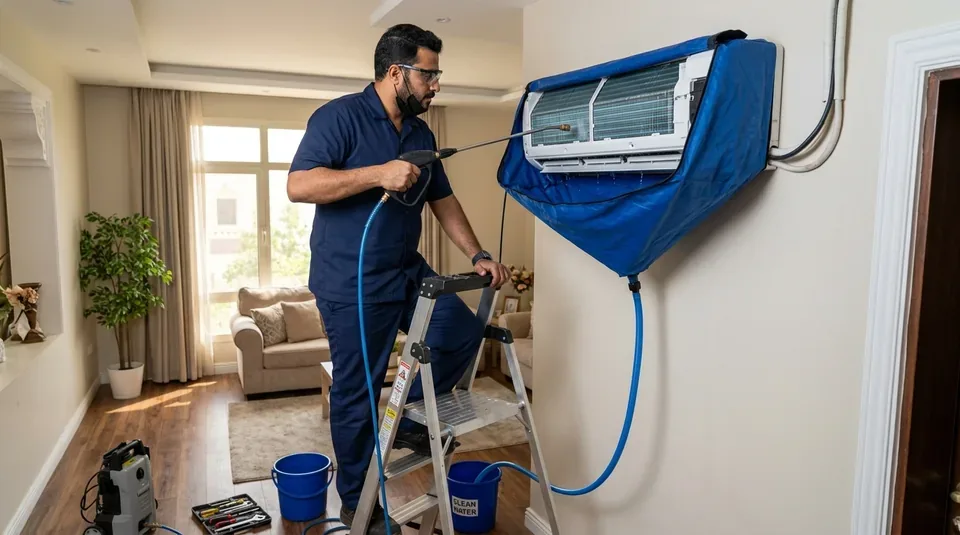
Specialized technician deep cleaning a wall-mounted split AC using a protective catchment bag in Jeddah and Makkah

Executive Summary — Key Takeaways in This Guide:

  • Source of musty odors: Sour or damp smells at startup originate from microbial biofilm thriving inside wet evaporator fins and on the cylindrical blower wheel—air fresheners only mask the symptom.
  • Why water drips indoors: Over 90% of indoor wall leaks are caused by gelatinous dust-slime blocking the condensate drain pan and hose, causing water to overflow backward into the room.
  • The clean-filter illusion: Washing outer plastic screens removes coarse lint, but fine wet dust packs onto the deep blower wheel blades, destroying aerodynamic lift and cutting airflow in half.
  • Wall-safe in-place washing: Professional deep cleaning uses a sealed waterproof catchment bag routed to a drain bucket while fully wrapping the electronic PCB board and fan motor.
  • Honest diagnostic boundary: Deep washing cures odors, drain overflows, and dust-choked airflow; however, if airflow is strong and clean but completely warm, you need an HVAC mechanic to check refrigerant or the compressor.
Technical Analysis Matrix

Diagnostic Matrix: Split AC Symptoms, Hidden Internal Sources & Correct Remediation

How to accurately distinguish hygiene and drainage blockages from mechanical refrigeration faults

Observed Room SymptomResponsible Internal ComponentDirect Physical Root CauseCorrect Technical Solution
Musty, Moldy, or Vinegar-Like Odor on StartupEvaporator coil aluminum fins and internal condensate drip panFungal and bacterial biofilm colonizing damp dust trapped between cooling fins, releasing odor compounds as air blows throughDeep foaming wash and sanitization of evaporator fins followed by thorough pressurized water flushing inside a catchment jacket
Water Dripping or Streaming Down the Interior WallPrimary/rear condensate drain trough and flexible drain hoseGelatinous bio-slime and wet dust plugging the drain outlet neck, forcing condensed water to overflow over the plastic lipHydro-flushing and vacuuming the condensate drain line while scrubbing both front and rear drip pans clean of slime
Weak, Uneven Airflow with Buffeting or Whirring NoiseCylindrical cross-flow blower wheel (squirrel-cage rotor)Heavy caked dust filling the curved aerodynamic blades of the blower cylinder, eliminating air scoop efficiency and causing rotor imbalanceRotational hydro-jet cleaning of every blower wheel blade segment until aerodynamic clearance is 100% restored
Black Flakes or Damp Dust Specks Blowing onto FurnitureAir discharge chute, motorized louvers, and internal foam insulation liningCondensation on cold discharge louvers breeding dark mold spots that flake off under high fan speedsDetaching or opening discharge louvers to scrub the internal air tunnel, blower housing, and deflectors thoroughly
Poor Midday Cooling & Frequent Compressor Tripping in SummerOutdoor unit condenser coil fins on the roof, balcony, or exterior wallThick desert dust and debris matting the outdoor condenser fins, blocking heat rejection and triggering thermal overload cutoffsPressure washing the outdoor condenser coil fins to clear impacted sand and restore normal heat dissipation
Strong, Odor-Free Airflow That Remains Completely WarmRefrigerant circuit, start capacitor, or outdoor mechanical compressorMechanical or electrical HVAC fault (blown capacitor or refrigerant leak) rather than dirt accumulationOutside hygiene cleaning scope — requires an HVAC refrigeration technician to test the capacitor, compressor, and gas pressure

6-Point Home Diagnostic Checklist: Inspect Your Split AC in 3 Minutes

Simple, non-invasive visual and sensory checks to determine if your AC requires deep internal coil and blower washing

Indicator #1High Indoor Air Quality Risk — Circulates fungal spores indoors

The First-Minute Startup Test: Turn on cooling and stand near the unit; do you smell damp earth or sour vinegar during the first two minutes?

Root Cause: Microbial volatile organic compounds (MVOCs) releasing from damp mold and biofilm coating the evaporator fins

Schedule an in-place deep wash and sanitization of the evaporator coil, drain pan, and blower wheel
Indicator #2High — Severely restricts airflow and strains the fan motor

The Flashlight Louver Check: With the AC completely off, shine a phone flashlight upward into the discharge slot; are the cylindrical blower blades coated in fuzzy gray/black mud?

Root Cause: Fine dust bypassing outer screens and bonding with condensation on the rotating squirrel-cage blades

Perform targeted rotational jet-washing of the cylindrical blower wheel inside a protective catchment bag
Indicator #3Critical Property Risk — Damages drywall, wallpaper, and outlets below

The Wall Corner Inspection: Are there water droplets, yellowish stains, or bubbling paint directly beneath the left or right bottom corner of the indoor unit?

Root Cause: Partial or complete slime blockage in the condensate drain outlet causing the drip pan to brim over

Immediately clear the condensate drain line and flush the drip pan before overflow ruins wall finishes
Indicator #4Critical — Total condensate drainage obstruction

The Exterior Drain Hose Check: On a humid day with the AC running, is water dripping steadily from the outer drain pipe, or is the pipe bone-dry while water leaks indoors?

Root Cause: A dry exterior drain hose combined with indoor dripping is 100% confirmation of a plugged condensate drain line

Flush and vacuum-clear the drain blockage while washing the evaporator coil so fresh dirt does not re-clog the pan
Indicator #5Moderate to High — Can cause ice buildup across starved coil zones

The Uneven Airflow Test: Does cold air blow from only one side of the louver while the other side feels dead or makes a fluttering sound?

Root Cause: Asymmetrical dust buildup clogging sections of the blower wheel or evaporator fins, disrupting laminar airflow

Complete hydro-cleaning of both the evaporator coil and blower wheel to restore uniform airflow across the entire louver width
Indicator #6High Operational Risk — Overheats the compressor and inflates power bills

The Outdoor Condenser Check: Is the exterior unit on your wall, balcony, or roof blanketed in thick sand, lint, or pigeon debris?

Root Cause: Impacted sand acts as thermal insulation on the condenser coil, spiking electricity draw and crippling afternoon cooling

Include exterior condenser pressure washing alongside your indoor unit cleaning for full thermal efficiency
In-Depth Technical Guide

Deep Technical Anatomy: How Split ACs Foul in Jeddah & Makkah and How Safe In-Place Washing Works

Five detailed modules covering psychrometric dust-moisture bonding, drain slime mechanics, and mess-free indoor hydro-washing protocols

Module 1: Module 1: Indoor Unit Anatomy

Why Washing Outer Mesh Filters Is Never Enough: The Three Hidden Contamination Zones Behind the Screen

Many homeowners assume that removing and rinsing the two plastic mesh screens beneath the front cover of a split AC is sufficient to keep the unit hygienic and efficient. In reality, those coarse nylon screens are engineered only to catch large lint fibers and heavy dust bunnies; their mesh apertures are far too wide to trap fine Arabian desert silt, microscopic skin dander, or aerosolized kitchen cooking oils and bukhoor smoke particles common in Jeddah and Makkah homes.

As these fine particulates pass effortlessly through the outer screens, they strike the first hidden contamination zone: the evaporator coil fins. Composed of hundreds of tightly spaced, razor-thin aluminum plates cooled below the dew point, the evaporator coil is perpetually wet with condensed humidity during operation. Fine dust bonds instantly with this wet metal surface, compacting into an insulating mud layer between the fins. Whenever the AC is switched off and the interior warms up, this dark, damp organic coating becomes an ideal incubator for mold and bacteria that emit pungent musty odors the next time the unit starts.

Deeper inside lie the second and third hidden zones: the cylindrical cross-flow blower wheel and the condensate drip troughs. Situated behind the evaporator coil, the cylindrical blower rotor relies on dozens of precisely curved micro-blades to scoop and project cold air into the room. As damp dust builds up inside the curvature of these blades, the wheel loses aerodynamic lift—causing airflow to drop drastically even at maximum fan speed. Simultaneously, sloughed-off biofilm and silt wash down into the narrow front and rear drain channels, setting the stage for condensate drain blockages and indoor water leaks.

Key Facts About Hidden Split AC Components

  • Removable plastic filters trap only coarse lint, allowing fine desert dust and domestic aerosols to penetrate deep into the unit.
  • Wet evaporator coil fins are the primary source of sour and musty odors due to trapped organic moisture.
  • Mud accumulation inside the curved blades of the cylindrical blower wheel is the leading cause of weak airflow and wind noise.
  • Blocked evaporator fins starve the coil of airflow, reducing cooling transfer and potentially causing coil icing.
  • Deep evaporator channels and blower wheels cannot be cleaned with dry brushes or vacuums; they require pressurized hydro-washing.
Field Specialist Pro-Tip:

Preventive Tip: Avoid burning heavy bukhoor or deep-frying without an exhaust hood near an operating split AC; smoky and oily aerosols condense onto the cold evaporator fins, creating a sticky film that traps dust twice as fast.

Important Safety Caution:

Hardware Warning: Never scrape evaporator coil fins horizontally with hard brushes or metal tools; bending these paper-thin aluminum fins permanently seals off airflow pathways.

Module 2: Module 2: Condensate Leak Mechanics

Why Split ACs Drip Water Indoors: How Hydrogel Bio-Slime Blocks Condensate Drain Lines

In Jeddah’s moisture-laden coastal air and inside heavily occupied family rooms in Makkah, a single split AC unit extracts several liters of atmospheric water vapor every day. This moisture condenses onto the cold evaporator coil and trickles down into a shallow plastic condensate trough running along the base of the indoor unit, exiting through a narrow corner spout connected to a flexible drain pipe routed through the wall.

Trouble begins when this distilled, chlorine-free condensate water mixes with fine silt and microbial spores washing off the evaporator fins. Because gravity-fed AC drain lines operate under zero pressure—relying solely on a gentle downward slope—slow-moving water allows bacteria and fungi to secrete a thick, gelatinous polysaccharide matrix commonly known as "jelly slime" or bio-slime. Combined with fine desert clay, this viscous hydrogel forms a stubborn plug right at the drain pan spout or inside bends of the concealed drain hose.

Once the drain neck is choked, the evaporator coil continues condensing liters of water from the humid room air with nowhere for it to go. Water brims over the shallow plastic trough lip and streams down the interior wall behind the unit or drips directly through the bottom air louver onto beds, sofas, and electronics. An even trickier scenario occurs in dual-trough designs when slime blocks the narrow side channels connecting the rear auxiliary drip groove to the front pan, causing hidden overflow down the backplate that ruins paint and gypsum before a single drop is seen on the front casing.

Key Takeaways on Indoor Condensate Water Leaks

  • Indoor water dripping is overwhelmingly caused by bio-slime and mud plugging the gravity drain line rather than mechanical failure.
  • Because condensate drains rely purely on gentle gravity flow, even a small gelatinous plug completely halts drainage.
  • Ignoring wall leaks leads to peeling paint, mold behind wallpaper, damaged gypsum board, and electrical hazards at wall sockets.
  • Simply blowing into the drain hose pushes the slime plug back into the pan temporarily; complete flushing and extraction is required.
  • Washing both the evaporator coil and the front/rear drip pans ensures new dirt does not immediately wash down and re-block the drain.
Field Specialist Pro-Tip:

Diagnostic Note: If water dripping is accompanied by ice forming on the front coil or cracking ice sounds, either severe dust blockage is starving the coil of warm air or low refrigerant pressure is freezing the evaporator.

Important Safety Caution:

Safety Alert: If condensate water is dripping directly onto a wall power outlet or extension cord beneath the AC, switch off the circuit breaker immediately and dry the area to prevent short circuits.

Module 3: Module 3: Mess-Free In-Place Washing Engineering

How Professional In-Place Split AC Washing Protects Walls, Furniture & Electronic Boards

A common hesitation among homeowners considering split AC deep cleaning is the fear that dirty wash water will splatter onto designer wallpaper, gypsum ceilings, curtains, or sofas positioned beneath the unit—or that water will short-circuit the AC’s electronic control board. While amateur washing methods pose real risks, our engineered in-place hydro-washing protocol isolates both the room interior and the AC’s electrical architecture with 100% containment.

The procedure begins by disconnecting electrical power at the isolator switch or breaker, followed by detaching the front plastic casing, removable filters, and motorized air louvers so they can be washed and sanitized separately. Next, the technician carefully wraps and waterproofs the side electronic PCB control compartment, display module, and fan motor housing using heavy-duty protective barriers. A specialized, multi-layer waterproof AC catchment jacket (wash bag) is then fitted tightly around the entire perimeter of the wall unit, sealing against the backplate and funneling all runoff through a wide bottom chute directly into a closed floor collection container.

With full containment verified, coil-safe foaming cleaner is applied deep into the evaporator fins and across the cylindrical blower wheel to emulsify kitchen grease, loosen caked clay, and neutralize fungal biofilm without corroding aluminum fins or copper return bends. Using a calibrated low-to-medium pressure coil washer—specifically regulated to clean deeply without bending delicate aluminum fins—the technician flushes the evaporator vertically and rotates the blower cylinder blade-by-blade until dark sludge gives way to crystal-clear rinse water. Finally, the condensate drain line is hydro-flushed, internal surfaces are dried, and the unit is reassembled for an operational airflow test.

Safety & Cleanliness Guarantees During In-Place Washing

  • Complete electrical isolation and waterproof wrapping of the PCB control board and fan motor prior to wet cleaning.
  • Full-perimeter waterproof catchment jacket installation that shields wall paint, wallpaper, and flooring beneath the unit.
  • Calibrated coil-washing water pressure engineered to flush deep between fins without bending delicate aluminum plates.
  • Non-corrosive, coil-safe cleaning and sanitizing agents that dissolve biofilm without etching copper or aluminum.
  • Post-wash drying, condensate drainage verification, and live airflow testing before completing the service.
Field Specialist Pro-Tip:

Preparation Tip: If a sofa or bed sits flush against the wall directly under the AC, shifting it forward by just 50–60 cm (or allowing our crew to drape a protective sheet over it) gives comfortable clearance for the wash stand and catchment bucket.

Important Safety Caution:

Technical Caution: Spraying store-bought "no-rinse" aerosol foam cleaners onto a heavily dust-caked evaporator without flushing the loosened mud out with pressurized water often causes the dirt and chemical residue to dry into a harder crust deep inside the fins.

Module 4: Module 4: Outdoor Condenser & Thermal Efficiency

The Forgotten Outdoor Unit: How Dust-Impacted Condenser Coils Cripple Summer Cooling & Spike Power Bills

While homeowners naturally focus on the indoor wall unit that blows cool air into the room, the outdoor condensing unit mounted on the rooftop, lightwell, or exterior facade endures brutal environmental punishment in Jeddah and Makkah. A split AC cools your room by absorbing indoor heat into the refrigerant gas and pumping it outside, where the outdoor condenser fan must reject that heat into the ambient air across finely spaced aluminum condenser fins.

Under frequent desert dust storms, high humidity, and pigeon activity on rooftops and building shafts, thick blankets of sand, lint, and feathers pack tightly into the rear condenser coil fins. Once this exterior radiator is choked with dirt, the unit cannot expel heat efficiently. Refrigerant head pressure skyrockets and the compressor overheats, triggering its internal thermal overload protector. For residents, this manifests as the AC suddenly blowing warm air during peak afternoon heat as the compressor repeatedly shuts down to cool itself—while electricity consumption surges dramatically.

Comprehensive split AC maintenance therefore pairs indoor hygienic coil washing with pressurized water flushing of the outdoor condenser fins (wherever safely accessible). Clearing impacted sand from the exterior coil immediately lowers compressor operating pressure, restores brisk midday cooling performance, reduces electrical current draw, and protects the compressor and start capacitor from premature thermal burnout during summer heatwaves.

Why Outdoor Condenser Washing Matters

  • The outdoor condenser coil expels indoor heat; when clogged with desert sand, the entire cooling cycle chokes.
  • Midday compressor cutouts (where the indoor fan blows warm air intermittently) are frequently caused by dirty, overheating outdoor coils.
  • Flushing the outdoor condenser radiator lowers compressor head pressure and reduces monthly electricity consumption.
  • Clearing pigeon debris and nesting material around exterior units prevents fan blockage and acidic fin corrosion.
  • Combining indoor hygiene washing with outdoor condenser flushing delivers maximum cooling output and hardware longevity.
Field Specialist Pro-Tip:

Summer Tip: Cleaning rooftop outdoor condenser coils right before summer—and ensuring nothing obstructs airflow within 1 meter of the fan discharge—significantly improves afternoon cooling stability.

Important Safety Caution:

Safety Precaution: Outdoor condenser washing must always be performed with the main breaker disconnected, keeping pressurized water away from the side electrical terminal box and capacitor housing.

Module 5: Module 5: Hygiene Cleaning vs. Mechanical HVAC Repair

When Your Split AC Needs Deep Hygienic Washing vs. Mechanical HVAC Repair or Refrigerant Service

At Al Awael, transparent diagnostic guidance comes before any service booking. Confusing hygiene-related airflow/drainage blockages with mechanical refrigeration failures often leads homeowners to pay for unnecessary "refrigerant top-ups" when the sealed gas circuit is actually full—or conversely, to book a cleaning crew when a compressor capacitor has blown.

You can apply a reliable diagnostic rule right in your room: place your hand directly in front of the AC discharge louver. If the airflow feels weak, muffled, or uneven across the slot, or if the air carries a musty odor, or if water is dripping down the wall, the problem is overwhelmingly physical fouling of the blower wheel, evaporator fins, and condensate drain. Deep hydro-washing resolves these symptoms completely without touching the sealed refrigerant system.

Conversely, if the evaporator fins and blower wheel are visibly clean, airflow blasts out strongly and evenly across the entire louver with zero odor or water leakage, yet the air remains completely warm (room-temperature fan air), or if the unit displays a digital error code or trips the circuit breaker, the issue is mechanical or electrical. Common causes include a failed outdoor start capacitor, a seized compressor, or a physical pinhole leak in the copper refrigerant lines—scenarios that require an HVAC refrigeration repair technician rather than a hygiene washing service.

Clear Boundary: Hygiene Washing vs. HVAC Repair

  • Deep hygiene washing solves: musty/sour odors, indoor water dripping, weak/noisy airflow, and dust-clogged coils and blower wheels.
  • Mechanical HVAC repair solves: blown capacitors, compressor replacement, copper line leak brazing, refrigerant charging, and PCB faults.
  • Refrigerant circulates in a hermetically sealed loop and is never "consumed" during normal operation; low gas always indicates a physical leak.
  • Cold air trapped inside the louver with weak throw distance means cooling works, but a mud-packed blower wheel cannot push the air out.
  • Proper coil and blower washing restores full cooling delivery and prevents unnecessary mechanical servicing expenses.
Field Specialist Pro-Tip:

Smart Test: If room cooling feels weak, hold your hand 5 cm from the discharge louver. If the air right at the opening feels ice-cold but barely reaches a meter into the room, your compressor and refrigerant are fine—your blower wheel is simply packed with dust and needs washing.

Important Safety Caution:

Scope Transparency Note: Al Awael’s AC cleaning service specializes in deep hydro-mechanical washing, biofilm sanitization, and condensate drain clearing for indoor and outdoor units; it does not include refrigerant gas charging, copper welding, or electrical part replacement.

Hyperlocal City Adaptation

Climate & Urban Adaptations: How Split AC Fouling Differs Between Jeddah & Makkah

Comparing Jeddah’s high coastal dew-point and bio-slime growth against Makkah’s extreme thermal loads and fine dust accumulation

Jeddah GovernorateJeddah Sectors Hub

Split AC Challenges in Coastal Jeddah

Jeddah’s position along the Red Sea coast exposes residential buildings to persistently high relative humidity and elevated dew points throughout most of the year. Consequently, split ACs in Jeddah extract massive volumes of condensate water every single day. This constant internal moisture accelerates bacterial hydrogel slime in drain pans and dark fungal colonization on cylindrical blower wheels at twice the rate seen in dry inland cities—making startup musty odors and indoor wall water leaks the number-one household complaint across Jeddah.

Furthermore, humid marine breezes carrying salt aerosols and fine dust in coastal neighborhoods rapidly coat outdoor condenser coils in a sticky, corrosive film during morning dew hours, requiring regular fresh-water pressure washing to prevent fin oxidation and head-pressure spikes.

  • North & Coastal Jeddah (Obhur, Ash Shati, Al Murjan, Al Muhammadiyah, An Naeem): Extreme coastal humidity drives rapid drain-line bio-slime blockages, indoor wall dripping, and mold odors.
  • Central High-Density Districts (Ar Rawdah, Az Zahra, As Salamah, Al Bawadi, Al Faisaliyah): Continuous apartment AC operation combined with indoor cooking aerosols and fine dust quickly packs blower wheels.
  • East Jeddah & Expanding Subdivisions (Al Hamdaniyah, As Samer, As Salihiyah, Al Falah): Open wind corridors and nearby construction blanket outdoor condensers and indoor coils in fine clay dust.
  • South Jeddah (Al Ajaweed, As Sanabil, Prince Fawaz, Al Wurood): Combined heat, dust, and seasonal humidity require synchronized indoor and outdoor coil washing before peak summer.

Split AC Challenges in Makkah’s High-Heat Environment

In Makkah, split air conditioners contend with extreme summer ambient temperatures frequently exceeding 45°C, amplified by heat-retaining rocky valleys and winds carrying ultra-fine mineral and desert dust. Because residential units run 24 hours a day for months on end, the sheer volume of indoor air cycled through each evaporator and blower wheel deposits heavy layers of fine dust deep inside the unit while coating outdoor rooftop condensers.

When this dense mineral dust mixes with indoor humidity generated by high room occupancy—particularly during family gatherings and peak Ramadan and Hajj seasons—it turns into heavy mud inside the blower blades and drain pan. Simultaneously, dust-blanketed outdoor condensers struggling under Makkah’s midday sun experience frequent thermal overload shutdowns unless proactively pressure-washed.

  • Southern & Western Makkah (Ash Shawqiyyah, Al Kakiyyah, Batha Quraish, Wali Al Ahd): Multi-unit family villas and apartments require pre-summer and pre-Ramadan deep blower and coil washing.
  • Eastern Makkah (Al Awali, Ash Shara’i, Ar Rashidiyyah): Windblown desert dust rapidly fouls rooftop outdoor condensers and settles as mud inside indoor condensate pans.
  • Central High-Occupancy Districts (Al Aziziyah, An Naseem, Ar Rusayfah, Al Khalidiyyah): Intensive 24/7 seasonal operation demands thorough coil sanitization and drain clearing to prevent leaks and odors.
  • Northern Makkah (At Taneem, An Nuzhah, Al Umrah, Al Buhayrat): Continuous summer duty cycles and fine dust ingress make annual in-place hydro-washing essential for airflow recovery.
Illustrative Service Scenario — For Educational Reference

Resolving Severe Musty Odor, Wall Water Dripping & Choked Airflow in a Living Room Split AC

Property Context & Initial Challenge:

A 24,000 BTU wall-mounted split AC in a busy family living room, operating daily for long hours, where residents experienced water dripping down the wall and weak airflow despite washing the outer mesh filters biweekly.

A pungent damp odor upon startup, steady water dripping from the bottom right corner onto the wall and sofa below, and weak, fluttering airflow across the left half of the discharge louver.

Outcome & Long-Term Prevention:

Complete elimination of the musty startup odor, immediate cessation of indoor wall dripping with steady exterior drain flow, and full restoration of quiet, powerful cooling airflow across the room—without needing a single gram of refrigerant.

Diagnostic Inspection Findings:

  • While the removable plastic mesh screens were clean, flashlight inspection revealed the underlying aluminum evaporator fins were matted with a damp gray film of fine dust and household aerosols.
  • The cylindrical blower wheel blades were packed with dark mud and fungal biofilm across the left section, destroying blade curvature and explaining the weak, noisy airflow.
  • The right-hand condensate drain pan spout was completely plugged by a thick gelatinous bio-slime mass, stopping water from entering the exterior drain hose and forcing it to overflow down the wall.
  • The outdoor condenser coil fins were blanketed in compacted desert dust, restricting heat rejection during afternoon operation.

Technical Protocol Applied:

  • Disconnected power, removed the front casing and louvers for separate washing, wrapped the PCB control board and motor in waterproof barriers, and fitted the sealed catchment bag around the indoor unit.
  • Applied coil-safe foaming cleaner and sanitizer deep into the evaporator fins and across the cylindrical blower wheel to break down mud and fungal biofilm.
  • Flushed the evaporator fins vertically and hydro-washed the rotating blower wheel blade-by-blade at controlled pressure until all black sludge drained into the floor bucket and metal surfaces shone clean.
  • Hydro-flushed the condensate drain pan and hose to eject the gelatinous slime plug, washed the outdoor condenser coil, dried the indoor housing, and verified strong, leak-free operation.
Safe Decision Boundaries

Safe Homeowner Care Limits vs. When to Call a Professional AC Washing Specialist

What routine upkeep you can safely handle at home versus deep internal cleaning that requires containment gear

Safe Routine Steps You Can Perform Yourself

  • Switching off the unit to remove and rinse the two outer plastic mesh filters with lukewarm water every 2 to 3 weeks, drying them in the shade before reinsertion.
  • Wiping the exterior plastic shell and outer louver blades with a slightly damp microfiber cloth while the unit is powered off.
  • Checking that the outdoor termination of the condensate drain pipe is not kinked upward, crushed, or plugged by mud dauber insects.
  • Running the AC on "Fan Only" mode for 10 minutes before shutting it off after humid days to dry the internal evaporator fins and inhibit mold.
  • Keeping doors and windows closed during operation and avoiding heavy incense burning directly beneath the intake grill.

Triggers Requiring Professional In-Place Deep AC Cleaning

  • Any deep washing of the evaporator fins and cylindrical blower wheel requiring pressurized water, waterproof catchment bags, and PCB electronics shielding.
  • Water dripping or streaming down the interior wall from the indoor unit due to a slime-blocked condensate drain pan or hose.
  • Persistent musty, moldy, or sour vinegar odors upon starting the AC that remain unchanged after washing the outer plastic filters.
  • Noticeably weak, muffled, or uneven airflow across the louver accompanied by fan buffeting or clinging black dust flakes.
  • Pre-summer or pre-Ramadan preventive restoration when blower blades and outdoor condenser coils are visibly coated in dust.

Honest Scope Note: Al Awael specializes in hygienic hydro-mechanical AC cleaning—washing evaporator coils, cylindrical blower wheels, condensate drain lines, and outdoor condensers to resolve odors, water leaks, and restricted airflow. If your unit is already clean and blowing strongly but produces zero cooling due to a failed compressor, blown capacitor, or refrigerant gas leak, we will transparently advise you to call a mechanical HVAC repair technician.

Frequently Asked Questions

Frequently Asked Questions About Split AC Deep Cleaning, Odors & Water Leaks

Clear, practical answers to the questions homeowners ask most before scheduling in-place AC cleaning

Do you unmount the split AC from the wall to wash it, or is it cleaned in place?+

The indoor unit is deep-cleaned right on the wall without disconnecting copper refrigerant lines. We fit a specialized waterproof catchment jacket around the unit that channels all wash water and sludge through a hose directly into a sealed floor container.

Will washing the AC stain our wallpaper, ruin wall paint, or wet the sofa underneath?+

No. Our waterproof wash jacket features rear and side sealing baffles that isolate the unit from the wall surface, and we protect the work zone below so zero water splatters onto wallpaper, gypsum, or furniture.

Is there any risk of water damaging the electronic PCB control board or fan motor during washing?+

We disconnect main power first and completely wrap the electronic PCB housing, digital display, and fan motor in waterproof barriers. Pressurized water is directed strictly at the evaporator fins, blower wheel, and drain trough.

How long does it take to deep clean a single split AC unit?+

A thorough in-place deep cleaning of one split AC unit—including cover disassembly, electronics shielding, coil and blower washing, drain flushing, and reassembly—typically takes 35 to 50 minutes.

Does deep cleaning permanently stop indoor water dripping from the AC?+

Yes, for all drain-blockage leaks. Rather than merely blowing air into the tube, we wash the evaporator coil, scrub the drip pan, and hydro-flush the entire gelatinous slime plug out of the condensate line so water flows freely outdoors.

Do you recharge refrigerant gas (Freon) or repair compressors as part of this service?+

Our service focuses exclusively on deep hygienic hydro-washing and condensate drain clearing. In most cases where cooling feels weak due to restricted airflow, washing the mud-packed blower and coil restores strong cooling immediately. Mechanical repairs and gas charging require an HVAC refrigeration technician.

How often should split ACs receive professional deep washing in Jeddah and Makkah?+

Given Jeddah’s year-round humidity and Makkah’s heavy summer dust and heat, we recommend preventive deep washing every 6 to 12 months (ideally pre-summer or pre-Ramadan), or immediately upon noticing musty odors, weak airflow, or water dripping.

Unified Service Request Builder

Share Your Request Details for Scheduling & Transparent Pricing

Enter your basic contact details, select your city (Jeddah or Makkah), and choose the service you need. This form organizes your inquiry for immediate coordination.

We respect your privacy. Your information is used strictly to respond to your service inquiry.
CallWhatsAppGet Quote