
Serving Jeddah & Makkah
Technical Diagnostic & Household Water Hygiene Guide — Jeddah & Makkah14 min technical & diagnostic readJeddah & Makkah

Water Tank Sediment, Sludge & Algae Sanitization: The Complete Diagnostic & Safe Cleaning Guide

How to pinpoint the exact source of musty tap water odors or yellowish turbidity, remove deep sand sludge and wall biofilm without harming epoxy waterproofing, and coordinate underground and rooftop tank hygiene in Jeddah and Makkah.

Villas and residential buildings across Jeddah and Makkah rely on a dual-stage water storage architecture: a primary underground reinforced concrete cistern located beneath the courtyard or parking area, paired with automated booster pumps that feed rooftop polyethylene or fiberglass tanks. Although municipal network water and desalinated tanker deliveries meet rigorous quality standards at the point of supply, storing thousands of liters inside static enclosures exposes the water to gradual physical and biological shifts. When residents begin noticing an earthy or musty odor during morning showers, yellowish water turbidity, or fine grit clogging faucet aerators and washing machine inlet screens, the root cause is almost always internal tank accumulation rather than the fresh incoming water supply.

Two distinct contamination layers develop inside unmaintained storage tanks, each requiring a specific mechanical and hygienic remediation approach. The first is heavy bottom sediment and sludge, which settles across the floor of the underground tank over months of repeated filling cycles, compounded by windblown desert dust and courtyard wash-water seeping through unsealed manhole covers. The second, more insidious layer is biological biofilm and microalgae adhering to vertical walls, baffle columns, and pipe joints; this slimy polysaccharide matrix shields microorganisms from normal residual chlorine levels and proliferates rapidly in rooftop tanks when intense solar heat combines with light penetration through missing or cracked inspection lids.

This diagnostic guide provides property owners and facility managers in Jeddah and Makkah with an objective, engineering-focused framework for evaluating and restoring household water storage hygiene. We explain how to distinguish underground cistern sediment issues from rooftop thermal algae growth based on tap symptoms, detail the exact non-destructive washing protocols required to protect internal epoxy or cementitious waterproofing linings, and establish a transparent boundary between hygienic tank cleaning services and structural waterproofing or crack-injection contracting.

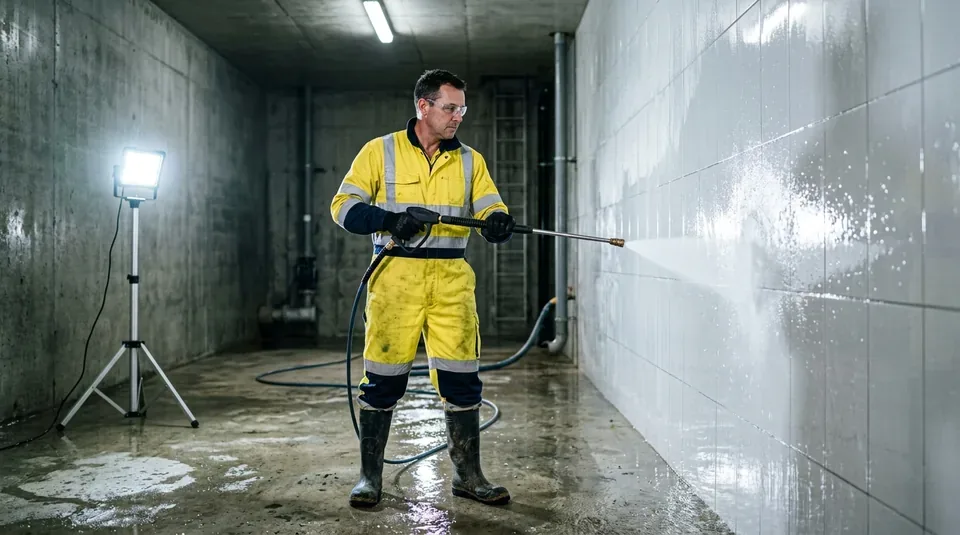
Specialized technician cleaning and sanitizing a water tank and removing sediment in Jeddah and Makkah

Executive Summary — Key Takeaways in This Guide:

  • Pinpointing the source: Gritty turbidity and clogged faucet aerators typically indicate agitated bottom sludge from the underground tank, whereas grassy odors and slimy water point to solar-driven algae in the rooftop tank.
  • Draining alone is ineffective: Pumping out water without physically scrubbing adherent wall biofilm and vacuuming corner sludge leaves microbial colonies intact to immediately re-contaminate fresh water.
  • Preserving waterproofing integrity: Epoxy-lined and cementitious-coated concrete tanks must be washed with medium-pressure water jets and soft-bristle brushes, strictly avoiding wire brushes or corrosive acids.
  • Synchronized dual-tank hygiene: Cleaning the underground cistern while neglecting the rooftop tank allows clean pumped water to mix with stagnant upper-tank sediment before reaching household fixtures.
  • Honest scope separation: Hygienic cleaning resolves sediment, biofilm, and stagnation odors, whereas structural wall cracks, root intrusion, or groundwater seepage require waterproofing repair prior to sanitization.
Technical Analysis Matrix

Diagnostic Comparison Matrix: Tank Contamination Types, Locations & Safe Remediation Protocols

Identifying the exact deposit composition and tank zone determines the correct mechanical removal and sanitization method without damaging tank linings

Contamination TypePrimary Tank ZoneObservable Tap Water SymptomCorrect Technical Remediation Protocol
Heavy Bottom Sand & Clay SludgeFloor of underground reinforced concrete tanks and around the suction sump pitFine grit in sinks, frequent clogging of faucet aerators and bidet sprayers, and spike in turbidity right after tanker refillingFull dewatering, gathering sludge with non-abrasive rubber squeegees, and extracting via heavy-slurry pumps prior to floor rinsing
Slimy Bacterial Biofilm LayerInternal vertical walls, support columns, and stagnant dead-zones away from inlet turbulenceMusty or stagnant odor during first morning water use, and a slippery gel-like texture felt on submerged tank wallsComplete mechanical scrubbing of walls and corners using soft-bristle brushes to disrupt the biofilm matrix followed by measured sanitization
Green Microalgae & Photosynthetic GrowthRooftop polyethylene or fiberglass tanks, especially where inspection lids are broken or walls transmit sunlightGreenish-yellow water tint, distinct grassy or pond-like smell, and microscopic green filaments trapped in inlet filtersDraining the rooftop tank, scrubbing interior walls to remove algal spores, sanitizing outlets, and installing an opaque tight-fitting lid
Mineral Scale Rings & Salt CrustsFluctuating water-line perimeter and around mechanical float valves in both underground and rooftop tanksFlaking white mineral crusts that jam float valves causing tank overflow, alongside rapid scaling in household water heatersTargeted descaling along the waterline using lining-safe agents, followed by thorough rinsing and float-valve articulation checks
Manhole Neck & Unsealed Cover IntrusionUnderground tank access neck and ceiling slab directly beneath courtyard cast-iron or concrete coversSudden water cloudiness or soapy smell immediately after courtyard washing or rainstorms, plus floating dead insectsCleaning and disinfecting the access neck and ceiling slab first, while sealing the manhole rim with rubber gaskets against surface runoff
Peeling Waterproofing or Rebar Rust SeepageWalls and floors of aging concrete cisterns experiencing waterproofing delamination or structural crackingOrange-brown rust discoloration, detached paint/epoxy flakes in water, or unexplained drops/gains in tank water levelHalting high-pressure washing immediately, gently dewatering for visual inspection, and referring for structural waterproofing renewal first

Quick Self-Diagnostic Checklist: 6 Indicators That Your Water Tank Requires Inspection & Cleaning

Evaluate these household symptoms to determine the urgency level and exact maintenance action needed for your storage system

Indicator #1High — Requires mechanical wall scrubbing and sanitization

Earthy, musty, or damp smell noticeable when turning on showers or taps first thing in the morning

Root Cause: Active bacterial biofilm colonization on internal tank walls combined with water stagnation and depleted residual chlorine

Schedule full draining, soft-brush wall scrubbing, and measured disinfection for both underground and rooftop tanks
Indicator #2High — Contaminates rooftop tank and damages plumbing valves

Tap water turns cloudy, turbid, or yellowish for several hours every time the underground tank is refilled

Root Cause: Inflow turbulence agitates a thick layer of settled bottom silt and sand sludge, which the booster pump immediately draws upward

Extract all bottom sludge from the underground cistern and establish a rule of turning off booster pumps during and right after refills
Indicator #3Critical — Direct biological and environmental contamination

Missing, cracked, or loose lid on the rooftop tank exposing stored water to direct sunlight and airborne dust

Root Cause: Wind displacement or UV degradation of plastic lids, turning the warm rooftop tank into an open incubator for green algae and birds/insects

Immediately drain, scrub, and sanitize the rooftop tank, then secure a UV-resistant, tight-locking replacement inspection cover
Indicator #4Critical — Direct entry of surface detergents and ground pathogens

Courtyard wash-water or rainwater seeping through an unsealed or flush-mounted underground tank manhole cover

Root Cause: Manhole cover sitting flush or below courtyard tile grade without a raised curb or intact rubber perimeter gasket

Perform complete tank decontamination and seal the manhole perimeter with a heavy-duty gasket or raised masonry collar
Indicator #5Moderate to High — Accelerates wear on pumps and water heaters

Frequent blockage of faucet aerators, showerheads, and visible sand particles inside washing machine detergent trays

Root Cause: Accumulated sand and scale on the tank floor reaching the intake height of the booster pump foot-valve (suction strainer)

Vacuum sand deposits from both tanks and verify that the pump suction foot-valve is positioned at a safe clearance above the floor
Indicator #6Structurally Critical — Exceeds standard hygiene cleaning scope

Visible cracks around the underground tank neck or sudden salty/brackish taste in coastal Jeddah neighborhoods

Root Cause: Structural wall cracking or waterproofing failure allowing high coastal water-table brine to infiltrate the underground cistern

Dewater the tank for structural inspection; if groundwater seepage is confirmed, complete crack injection and waterproofing before sanitizing
In-Depth Technical Guide

Deep Technical Analysis: Sediment Physics, Biofilm Biology & Safe Tank Washing Engineering

Five comprehensive engineering modules explaining how contaminants form under Jeddah and Makkah conditions and how professional restoration protects tank longevity

Module 1: Module 1: Physics & Microbiology

How Bottom Sludge and Wall Biofilm Develop Inside Tanks Despite Clean Incoming Water

A common question among homeowners in Jeddah and Makkah is how a thick carpet of dark mud and sand can accumulate across the floor of an underground tank that is exclusively supplied by municipal desalination lines or certified water tankers. The explanation lies in cumulative micro-sedimentation physics. Every cubic meter of potable water carries trace, legally permissible levels of dissolved minerals and microscopic suspended particulates. As hundreds of tons of water cycle through a residential cistern over twelve months, the tank acts as a giant gravitational settling basin where fine particles slowly precipitate onto the floor, compounded by airborne desert dust entering through unsealed vents and manhole rims.

Once this physical sediment bed forms, a secondary microbiological process begins as warm ambient temperatures accelerate the dissipation of free residual chlorine inside the tank. Opportunistic microorganisms attach to micro-irregularities along the vertical walls and support columns, secreting an extracellular polymeric substance known as biofilm. This slimy hydrogel coating—readily felt when sliding a gloved hand across an uncleaned tank wall—acts as a protective shield that prevents normal chlorine levels in fresh water refills from neutralizing the embedded bacteria, while releasing volatile organic compounds that impart a distinct musty or earthy odor to household tap water.

In rooftop tanks exposed to intense solar radiation, contamination follows a photothermal pathway. Whenever an inspection lid cracks or blows off in coastal winds, or when aging fiberglass and thin polyethylene walls allow sunlight penetration, airborne algal spores initiate rapid photosynthesis inside the warm upper water column. Within weeks, green and brown microalgae colonize the internal walls and float valve assemblies, shifting tap water color toward yellowish-green and releasing organic filaments that foul household plumbing fixtures.

Key Scientific Takeaways on Tank Contamination

  • Bottom sludge is the cumulative result of hundreds of tons of water settling over time combined with dust ingress, even when supply water is clean.
  • Wall biofilm cannot be removed by simply draining and refilling; it requires physical brushing to disrupt its protective gel matrix.
  • High ambient temperatures in Jeddah and Makkah rapidly evaporate residual chlorine, leaving stagnant tank water vulnerable to microbial growth.
  • Sunlight penetration into rooftop tanks is the primary catalyst for photosynthetic green algae proliferation.
  • Dead corners far from inlet turbulence and areas behind structural baffle columns accumulate the highest concentrations of biological silt.
Field Specialist Pro-Tip:

Diagnostic Tip: To isolate whether contamination originates in the underground cistern or rooftop tank, compare a water sample drawn near the ground booster pump outlet against tap water from an upper residential floor.

Important Safety Caution:

Important Caution: Dumping chlorine tablets or bleach directly into a sludge-filled tank without first removing the sediment causes chemical reaction with organic mud, creating harsh chloramine odors while failing to kill bacteria shielded beneath the silt.

Module 2: Module 2: Structural & Material Differences

Engineering Differences Between Cleaning Underground Concrete Cisterns and Rooftop Polyethylene/Fiberglass Tanks

Underground cisterns and rooftop storage tanks differ fundamentally in structural geometry, lining materials, and environmental exposure. Underground tanks are constructed from reinforced concrete buried beneath courtyards or driveways and are internally coated with potable-grade blue epoxy resin, flexible polymer-modified cementitious waterproofing, or glazed ceramic tiles. Because of their large volume, internal support columns, and baffle walls, cleaning an underground tank requires confined-space entry protocols, forced fresh-air ventilation, low-voltage waterproof lighting, and heavy-duty submersible slurry pumps capable of lifting dense bottom sediment out of the floor sump pit.

Conversely, rooftop tanks across Jeddah and Makkah are predominantly rotational-molded multi-layer polyethylene or fiberglass vessels. While their non-porous interior walls resist deep mineral absorption, they endure extreme thermal cycling under direct summer sun. Polyethylene surfaces are highly susceptible to mechanical scoring; scrubbing a plastic or fiberglass interior with abrasive pads or metal scrapers creates microscopic grooves that permanently harbor algal spores and biofilm. Proper rooftop tank maintenance therefore relies on high-density non-scratch sponges, soft polymer brushes, and meticulous flushing of outlet unions and float mechanisms.

Crucially, the hydraulic link between both vessels dictates an unbreakable rule in residential water hygiene: cleaning one tank while ignoring its counterpart compromises the entire operation. Pumping freshly sanitized water from a spotless underground cistern into a rooftop tank coated with old algae immediately re-contaminates the water flowing down to household faucets. Similarly, washing only the rooftop vessel provides temporary relief if the ground booster pump continues drawing fine silt from an uncleaned underground floor.

Core Rules for Underground & Rooftop Tank Care

  • Underground concrete cisterns require confined-space ventilation and high-head slurry pumps to extract deep floor silt.
  • Polyethylene and fiberglass rooftop tanks must be scrubbed only with non-abrasive tools to prevent surface micro-scratches.
  • Sequential cleaning—underground tank first, followed immediately by the rooftop tank—is essential to prevent cross-contamination.
  • Main distribution valves feeding household plumbing must be shut off during washing so dislodged sediment cannot enter indoor pipes.
  • Inspecting mechanical/electric float switches and pump foot-valves while tanks are empty prevents future overflows and dry-running.
Field Specialist Pro-Tip:

Practical Tip: Shut off the main municipal supply valve or pause tanker deliveries 24–48 hours before your scheduled cleaning appointment so household consumption lowers the water level naturally, minimizing water waste.

Important Safety Caution:

Safety Warning: Untrained entry into deep underground water tanks without forced air ventilation—especially when using concentrated chlorine or acidic cleaners—poses a severe asphyxiation hazard due to oxygen displacement and toxic gas accumulation.

Module 3: Module 3: Waterproofing Lining Protection

How to Wash Reinforced Concrete Tanks Effectively Without Damaging Epoxy or Cementitious Waterproofing

The internal waterproofing lining of an underground concrete cistern serves a critical dual structural function: it prevents stored potable water from leaking into building foundations and stops surrounding subsoil moisture or rebar corrosion from infiltrating the domestic water supply. Whether a cistern is lined with non-toxic food-grade epoxy resin or polymer-modified cementitious waterproofing, these coatings are engineered to withstand hydrostatic pressure—not aggressive mechanical abrasion or harsh acid etching during improper cleaning.

One of the most destructive practices in unregulated tank cleaning is pouring raw hydrochloric acid ("flash") onto walls to bleach mineral stains, or scraping surfaces with steel wire brushes and sharp metal spatulas. Strong acids chemically dissolve the calcium silicate hydrate matrix inside cementitious coatings, rendering them porous and crumbly, while blistering and delaminating epoxy films. Similarly, blasting walls at point-blank range with narrow pencil-jet pressure washers can strip coating edges along construction joints and expose bare concrete.

A professional, lining-safe washing protocol relies on controlled hydro-mechanical agitation rather than chemical stripping. Technicians pre-wet vertical surfaces to soften dried silt, then scrub systematically using medium-soft nylon bristle brushes and neutral, potable-water-approved sanitizing solutions. When rinsing with pressure equipment, nozzles are strictly set to wide fan-spray patterns (25° to 40°) and held at a safe standoff distance of 30–40 cm from the wall, thoroughly shearing away biological biofilm while leaving epoxy and cementitious linings completely intact.

Strict Controls for Protecting Tank Waterproofing

  • Corrosive acids ("flash") and industrial solvents are strictly prohibited inside potable water storage tanks.
  • Soft nylon brushes and flexible rubber squeegees replace wire brushes and metal scrapers across all interior surfaces.
  • Pressure rinsing utilizes wide fan nozzles at controlled distances to prevent peeling epoxy seams or eroding cementitious coats.
  • Technicians visually inspect linings once silt is cleared, treating any existing osmotic epoxy blisters gently without puncturing them.
  • Comprehensive fresh-water rinsing and complete vacuum extraction ensure zero chemical residue remains on the waterproof membrane.
Field Specialist Pro-Tip:

Technical Tip: Intact food-grade epoxy has a naturally low-friction surface that releases biofilm easily under soft nylon brushing—aggressive scrubbing is never required on healthy epoxy.

Important Safety Caution:

Owner Alert: If blue paint flakes or cement granules appear during initial dewatering, the internal coating is already experiencing age-related delamination and requires gentle handling or scheduled waterproofing renewal.

Module 4: Module 4: Step-by-Step Sanitization Protocol

The Six-Stage Engineering Protocol for Dewatering, Desludging, Washing & Balanced Sanitization

A rigorous tank restoration workflow begins with hydraulic isolation—shutting off inlet supply valves and booster pump breakers—followed by deploying a high-capacity submersible pump to discharge stagnant water into the sanitary drain until only a shallow slurry layer remains on the floor. In Stage Two, forced-air ventilation is activated and a technician wearing dedicated, sanitized waterproof boots enters the cistern. Cleaning starts at the ceiling slab and access manhole neck before moving top-down along the walls, using wide rubber squeegees to channel all bottom mud and sand toward the sump pit for complete slurry extraction.

Stages Three and Four focus on mechanical biofilm eradication and primary rinsing. Every square meter of vertical wall, support column, floor joint, and suction strainer is scrubbed with nylon brushes and potable-safe cleaning agents, then rinsed with wide-angle water jets. All wash water is pumped out continuously until effluent running toward the sump pit is crystal clear. Once physical cleanliness is achieved, Stage Five applies a precisely measured sanitizing solution across all interior surfaces, allowing sufficient antimicrobial contact time to neutralize residual bacteria and algal spores.

Stage Six is what separates professional hygiene protocols from amateur cleaning that leaves tap water smelling heavily of bleach. Instead of leaving concentrated disinfectant pooled on the floor and filling fresh water on top of it, technicians perform a final fresh-water rinse of the sanitized walls, extract all rinse water from the sump, and sponge-dry remaining puddles. When the tank is subsequently refilled with municipal or tanker water containing standard potable residual chlorine, the household enjoys crisp, odorless, and hygienically safe water immediately.

Summary of the Six-Stage Hygiene Standard

  • Stages 1 & 2: Hydraulic valve isolation, bulk dewatering, and complete extraction of bottom floor sludge.
  • Stage 3: Top-down mechanical scrubbing (manhole neck, walls, columns, then floor) to remove adherent biofilm.
  • Stage 4: Multi-pass pressurized rinsing and sump extraction until floor runoff is completely clear.
  • Stage 5: Uniform application of measured disinfectant with proper surface contact time.
  • Stage 6: Final fresh-water rinse and sponge-drying to eliminate harsh chemical tastes or bleach odors upon refilling.
Field Specialist Pro-Tip:

Golden Rule: After refilling a newly cleaned underground cistern, wait 1 to 2 hours for inflow turbulence to settle completely before switching on the booster pump to fill the cleaned rooftop tank.

Important Safety Caution:

Hygiene Mandate: Always verify that technicians use dedicated waterproof boots, hoses, and brushes reserved exclusively for potable water tanks and never used in drainage or external sanitation work.

Module 5: Module 5: Cleaning vs. Structural Repair Boundaries

When Hygienic Cleaning Is Sufficient vs. When Structural Cracks Require Waterproofing Repair

A cornerstone of technical transparency at Al Awael is drawing an unmistakable line between hygienic water tank cleaning and structural waterproofing or crack-injection contracting. Homeowners frequently request tank cleaning when experiencing persistent water turbidity, sudden brackish taste, or unexplained spikes in water consumption. Once our technicians pump out the standing water and clear the bottom silt, the bare interior surfaces reveal the true condition of the cistern: either the waterproofing membrane is intact and the issue was purely accumulated sediment and biofilm, or an underlying structural defect is present.

In coastal Jeddah districts with a high saline water table, a hairline crack or failed construction joint in an underground concrete tank can trigger reverse hydrostatic infiltration. When the internal water level drops, external brackish groundwater presses inward through the fissure, contaminating potable water with salt and leaving reddish-brown rebar rust streaks down the wall. Conversely, in rocky or elevated terrains across Makkah and eastern Jeddah, structural cracks allow treated water to leak outward into the surrounding soil—driving up utility bills and attracting aggressive tree roots from nearby courtyard landscaping.

When dewatering and cleaning uncover active concrete fissures, honeycombing, root penetration, or widespread epoxy delamination, hygienic washing alone will not permanently resolve water quality or loss issues. In such scenarios, our cleaning crew completes the desludging and surface preparation to expose the defect clearly, then provides an honest assessment advising the property owner to engage structural waterproofing repair (crack injection and membrane recoating) first, followed by final sanitization once the new lining has fully cured.

Clear Distinction: Hygienic Cleaning vs. Structural Repair

  • Hygienic cleaning resolves: bottom sand/clay sludge, green algae, bacterial wall biofilm, and stagnation odors.
  • Structural waterproofing resolves: concrete cracks, brackish groundwater seepage, outward water loss, and peeling linings.
  • Dewatering and desludging are essential first steps to expose bare walls for an accurate visual assessment of lining integrity.
  • Tree root intrusion through tank walls or manhole necks requires mechanical root removal and masonry sealing to stop contamination.
  • Following any new epoxy or cementitious repair, full chemical curing time must elapse before performing final pre-fill sanitization.
Field Specialist Pro-Tip:

Inspection Tip: To test for structural leaks before calling a technician, shut off both the main inlet supply and the booster pump for 12 hours and mark the water level; any drop indicates a structural leak.

Important Safety Caution:

Scope Transparency Note: Water tank cleaning and sanitization is a specialized hygiene service targeting sediment, algae, and biofilm; it does not substitute for civil engineering crack injection or waterproofing membrane installation.

Hyperlocal City Adaptation

Environmental & Architectural Adaptations: Water Tank Challenges in Jeddah & Makkah

How Jeddah’s coastal water table and humidity versus Makkah’s rocky terrain and seasonal peak demand shape water tank maintenance needs

Jeddah GovernorateJeddah Sectors Hub

Water Tank Dynamics in Jeddah

Jeddah’s coastal environment combines high ambient humidity with a shallow, saline groundwater table across western and low-lying neighborhoods, placing underground concrete cisterns under dual stress. Warm, humid air inside the tank headspace accelerates bacterial biofilm formation along the ceiling slab and manhole neck, while surrounding brackish groundwater makes preserving internal epoxy or cementitious waterproofing paramount—any lining damage from harsh cleaning chemicals risks salty seepage into the domestic supply.

On Jeddah rooftops, strong Red Sea breezes carry fine dust and marine aerosols that rapidly foul upper polyethylene tanks whenever inspection lids are loose or missing. Furthermore, fluctuating municipal pumping schedules and tanker deliveries in expanding residential subdivisions frequently agitate settled floor sediment, making synchronized underground and rooftop desludging essential.

  • North & Coastal Jeddah (Obhur, Ash Shati, Al Murjan, Al Basateen): High coastal water tables require strict non-abrasive epoxy washing protocols and careful inspection against brackish groundwater infiltration.
  • Central Established Districts (Ar Rawdah, Az Zahra, As Salamah, Al Faisaliyah): High-occupancy apartment buildings with large shared cisterns and multiple rooftop tanks require coordinated multi-tank sanitization.
  • East Jeddah & Expanding Subdivisions (As Samer, Al Hamdaniyah, As Salihiyah, Al Falah): Active surrounding construction and open desert winds increase fine sand ingress through unsealed courtyard manhole covers.
  • South Jeddah (As Sanabil, Al Ajaweed, Prince Fawaz, Al Khumrah): Alternating reliance on network pumping and tanker deliveries necessitates periodic bottom sludge extraction and rooftop UV lid checks.

Water Tank Dynamics in Makkah

In Makkah, rocky mountainous topography and extreme summer heat create a distinct set of water storage challenges. Underground cisterns excavated into bedrock or built beneath residential courtyards accumulate fine mineral scale and desert silt, while rooftop tanks endure intense solar radiation that heats stored water, rapidly dissipating residual chlorine and triggering explosive green algae and thermophilic biofilm growth if lids are compromised.

Additionally, many Makkah residential buildings experience sharp fluctuations in water turnover between off-peak months and high-occupancy seasons (Ramadan and Hajj). Prolonged water stagnation during low-occupancy periods fosters musty wall biofilm, whereas rapid refilling cycles during peak seasons violently agitate bottom sediment into the building plumbing unless tanks are proactively desludged beforehand.

  • Southern & Western Makkah (Ash Shawqiyyah, Al Kakiyyah, Batha Quraish, Wali Al Ahd): High density of modern villas and residential buildings where removing construction dust sediment and sealing courtyard covers is critical.
  • Eastern & Elevated Districts (Al Awali, Ash Shara’i, Ar Rashidiyyah): High solar exposure and wind gusts make rooftop tanks highly vulnerable to missing lids, dust intrusion, and green algae.
  • Central & High-Demand Districts (Al Aziziyah, An Naseem, Ar Rusayfah, Al Khalidiyyah): Multi-story buildings experiencing heavy seasonal demand require pre-Ramadan and pre-Hajj full-system desludging and sanitization.
  • Northern Makkah (At Taneem, An Nuzhah, Al Umrah, Al Buhayrat): Properties with extended storage intervals benefit from scheduled bottom silt extraction to protect booster pumps and indoor filters.
Illustrative Service Scenario — For Educational Reference

Resolving Recurring Yellowish Turbidity and Morning Musty Odor in a Dual-Tank Residential Villa

Property Context & Initial Challenge:

A two-story residential villa with a rooftop annex, equipped with an epoxy-lined underground concrete cistern in the front courtyard and a rooftop polyethylene tank, neither cleaned for over two years.

Residents reported a strong earthy odor during morning showers, accompanied by yellowish cloudy water and clogged bidet/washing machine filters every time the underground cistern was refilled.

Outcome & Long-Term Prevention:

Complete restoration of crystal-clear, odor-free tap water across all floors and elimination of filter blockages, supported by a preventive routine of pausing the booster pump during refills and scheduling annual maintenance.

Diagnostic Inspection Findings:

  • A 4-cm layer of fine clay and sand sludge covered the underground tank floor, which became suspended whenever fresh water rushed in because the automatic booster pump remained active during refilling.
  • A displaced rubber gasket around the courtyard manhole cover allowed surface wash-water and fine dust to trickle down the tank access neck.
  • Slippery bacterial biofilm coated the underground tank walls in dead corners far from the inlet pipe, while the underlying blue epoxy waterproofing remained structurally intact.
  • A cracked plastic inspection lid on the rooftop tank allowed sunlight entry, fostering green algae patches along the upper walls and secondary silt accumulation on the tank floor.

Technical Protocol Applied:

  • Isolated inlet valves and pump breakers, dewatered the underground cistern, squeegeed floor sludge into the sump pit, and extracted all heavy sediment via slurry pump.
  • Scrubbed the manhole neck and epoxy walls using soft nylon brushes and potable-safe cleaner, rinsed with wide-fan medium pressure, applied measured disinfectant, and performed a final fresh rinse and sponge-dry.
  • Immediately drained the rooftop polyethylene tank, removed green algae and floor silt using non-scratch pads, sanitized and rinsed the interior, fitted a new UV-opaque lid, and resealed the ground manhole gasket.
  • Refilled the underground cistern while keeping the booster pump switched off for two hours to ensure complete settling before pumping clean water up to the rooftop vessel.
Safe Decision Boundaries

Safe Home Maintenance Limits vs. When to Call a Specialized Tank Hygiene Crew

Clear distinction between safe exterior checks homeowners can perform and confined-space operations requiring specialized extraction equipment

Safe Homeowner Preventive Actions (Without Tank Entry)

  • Visually inspecting the exterior courtyard manhole cover to ensure the rubber gasket sits tight and surface wash-water drains away from the rim.
  • Checking that the rooftop tank inspection lid is intact, opaque, and securely fastened against wind, sunlight, and birds.
  • Switching off the ground booster pump during tanker refills and for 1–2 hours afterward so inflow turbulence does not push floor silt into the rooftop tank.
  • Periodically unscrewing and rinsing faucet aerators, showerhead screens, and washing machine inlet filters to clear trapped sand grains.
  • Observing float-valve shutoff behavior safely from outside the opening (without leaning into the confined space) to prevent tank overflow.

Triggers Requiring Immediate Professional Tank Cleaning

  • Any task requiring full dewatering and physical entry into an underground cistern to scrape floor sludge and scrub walls safely with forced ventilation.
  • Persistent musty odors, grassy tastes, or yellowish water turbidity that continues even after refilling with fresh water.
  • More than 6 to 12 months have elapsed since the underground and rooftop tanks were last cleaned and sanitized together.
  • Emergency contamination events such as rainwater runoff, soapy courtyard wash-water intrusion, or pests entering through a broken lid.
  • Moving into a newly constructed villa (containing leftover masonry dust and debris) or re-occupying a property where water sat stagnant for months.

Honest Scope Note: Al Awael specializes in hygienic water tank dewatering, sludge extraction, wall scrubbing, and sanitization. If draining your tank reveals structural concrete cracks or failed waterproofing membranes causing water loss or groundwater seepage, we will transparently advise you so structural waterproofing repair can be completed prior to final sanitization.

Frequently Asked Questions

Frequently Asked Questions About Water Tank Cleaning & Sanitization in Jeddah & Makkah

Direct, engineering-backed answers to the most common questions from villa owners and building managers

How long does it take to clean and sanitize both the underground and rooftop tanks of a villa?+

A standard dual-tank cleaning and sanitization service typically takes between 2 to 4 hours, depending on the underground cistern capacity, remaining water volume at arrival, and the thickness of bottom sludge.

Do I need to completely drain the water tank before the cleaning team arrives?+

You do not need to drain it yourself, as our crew brings high-capacity submersible pumps. However, shutting off the main supply valve or pausing tanker refills 24–48 hours prior helps consume existing water naturally, reducing waste and speeding up dewatering.

Will our tap water smell strongly of chlorine or bleach after the tank is sanitized?+

No. Because our protocol includes a final fresh-water rinse and complete sump extraction after the disinfectant contact time finishes, concentrated sanitizers are never left pooled at the bottom to taint incoming fresh water.

Does pressure washing or scrubbing damage the blue epoxy waterproofing lining inside the tank?+

Professional hygiene washing is completely safe for intact linings because we strictly use soft nylon brushes and wide-angle medium-pressure water fans, avoiding wire brushes and corrosive acids entirely.

How often should residential water tanks be cleaned in Jeddah and Makkah climates?+

Preventive cleaning and sanitization is recommended every 6 to 12 months, or immediately following construction work, dust storms where a lid was left open, or any noticeable shift in tap water odor or clarity.

Why does tap water sometimes turn cloudy right after a tanker refill even when the delivered water is clean?+

This happens either because high-velocity inflow agitates an existing bed of bottom silt, or because the booster pump was left running during the refill and sucked turbulent bottom water up to the rooftop tank. Cleaning the floor and pausing the pump during refills solves both.

What happens if the technician discovers a structural crack or waterproofing leak after draining the tank?+

Our crew will finish extracting the water and bottom sludge so the defect is clearly exposed and clean, then document the finding for you so a waterproofing specialist can seal the crack before final pre-fill sanitization takes place.

Unified Service Request Builder

Share Your Request Details for Scheduling & Transparent Pricing

Enter your basic contact details, select your city (Jeddah or Makkah), and choose the service you need. This form organizes your inquiry for immediate coordination.

We respect your privacy. Your information is used strictly to respond to your service inquiry.
CallWhatsAppGet Quote